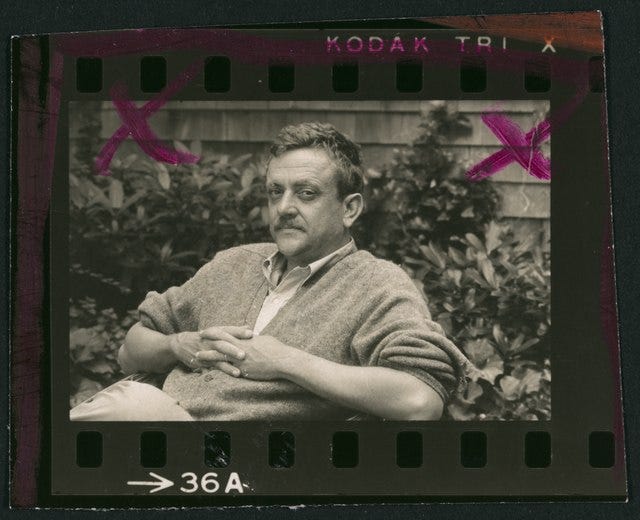
This article was originally published on my personal website in 2021.
No one “got” the late 20th century like Kurt Vonnegut, the science fiction writer and humorist best known for his 1969 World War II book, Slaughterhouse-Five. He saw the dangers of late capitalism, of religious fanaticism, of climate change, and of technological change with such clear eyes that it would be too difficult to read him if it weren’t for the fact that he was also very humane and very funny.
All told, he published 14 novels, 98 short stories, a children’s book, and god knows how many essays over the course of his 84 years. That can be a little daunting if you’re trying to pick a place to start (and didn’t, as so many of us did, have to read his work in high school English class).
So what follows is a breakdown of what to start with if you’re interested in Vonnegut. It’s a subjective list, obviously, but I claim three tiny bits of authority on the topic:
* I’ve read all of his novels, as well as most of his short stories and essays.
* My original blog was named “A Man Without a Country,” which was ripped off from one of his books. This was a terrible career move, as Vonnegut was always gonna beat me on SEO.
* My wife and I popped his saying, “If this isn’t nice, what is?” into our wedding vows.
So without further ado:
The Best Novels to Start With
Vonnegut did something no other author did, to my knowledge, which is that he published a self-graded list of the books he had published so far in 1982. This means some of his later books are left off of the list, but it’s actually a pretty good ranking, with a couple of tweaks. So if you want the opinion of the author himself, here they are:
* Player Piano — B
* The Sirens of Titan — A
* Mother Night — A
* Cat's Cradle — A+
* God Bless You, Mr. Rosewater — A
* Slaughterhouse-Five — A+
* Welcome to the Monkey House — B-
* Happy Birthday, Wanda June — D
* Breakfast of Champions — C
* Wampeters, Foma & Granfalloons — C
* Slapstick — D
* Jailbird — A
* Palm Sunday — C
At least two of these he’s far too harsh on (Breakfast of Champions is one of his best, and Slapstick is much better than a D), and maybe one he’s a bit too kind to (Cat’s Cradle is more of a B, to be honest), but it’s otherwise pretty accurate.
Here’s a breakdown of where to start:
Best Overall: Slaughterhouse-Five (1969)
Slaughterhouse-Five is quintessential Vonnegut. Everything that came before doesn’t quite feel like Vonnegut, and everything that comes after echoes it. It has the black humor, the repeated phrases, the sudden appearances by the author, and the sci-fi weirdness that he did best.
The story is based on Vonnegut’s own experiences as a prisoner-of-war in World War II, when he survived the firebombing of Dresden. The main character in the book is a man named Billy Pilgrim who, depending on how you read it, either has a mental breakdown during the war, or he becomes “unstuck in time,” which means that he zips around to different moments in his life with no apparent control of where he’s going next. The book zips with him to those moments, including the moment on his wedding night where he is abducted by aliens called Trafalmadorians and is placed in an alien zoo with a pornstar as his “mate.”
While living with the aliens, he learns that they see time “as you might see a stretch of the Rocky Mountains.” In other words, when they look at you, they see you now, they see you at the moment of your birth, and at the moment of your death, which makes every human look like a centipede. This gives them a fatalistic attitude towards death — they (and the book) say “So it goes” whenever someone dies. “So it goes” appears 106 times in the book.
It sounds, reading most synopses, like a very cynical book, but the magic of Vonnegut is just how humane it is. He’s upset about the loss of life he saw in the war, he can’t comprehend the suffering we put each other through, and the only way he manages to cope with it is through jokes. But the humor doesn’t harden you, it softens you. You can’t call it an easy read, but you can call it a beautiful read.
With all of that said, Vonnegut can be jarring to read (I’ve heard more than one person say he made them sick to their stomach), so if you’re looking for something that feels a bit more like a traditional novel, go with one of his earlier books.
Best for people who don’t “get” Vonnegut: The Sirens of Titan (1959)
Before he was famous, Vonnegut was a bit of a hack — in a good way. He wrote short stories and his first couple of novels as a way of feeding his family, and he occasionally had to work other jobs — PR for a major corporation, running a Saab dealership — in order to make ends meet.
The Sirens of Titan was his second book, and it is the most classically pulpy sci-fi of any of Vonnegut’s books. It’s about a space-traveler and his dog who, by accident, gains the ability to materialize on other planets, and also to see the past in future. Using this ability and knowledge, he founds a church (“Of God the Utterly Indifferent”), and squabbles with an alien robot trapped on Titan, a moon of Saturn.
For people who don’t like Vonnegut, this is probably as close as you can get to the good parts of his work before he really developed his style, which is an acquired taste. It’s also one of his best books period, and thus possibly the best Vonnegut book for beginners.
Best for people who don’t “get” Vonnegut OR science-fiction: Mother Night (1962)
If sci-fi is not your bag, your best choice is probably Mother Night. The book is about Howard Campbell, Jr., an American who was recruited by the OSS (precursor of the CIA) to spy on the Nazis from within the party. In his role, Campbell becomes an English-speaking propaganda broadcaster for the Nazis, sending out messages to the Allied troops telling them to give up and surrender (kind of a German Tokyo Rose). He does his job so well that after the war, he ends up on trial in Israel for crimes against humanity, all while scrambling to prove that he was actually a spy.
Vonnegut gives a moral to the story: “We are what we pretend to be, so we must be very careful what we pretend to be.” It’s one of his more straightforward books, and its one of his more affecting — many people do terrible things during the war, for all sorts of “justified” reasons. Vonnegut, for his part, wants to weigh the justification against the deed.
He never did a spy novel again, though he did one more set in jail (1979’s Jailbird, about a Watergate conspirator). It remains one of his most moving. And it’s not too Vonnegut for people who aren’t into him just yet.
Next Steps
If you liked one of those books and are looking for something that does have the Vonnegut style, the best of his remaining novels are:
Breakfast of Champions(1973)
Breakfast of Champions is the first book Vonnegut wrote after he became mega-successful with Slaughterhouse-Five, so he just kind of lets all of his weird impulses off the chain. The resulting book is probably his funniest, and also probably the Vonneguttiest book he ever wrote. It is also not for people who aren’t into Vonnegut. It’s about a syphilitic Pontiac dealer who is slowly losing his mind and a failing sci-fi writer, but honestly, who cares about the plot? This book is bonkers and hilarious.
Cat’s Cradle (1963)
Vonnegut’s A+ for this may be overstated, but it’s probably his highest regarded book after Slaughterhouse-Five. It involves an inventor who develops something called “Ice-Nine,” a new type of ice that freezes at a higher temperature, and thus has the ability to freeze all of the oceans on earth. It has all the classic Vonnegut features: a made-up religion that’s mostly just goofy quips, horrifying sci-fi catastrophes, and short verbal tics that are repeated throughout the book.
Slapstick (1976)
Slapstick deserves far better than the D he gave it, but it’s possible that Vonnegut’s judgment was clouded by how the critics had panned this book (something which had never happened to him before). In reality, it’s delightful. Inspired by his relat…