This article was originally published on my personal website in slightly different form.
Ask the average American when fascism was defeated, and they will tell you 1945. Fascism, they say, died with Hitler and Mussolini. When did America start fighting fascism? December, 1941. Four years and we had the thing licked.
This is, of course, nonsense. Fascism continued to not only exist, but to be actively supported by the US government throughout the world as a bulwark against communism after the end of WWII.
The war against fascism did not start with Hitler and Mussolini, though: the first stage was in Spain, where an amalgamation of liberals, communists, and anarchists fought against the forces of Francisco Franco. 3,000 Americans, known as the Abraham Lincoln Brigades, went to Spain starting in 1936 to fight Francisco Franco, the general who was attempting to overthrow Spain's democratically elected republic. They fought Franco — who had the fury of the German and Italian military behind him, as Hitler and Mussolini saw this as an ideal spot to test out their war machine — with zero support from the government of the United States, which had decided to stay neutral.
About a third of them died. Those who returned were considered heroes for a few brief years until the Red Scares of the 50's started up, and they were labeled as "premature antifascists." The man they were fighting went on to rule Spain until his death in 1975 — 30 years after the end of World War II.
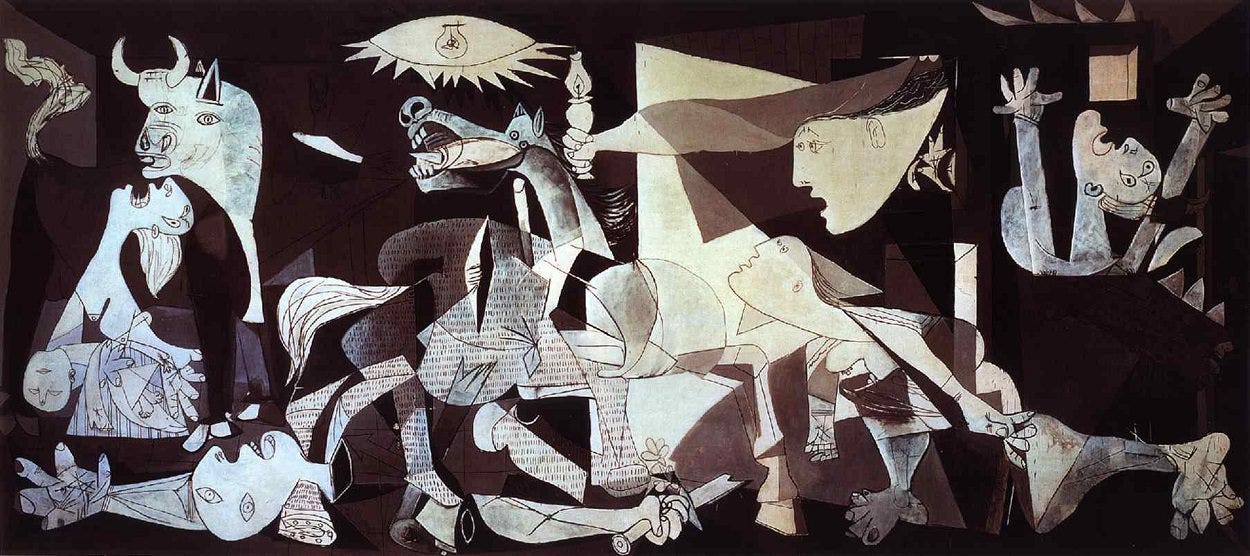
While the Republicans (the broad name for the anti-fascist side in the war) eventually lost to Franco, the fight itself has left a massive impression on American culture. Some of the greatest works of art in the past century have been centered around or have referenced the war. Hemingway's For Whom the Bell Tolls, George Orwell's Homage to Catalonia (not to mention Animal Farm and Nineteen Eighty-Four), Picasso's Guernica, the 1942 classic Casablanca, the 2006 classic Pan's Labyrinth, and Carlos Ruiz Zafon's beautiful gothic novel The Shadow of the Wind, all revolve around "the good fight."
In a time of resurgent fascism — and when “antifascism” has again become a slur — it seems appropriate to look back at some of the great works that came from this honorable, doomed fight.
For Whom the Bell Tolls
Ernest Hemingway was a reporter in Spain during the Civil War. He was one of the last journalists to leave the country after the fall of the Republicans, and he used his experiences to write his masterpiece For Whom The Bell Tolls. The title comes from a meditation written by the English poet John Donne:
"No man is an Iland, intire of it selfe; every man is a peece of the Continent, a part of the maine; if a Clod bee washed away by the Sea, Europe is the lesse, as well as if a Promontorie were, as well as if a Mannor of thy friends or of thine owne were; any mans death diminishes me, because I am involved in Mankinde; And therefore never send to know for whom the bell tolls; It tolls for thee."
While in Spain, one of the people Hemingway met was Robert Hale Merriman, the young Californian leftist who commanded the Abraham Lincoln Battalion during the war. Hemingway was impressed with the young man, and likely based his principled, loner hero Robert Jordan off of him.
It's a very typical Hemingway book, which is to say there's a lot of machismo, a lot of short, declarative sentences about courage and bravery, and a lot of (let's call it what it is) dick-swinging.
But it is a great book. Hemingway's politics were a weird brand of testosterone-fueled leftism, but he came down firmly against fascism. There's a telling passage from the book where Jordan explains fascism in America to two Spanish guerrillas.
"But there are not great estates that must be broken up?"
"Yes. But there are those who believe that taxes will break them up."
"How?"
Robert Jordan, wiping out the stew bowl with bread, explained how the income tax and inheritance tax worked. "But the big estates remain. Also there are taxes on the land," he said.
"But surely the big proprietors and the rich will make a revolution against such taxes. Such taxes appear to me to be revolutionary. They will revolt against the government when they see that they are threatened, exactly as the fascists have done here," Primitivo said.
"It is possible."
"Then you will have to fight in your country as we fight here."
"Yes, we will have to fight."
"But are there not many fascists in your country?"
"There are many who do not know they are fascists but will find it out when the time comes."
"But you cannot destroy them until they rebel?"
"No," Robert Jordan said. "We cannot destroy them. But we can educate the people so that they will fear fascism and recognize it as it appears and combat it."
Interestingly, For Whom the Bell Tolls was not particularly loved by the actual Americans who fought for the Republicans during the war -- they did not think that Jordan's independent, lonely, all-American male was super representative of the actual men who fought in Spain. Most of them were working class. Most of them had minority or immigrant backgrounds. Most of them were believers in left-wing ideologies.
Casablanca and Pan’s Labyrinth
On their face, Casablanca and Pan's Labyrinth are not very similar movies. In Casablanca, this dude is the villain:
And in Pan's Labyrinth, this dude is the villain:
They are united, though, by a common thread: their heroes cut their teeth in the Spanish Civil War. Ofelia, the heroine of Pan's Labyrinth is young girl struggling to survive in a fascist military camp at the tail end of the war. And Rick Blaine, Humphrey Bogart’s hero in Casablanca is wanted by the Nazi's because he fought with the Abraham Lincoln Brigades.
Both stories also look directly into the eyes of nihilism and despair. It is hard, in retrospect, to not see Spain as a cautionary tale. Spain gives us a glimpse of what the world would've looked like if World War II had been lost. Franco's Spain was isolated for a decade or so after the end of World War II, but in the 50's, the United States had new enemies, and could no longer resist allying itself with anti-communist forces in mainland Europe. In part, this is why the fascists were able to stay in power for decades. When democracy was finally restored to Spain in the 70's, Franco's men were granted amnesty, and many continued to work in the government. The Basque and Catalonian separatist movements, still very much in the news today, got their start as leftist separatist movements during the Franco era.
Spain, then, is a country that we failed. And this hurt was still fresh in the early 40's: Casablanca's Rick is depicted, when we meet him, as a wounded idealist who has lost wars and the love of his life, and has sunk into a sort of self-centered nihilism.
"I stick my neck out for nobody," he says. But as the other characters point out to him, this was not always the case:
Captain Renault:In 1935, you ran guns to Ethiopia. In 1936, you fought in Spain, on the Loyalist side.
Rick:I got well paid for it on both occasions.
Captain Renault:The winning side would have paid you much better.
His nihilism, over the course of the movie, is revealed to be a façade that Rick adopted out of necessity after the heartbreak of losing so much. The movie itself, released in 1942, was something of a call to arms for Americans in the early days of the war, long before it was clear that the Allies would triumph. Many Americans had, until just recently, been broadly in support of the European fascists (their non-interventionist motto, "America First," has since been reused in the 45th American President's inauguration speech).
At the end (this is a spoiler, but honest to god, if you haven't seen Casablanca yet, what the fuck are you doing with your life?), Rick forgoes his own personal happiness in the cause of fighting bac…