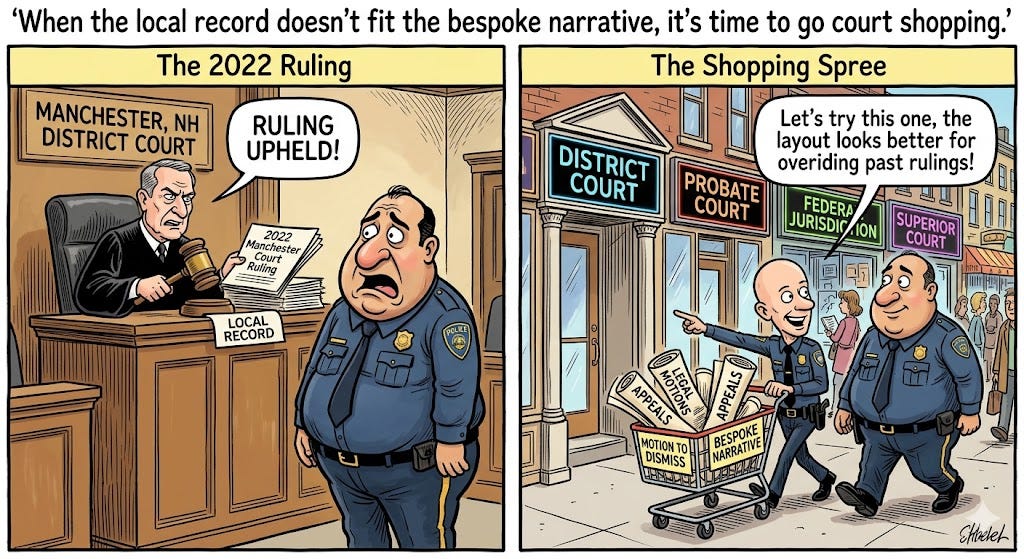
Captain Daniel Unsworth and Officer Khalil Mafhoum Court Shopping in West Roxbury: Bypassing the New Hampshire Superior Court Precedent
In this episode, we unpack Chapter 14 of Watertown: Under Color of Law, titled “Tactical Liability.” This chapter traces the parallel collapse of two carefully managed narratives: an officer’s attempt to manipulate his legal residency across state lines, and a high-ranking commander’s high-stakes bid for a career promotion. We examine how data-driven oversight can shatter a public relations facade and expose the profound vulnerability of an institution that treats transparency as a tactical threat.
Key Themes & Discussion Points
* The Sworn Residency Paradox
* A forensic look at the legal timeline of February 17, 2026, when Officer Khalil Mafhoum executed a remortgage on his New Hampshire residence.
* We analyze the profound legal contradiction of an officer signing federal mortgage documents under penalty of perjury declaring his primary domicile is in Manchester, New Hampshire, while simultaneously collecting a municipal paycheck from a department that mandates residency within fifteen miles of its jurisdiction.
* The Belmont Rejection
* We trace the definitive conclusion of the Belmont Chief of Police selection process on February 26, 2026.
* How the Belmont Select Board’s unanimous decision to pass over Captain Danny Unsworth in favor of an out-of-town veteran functioned as a public rejection of Watertown’s insular, defensive command style.
* The contrast between Belmont’s rigorous vetting of nineteen candidates and Watertown’s decision to bypass qualified internal veterans for a compromised candidate.
* The Potemkin Village of Policy
* We explore the historical and literary allusion of the Potemkin Village to describe Watertown’s public-facing commitment to “Kingian Nonviolence” and professional standards.
* How the department paints an elaborate, flawless facade of progressive oversight for community consumption, while the underlying personnel decisions are anchored by residency fraud and civil rights liabilities.
* The “Warrior” Pivot
* The sudden psychological and administrative shift that occurs the moment an institutional leader faces exposure.
* How the heavily branded principles of de-escalation and conflict reconciliation were instantly discarded and replaced by an aggressive, traditional “warrior” posture to protect a fracturing reputation.
Quotes Featured in This Episode
“The existence of a sworn federal statement suggests a perspective in which administrative rules are treated as situational variables—enforceable for the purpose of a loan, yet seemingly bypassed for the purpose of a municipal paycheck... Much like the hollow villages of the Dnieper, the department’s ‘commitment to transparency’ serves as a tactical liability rather than a foundational creed.”
Book Club & Discussion Questions
* The Dual-State Shell Game: When an individual swears under penalty of perjury to a federal bank that their primary home is in New Hampshire, yet tells a municipality they comply with a local radius mandate, which institution is being defrauded?
* The Facade of Reform: How do high-minded training frameworks like Kingian Nonviolence become a “Potemkin Village” when a department’s actual response to public scrutiny is reactionary aggression?
* Vetting Accountability: Belmont went out of its way to find a leader with a verified history of high professional standards, while Watertown command facilitated a hire with a forced resignation for covering up a crash. What does this divergence tell us about how different municipalities calibrate the scales of justice?
Resource Links & References
* Featured Book: Watertown: Under Color of Law by Amy M. Dubé (2026, Red Oak Media).
* Verbatim Document Tracking: Registry deeds, federal mortgage numbers, and board timelines can be verified verbatim in the master file “MAY 10 BEST BEST Under Color of Law cloud.docx”.
* Related Chapters: Chapter 13 (”Character Assassination”) and Chapter 15 (”Unlicensed Doctors”).