Friends,
This week we discussed the Bible’s second creation story, which can be found in Genesis 2:4-25. We focused mainly on humanity, and what this story says about who we are supposed to be and what we are supposed to do in this God-given life. Thank you so much to everyone who joined us - what great conversations we had!
Above you can access the audio recording. Below you can find links to the video recording and slides, a recap of our discussion, an engagement with our art of the week (this time it was a poet!), and a look ahead to next week.
Resources
Recap
In Genesis 1 God creates everything over a span of six days, and it is only at the end of the sixth day that God makes people. We are the pinnacle of creation: before humans, God called everything he made “good.” But after he made humans, he finally looked at the whole and called it “very good.”
Genesis 2 tells the story differently. We start out with a bare earth: nothing but soil with rivers running through it all, keeping the ground watered. The first thing God makes, right out of the gate, is man: a single male human. He is a human (Hebrew: adam), and he is made out of the earth (Hebrew: adamah). The Hebrew pun links us to this earth: there is something deeply good about our connection to the soil. We are called to cultivate the earth.
The second thing God makes is plants; he plants a garden in the region of Eden. They too spring up from the ground (Hebrew: adamah).
But now God points out something crucial: It is not good for the man to be alone. So, third, God makes animals. These come out of the soil (Hebrew: adamah) too. Each animal parades in front of the man, and one by one he names them. But none of them is a suitable helper for the man.
So God does something different. The fourth act of creation in Genesis 2 is a woman. She is the piece that was missing, the blank space that needed to be filled.
Upon meeting her, the man breaks into poetry. He calls her woman (Hebrew: ishah), because she was created out of man (Hebrew: ish). Just as a Hebrew pun linked the human/adam with the soil/adamah, here we find another similar pun linking the man and his wife. And this second pun is spoken not by the narrator, but by the man himself. I love Bruce Waltke’s insight into this moment:
The narrator names him [adam] by his relation to the ground [adamah], but Adam names himself [ish] in relation to his wife [ishah]. A man and woman are never more like God than on their wedding day when they commit themselves unconditionally to one another. (Genesis, p. 89)
Of course this is not just a story about one man and one woman; in a very important way, this is a story about all of us. So, to sum up, according to Genesis 1-2 the following things are true of your identity:
* you were made in God's image and likeness (1:26)
* you were formed from dust - at least in the case of man (2:7)
* God gave you the breath of life (2:7)
* it is not good to be alone (2:18)
* you were formed from man (in the case of woman) (2:22)
And, according to Genesis 1-2, your vocation includes:
* to rule over fish, birds, livestock, wild animals, creeping things (1:26, etc.)
* to be fruitful and multiply; fill the earth and subdue it (1:28)
* to work the garden and take care of it (2:15)
* to name the animals (2:19)
* to leave your parents and be united to your spouse (2:24)
The Bible has quite a bit more to say about what it means to be human, but that’s not a bad place to start!
Art
As Kingfishers Catch Fire
As kingfishers catch fire, dragonflies draw flame;
As tumbled over rim in roundy wells
Stones ring; like each tucked string tells, each hung bell's
Bow swung finds tongue to fling out broad its name;
Each mortal thing does one thing and the same:
Deals out that being indoors each one dwells;
Selves — goes itself; myself it speaks and spells,
Crying Whát I dó is me: for that I came.
I say móre: the just man justices;
Keeps grace: thát keeps all his goings graces;
Acts in God's eye what in God's eye he is —
Chríst — for Christ plays in ten thousand places,
Lovely in limbs, and lovely in eyes not his
To the Father through the features of men's faces.
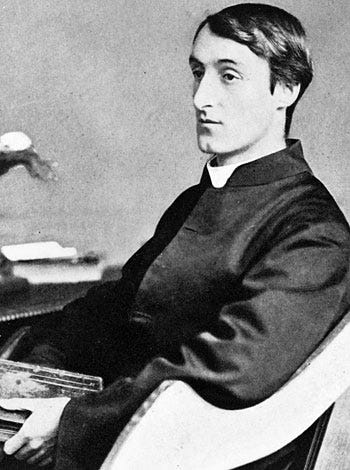
Gerard Manley Hopkins (Wikipedia, Poetry Foundation, Official Site) was a brilliant poet whose work offers deep and beautiful engagements with his Christian faith. I first discovered him years ago when someone gave me a copy of Eugene Peterson’s Christ Plays in Ten Thousand Places as a college graduation gift. Since it was the inspiration for the book’s title, Peterson had the above poem printed in the front matter, and I remember reading it over and over. I’ve been hooked on Hopkins’ work ever since.
I don’t find his poetry to be easy at all. But to me, Hopkins is very much worth the effort it takes to understand him!
Here are a few of my absolute favorites:
* That Nature is a Heraclitean Fire and of the comfort of the Resurrection
Notice how he engages with the physical world around him - especially the natural world - and how this is linked up for him with the reality of God.
For Next Week
We’ve seen God create these past few weeks, and the results of those acts of creation have been good. For this coming week, read Genesis 3 and wrestle with it a bit. How does the reality of sin impact our ability to be the people God made us to be, and to do the things God has called us to do? How does our sin impact the rest of creation too?
In Christ,
Pastor Cabe