Friends,
Yesterday we gathered once again to discuss Genesis. We looked at the creation story in Genesis 1:1-2:3 - one of the most beautiful passages in the whole Bible.
Below you can find links to the video recording and the slides, a recap of our discussion, our weekly piece of art, and a glance toward next week. Also see above for the audio recording of the session; I know a few of you aren’t able to join in during our meetings, but are watching the recordings later. I’m going to start dropping the audio recordings into these emails in case some of you wanted to listen on your commute or while you’re mowing the lawn or cooking or exercising or something. Let me know if that is helpful to you!
Resources
* Slides
Recap
We started by pointing out that your origin story matters - what kind of story you tell yourself about where you come from and why you are here makes a huge difference for how you live day to day.
Genesis was not the only option in its day - there were others. The author seems to have been familiar with some of these, and seems to be telling his story as in part a argument against some of these other stories. More than that: Genesis is trying to tell a better story.
For instance, when God creates, he doesn’t have to struggle. Unlike one Babylonian creation myth where the earth is the product of a violent conflict between two different gods, and unlike the Canaanite gods who have to struggle against the material world to separate the waters above the sky from the waters below, in the Genesis account there is no fight; no conflict. No one seems to rival God and God’s plans to create at all. It seems almost effortless. Check the video or the slides for a few other examples of how the Genesis 1 creation story seems to be written as a criticism of the creation accounts of some of its neighbors.
In the creation story itself, the world started out formless, void, and dark, but God’s Spirit hovered over it all. God springs into action, going through six days of creating different things.
First, in days one through three, God adds form to the formlessness: he creates light, he separates the waters and thus makes the sea and sky, and he makes land and vegetation. Second, in days four through six, God fills the emptiness of creation, installing stuff in each of the places he just formed: he makes lights, he puts fish in the sea and birds in the sky, and he makes land animals and finally humans. Each of the six days share similar features; the repetition is part of what makes this passage so beautiful, and almost poetic.
Finally, on the seventh day God rests. He doesn’t here command us to do the same (that comes later), but he is setting the pattern. We can also see how the structure of the whole is to give order not only to space, but to time as well: when God installs the lights in the heavens on day four he commands: “let them serve as signs to mark sacred times, and days and years” (Genesis 1:14b NIV11). Here this goes further still: in God’s act of creation God has invented the week, a very important rhythm for us even up to today.
Just like Genesis was probably intended to be in part a criticism of other origin stories in its world, it can serve the same function for our world too:
* God caused the Creation (vs. strict materialism)
* The universe is ordered under God (physics, etc. was God’s idea)
* God is bigger than chaos (vs. despair)
* God is bigger than nature (vs. Romantics)
* There is a higher purpose for human existence (vs. we make our own meaning)
* The Creation was originally very good (vs. Tennyson’s “Nature, red in tooth and claw”)
* Take a day off once a week to pursue rest, goodness, and peace (vs. idolatry of work)
I don’t know about you, but all of this comes together for me to make a much better story than all the other options people sometimes believe these days!
Art
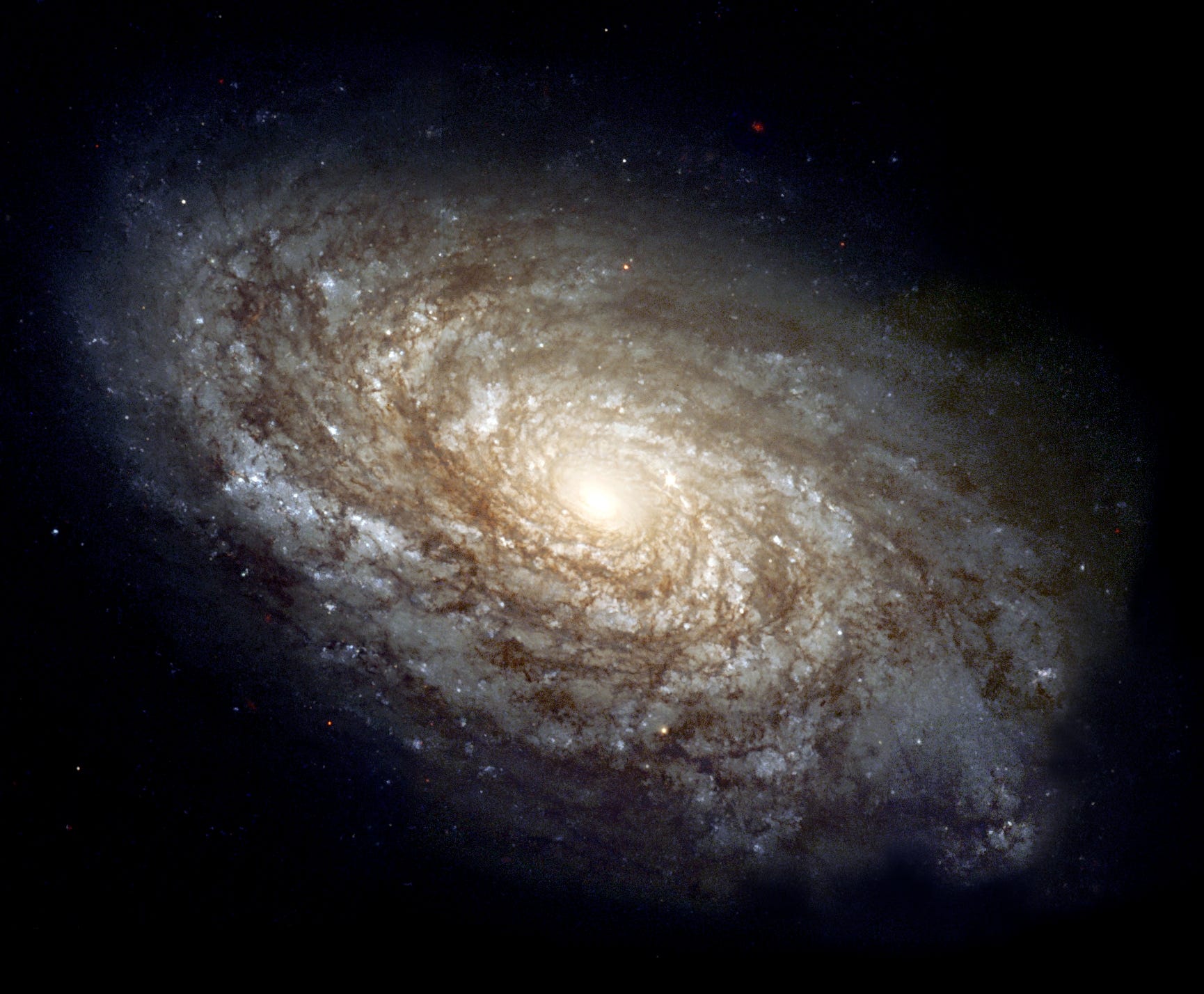
I’m not sure where or how, but I think it was as a college freshman that I first stumbled upon NGC 4414. I was an astronomy major at the time (I later switched to physics - you know, to be practical), but I just remember being struck by its beauty. I quickly drafted it to be my computer’s desktop background, a position it held for years.
It seems most of the universe is empty space: it takes about eight minutes for light from the sun to get to us here on the surface of the earth, and it takes about seventeen years for light to get here from the next closest star to us, Alpha Centauri. But way, way further out there, only one wonder among a billion trillion others, is NGC 4414.
How unnecessary, how gratuitous its beauty is. And how patient: when the light you see captured above departed to head our way, the dinosaurs had only just gone extinct. Sixty two million years is a long time to wait for a photo op, but the distance is even more remarkable to me than the timeline. Light travels very fast, about six hundred seventy million miles per hour. And again, it went that fast for sixty two million years. Add to that this: NGC 4414 isn’t even that far away in the grand scheme of things.
As best we can tell, this cosmos is enormous. How much bigger must be the God who dreamed it all up?
For Next Week
For next week read Genesis 2:4-25. Again, I’d encourage you to read it out loud, with other people if you can. It’s the story of Adam, Eve, and the Garden of Eden. Just like the rest of Genesis 1-11, it’s the story of where we come from, who we are, and why we are here. Can’t wait to wrestle with it with you!
In Christ,
Pastor Cabe