Friends,
Grace to you and peace from God the Father and our Lord Jesus Christ!
If there’s one thing that has surprised me about this study of the Apostle Paul, it is how difficult it has been. I would have thought it couldn’t get harder than Revelation, but trying to do Paul justice has been a real challenge for me! Or maybe I’m just feeling that way because yesterday we wrestled with one of the densest, most difficult passages in Paul. Either way, I hope this series has been helpful, eye-opening, and life-giving to you!
See below for a collection of resources, art, and a look ahead to next week. Like last week I’m going to do an audio summary instead of a written one. Click the audio widget at the top of this email to listen, and let me know what you think.
Resources
* Video Recording (AM)
* Slides
The Art of Paul
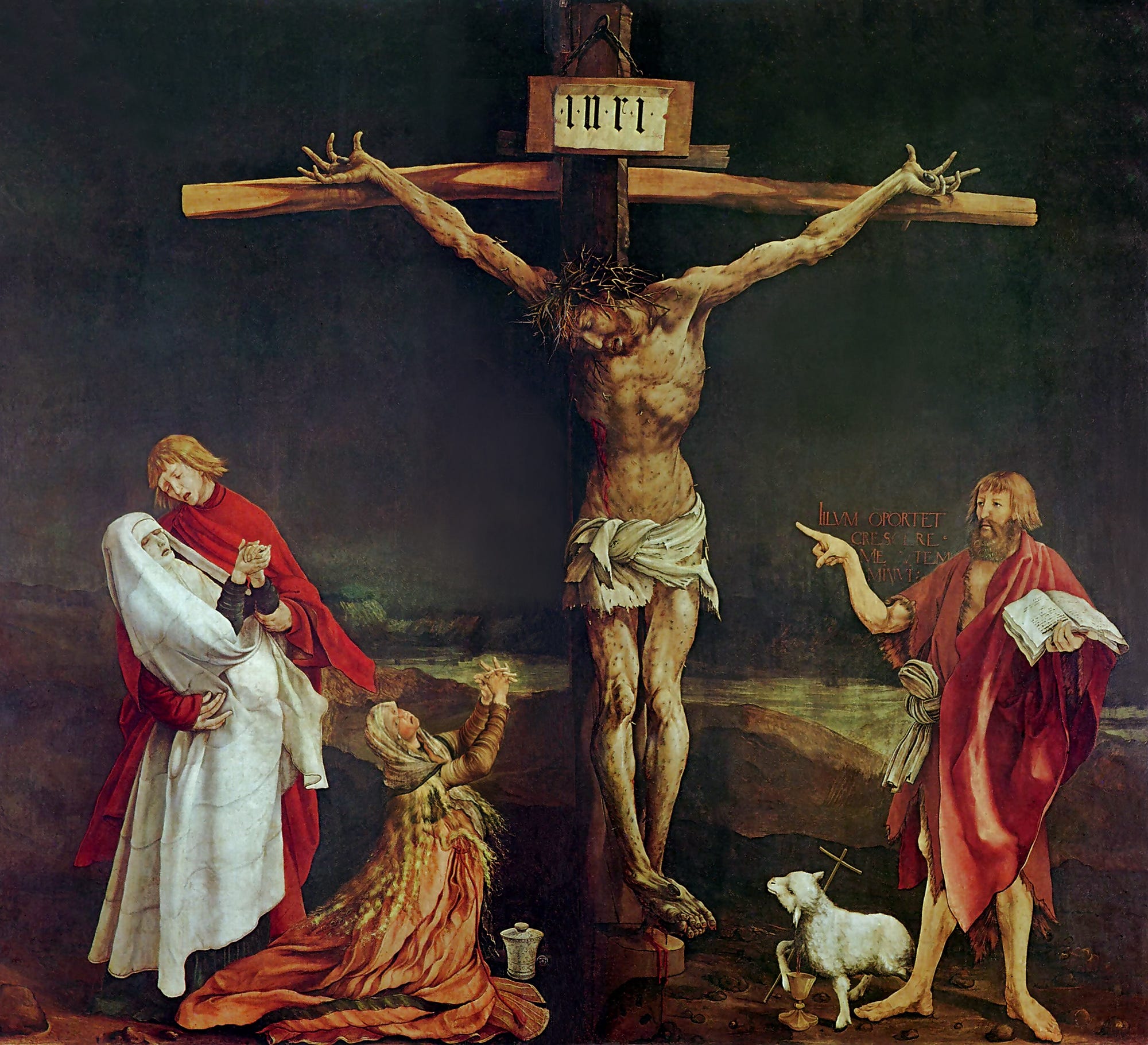
When it comes to a painting of the crucifixion, to me it’s hard to imagine topping this panel from Matthias Grunewald’s Isenheim Altarpiece (1512-1516).
An agonizing Christ hangs, emaciated, covered in thorns from head to toe, his skin covered in pox, his mangled hands seeming to cry dereliction: “My God, my God, why have you forsaken me?” (Mark 15:34, Matt 27:46, Ps 22:1). On our left, John the disciple consoles Mary, Jesus’s pale-faced mother, while Mary Magdalene with her alabaster box of ointment kneels nearby. On our right, John the Baptist holds an open scroll (Isaiah?) as he declares in Latin, “He must increase; I must decrease” (John 3:30), while his almost Suess-like index finger gestures at the Crucified One as if to say, “Behold, the lamb of God who takes away the sins of the world” (John 1:29). At his feet a pierced lamb, blood flowing from his wound into a cup, marches victoriously with a cross.
I have a bit of a history with this one. A very large and imposing print of this painting used to hang on the wall in my office. It’s served for the past ten plus years as a conversation piece, a reminder of my calling, and an encouragement when I needed to recenter myself, particularly on the occasional Sunday morning. There was a little incident with some water a month or so ago, and sadly my print is no more. In one form or another it is definitely something I plan on replacing!
The always insightful Charlsie Rogge (who has logged numerous hours as a docent at the Museum of Fine Arts, Houston) pointed out that John the Baptist’s eyes seem to be looking out at the viewer, as opposed to at Jesus himself. I’d be curious to hear her further musings on what that might mean. I’ll share my brief, tentative thought though. I still think of John’s finger as pointing mainly at Jesus - John and his finger in this painting have been used as an illustration in more than one book about preaching (and as the cover image for more than one book about the 20th century Swiss theologian Karl Barth, who hung a print of it over his desk). So perhaps John’s eyes are looking out at us because that is where his message is directed. This is the lamb of God, who takes away the sins of the world; we must decrease, he will increase. And maybe, in a way, he’s pointing at us too, to drive the point home!
You can read more about this painting, and about the larger work of which it is a part, here: Wikipedia, Khan Academy.
For Next Week
Next week we’ll move on to another look at Paul’s message, focusing on “The Love of God.” At this point I’m waffling between Romans, Colossians, and Ephesians. Either way, I’m looking forward to it; I hope you are too!
In Christ,
Pastor Cabe