Friends,
Thanks for joining in yesterday for our conversation about the great flood of Noah’s generation. We started in Genesis 6:1 and took it all the way to Genesis 8:1; in other words we saw the un-creation of the world, but we didn’t get to its re-creation. Fear not - next week we’ll pick up right where we left off and take it all the way to the end of chapter 9.
In this email you can find an audio recording (see above), as well as links to the video recording and slides, a brief recap, our art piece, and a look ahead to next week.
Resources
Recap
We talked a lot about the little minutiae in this story, because there are a lot of little details that are quite interesting if you tease them apart a bit. Like the rest of Genesis 1-11, this is a very well crafted story. But for the purposes of our recap here, let’s take a step back and look at the big picture.
Humanity’s sin has corrupted the earth, so God resolves to corrupt it the rest of the way and start again afresh. But God provides for continuity between the old creation and the new creation by calling one man, Noah, along with his family. Noah was not perfect (see chapter 9), but he did trust God. In fact, in Genesis 6 and 7 that is just about the only thing we see Noah doing: trusting God and doing what God says. God establishes a covenant with Noah, the first such covenant in the whole Bible. The contours of that covenant will be one of our main topics next week.
But this week I want you to notice that this is also the first salvation story in the Bible. There have been several stories about the consequences of sin, and those stories tend to have powerful features of grace in them. But this story is really the first proper salvation account. And the shape of this first salvation story echoes in all the other major salvation stories in the Bible.
Let’s just look at the two biggest salvation stories in the Bible. In the story of the Exodus, God saves his people by taking them through the Red Sea. God protects them from the water, but their Egyptian pursuers are destroyed by it. God preserves his covenant people through a kind of ‘flood’: an enslaved people descend into the sea, and they come out the other side a free people.
In the story of Jesus, the cross and the tomb are where he descends into the depths of death, but is preserved. The resurrection marks God’s covenant-fulfiller and initiates a new creation even more profound than Noah’s new creation. And so we too, slaves to sin and death, descend into the waters of baptism and come out the other side, free. We are buried in the chaotic, uncreating waters, and God preserves us, rescues us. Just as Noah was preserved in the ark, so are we too preserved in Christ and in Christ’s body, the church. Just as Noah preserved what was to last from the old creation to the new creation in the ark (mainly the animals), so are we called to preserve the things that will last: love, joy, peace, patience, kindness, goodness, faithfulness, gentleness, and self-control, to name a few things.
Or, as Paul put it in a different place, “Therefore, if anyone is in Christ, the new creation has come: The old has gone, the new is here!” (2 Corinthians 5:17 NIV11).
Art
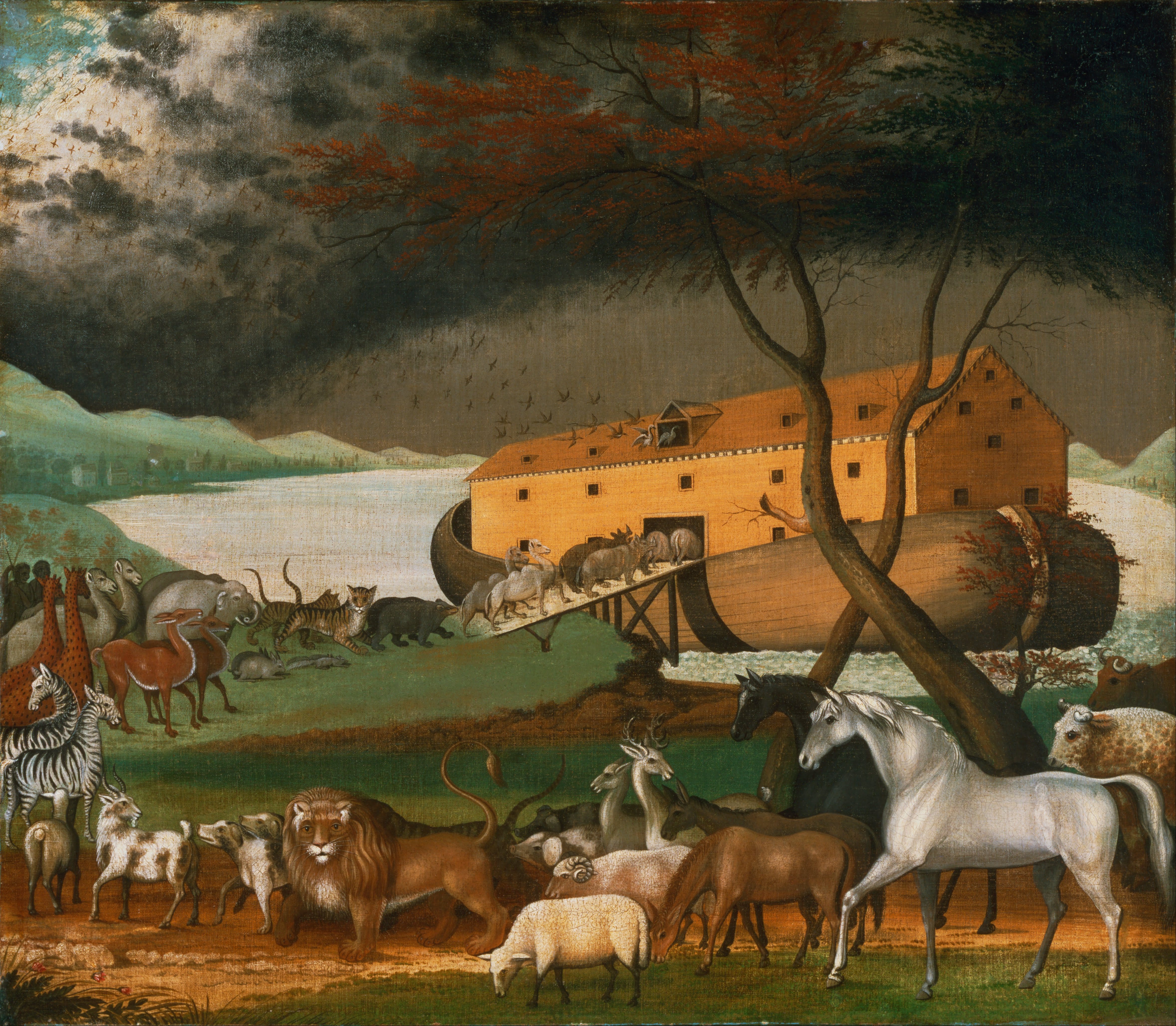
Edward Hicks was a Quaker minister in the early nineteenth century in Pennsylvania. Here you see a storybook-esque procession of animals into the ark. It strikes me as a very peaceful image in the foreground, but the gathering clouds in the background indicate what’s coming.
The Hicks painting with which I am most familiar offers a similar view of a harmonious animal kingdom as the image above, but without the presence of the foreboding clouds indicating impending doom. It’s “The Peaceable Kingdom” (1826), inspired by Isaiah 11 and other similar passages:
The wolf will live with the lamb,
the leopard will lie down with the goat,
the calf and the lion and the yearling together;
and a little child will lead them.
The cow will feed with the bear,
their young will lie down together,
and the lion will eat straw like the ox.
The infant will play near the cobra’s den,
and the young child will put its hand into the viper’s nest.
They will neither harm nor destroy
on all my holy mountain,
for the earth will be filled with the knowledge of the LORD
as the waters cover the sea. (Isaiah 11:6-9 NIV11)
There is something of Noah’s ark even here. The peace of God’s new creation in the end reflects the peace that was intended in the beginning. While by Noah’s generation this peace has broken down in a big way, as the animals gather on the ark it seems to be (partially, temporarily) restored. This isn’t made explicit in the text of Genesis 6-7, but I do think all the artists who portray the animals peacefully lining up in an orderly fashion are picking up on something real here. Noah’s new creation won’t always be so peaceful, but Jesus’s New Creation will be. It’s interesting to imagine these animals, slated to be a part of Noah’s new creation, behaving in a manner befitting Jesus’s final New Creation. A foretaste of what is to come!
Next Week
Next week we’ll continue with the Noah story. Take another look at Genesis 6-9 to get a sense of the full sweep of the story. And go ahead and bring your Bibles next week again - it should help situate the details in the scope of the whole (long) story!
In Christ,
Pastor Cabe