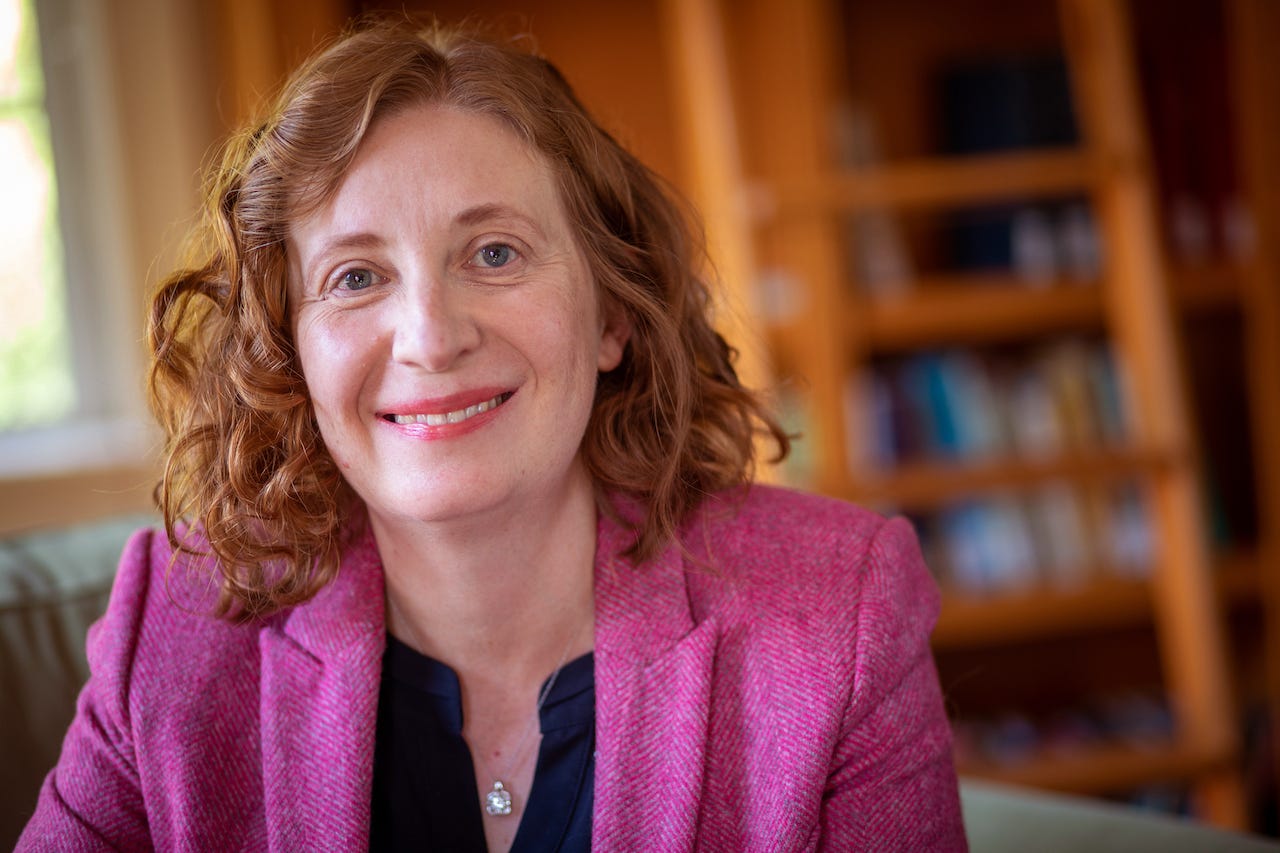
For the first Daily Theology Podcast episode of 2024, we welcome Heather Miller Rubens of the Institute for Islamic, Christian, and Jewish Studies. We talk about how her early interest in Hebrew scriptures led to the study of Jewish Catholic relations, the work of the ICJS, and about how to do interreligious dialogue well. We focus especially on her forthcoming project, In Good Faith: An Argument for an Interreligious Society, and her argument that the public sphere actually needs more talk about religion, not less, if we want to live in a healthy and functioning society.
Dr. Heather Miller Rubens is the Executive Director and Roman Catholic Scholar at the Institute for Islamic, Christian, and Jewish Studies (ICJS). She has a BA from Georgetown University, and an MA and PhD from the University of Chicago Divinity School. Her research focuses on theological, ethical, and political issues relating to the roles of religion and interreligious dialogue in the public square.
You can also see the full transcript for this episode below.
Thanks as always to Matt Hines of the band Eastern Sea for providing the music for the Daily Theology Podcast.
Transcript of Episode #50 - Heather Miller Rubens
#50 – Heather Miller Rubens
[Opening Music]
Stephen Okey: Welcome to the Daily Theology Podcast, a podcast on the craft and vocation of theology. I'm your host, Stephen Okey.
In today's episode, I talk with Heather Miller Rubens, who is the Executive Director and Roman Catholic scholar at the Institute for Islamic, Christian, and Jewish Studies. We talk about how her early interest in Hebrew scriptures led to the study of Jewish Catholic relations, the work of the ICJS, and about how to do inter-religious dialogue well. We focus especially on her forthcoming project "In Good Faith: An Argument for an Interreligious Society," and her argument that the public sphere actually needs more talk about religion, not less, if we want to live in a healthy and functioning society.
Thanks to everyone who has subscribed through Substack, where this podcast is joined to my Okeydoxy newsletter. New episodes of the podcast will come out each month while newsletters will come out every two weeks or so. The next one of those will be on Martin Scorsese's "The Last Temptation of Christ" as part of my "Celluloid Christ" series.
I hope you enjoy the episode and thanks for listening.
[Music Transition]
Stephen Okey: Today for the Daily Theology Podcast, I'm talking to my friend, Heather Miller Rubens. Heather, thank you for being here.
Heather Miller Rubens: Thank you for inviting me.
Stephen Okey: You are the executive director, and Roman Catholic scholar at the Institute for Islamic, Christian, and Jewish Studies, which sounds like a lot of heavy double duty. So I like to, I like to open by asking people, how did you get into doing theology?
Heather Miller Rubens: Yeah, so I went to Catholic school my whole life, from elementary school through college, at Georgetown University, where we met as undergrads so many, many years ago. And I was a double major in theology and creative writing. And towards the end of my time there, I actually took a Hebrew Bible class with Father Jim Walsh and started learning Biblical Hebrew with him, and he sort of encouraged me to keep going with religion, the study of religion, as did a lot of my other undergraduate mentors as well.
And I knew I wanted to, to, to study a religion that I didn't identify with. It wasn't mine and really very much enjoyed Hebrew, and so went to the Oxford Center for Hebrew and Jewish Studies for a 1 year masters and sort of immerse myself in the study of Judaism and the study of the Hebrew language, and then went to the University of Chicago to pursue a doctoral degree and an additional masters.
And at the University of Chicago I was able to combine my doctoral studies with Judaism and Christianity, and do that under the history of Judaism section. So, I actually trained as a historian at the University of Chicago, focusing on the early 20th century and Jewish Catholic relations in Europe and in the United States.
And then the job posted at the institute for, um, at the time the Institute for Christian and Jewish Studies. They were looking for a Roman Catholic scholar who was interested in Catholic Jewish relations, which was exactly what my dissertation was about.
And so I applied and landed at ICJS and, we're an academic nonprofit, and so the organization is very much focused on, not only religion in this kind of academic classroom, but religion in community. So we work a lot with, religious practitioners, so clergy and religious leaders and congregations, but we also work with the general public, and folks who have different relationships to religion.
And so, in my work at ICJS since 2011, I keep asking more and more theological questions and more and more questions of belief and how our beliefs, not only about our own communities, but our beliefs about each other, so, especially beliefs that cross religious traditions, really impact our, our relationship to one another and sort of helping people explore what that means.
So the, the kind of horizontal relationships, the intergroup relationships, between communities and between individuals, and then how that, the vertical relationship with, with the divine, with God, how that impacts those relationships.
Stephen Okey: So I want to step back, just to something you said, which was, you know, as you were wrapping up undergrad, you wanted to study something that was outside your own religious tradition or something that you did not yourself identify with. Why? What was it that was motivating you there?
Heather Miller Rubens: Ah, that's a great question. I don't know. I think it was a, uh,
Stephen Okey: That's fair.
Heather Miller Rubens: I like how, how much you could apply agency to, to some choices made in your early twenties. Um, I'm not entirely positive. I, I think I had a, just a deep curiosity about the Jewish tradition in particular and the Hebrew Bible was the sort of entry point into that.
And then just learning more about rabbinic tradition and interpretation of the Hebrew Bible, and how much it is different than Catholic interpretation, Christian interpretation of the Hebrew Bible. And so what does it mean when two communities share a common text, but interpret that text in, in different ways, and how do you sit with that? How do you sit with that reality? And again, even right within, of course, within each tradition, there's so much diversity that sort of internal diversity to interpretation, but diversity across traditions is what really interested me. And I wanted to go deeper into that.
Stephen Okey: Yeah, that makes sense. I know for me, part of why I went into theology was trying to work out my own issues, uh, on some level. And so it's, it's nice to hear something that's kind of a more healthy response, maybe, uh, for academic interests.
Heather Miller Rubens: I'll also say, and this is something I've circled back to now in, in, in sort of my practice as a, I identify as kind of a scholar practitioner of interreligious dialogue at this point, that my academic interest is in the so called Jewish question. And so what does it mean for the modern nation state to be born in, in, in the sort of European context and to come up and say, religious diversity is a problem for the modern nation state.
And, you know, the, the, the horrific answer to the so called Jewish question is the final solution of the Holocaust. And so what does it mean when a Christian society decides that religious diversity internal within it, it's not possible and, and seeks a genocidal response. And so, and I think those questions about the status of religious diversity, what, what does it mean to live in a religiously diverse world?
Is that always a problem? I thin…