Cybersecurity systems increasingly rely on machine learning to distinguish suspicious activity from ordinary behavior. These systems develop behavioral baselines from historical observations and adjust their judgments as conditions change. That capacity helps security teams monitor environments too large for manual review. It also creates an opening for adversaries capable of manipulating what a model learns.
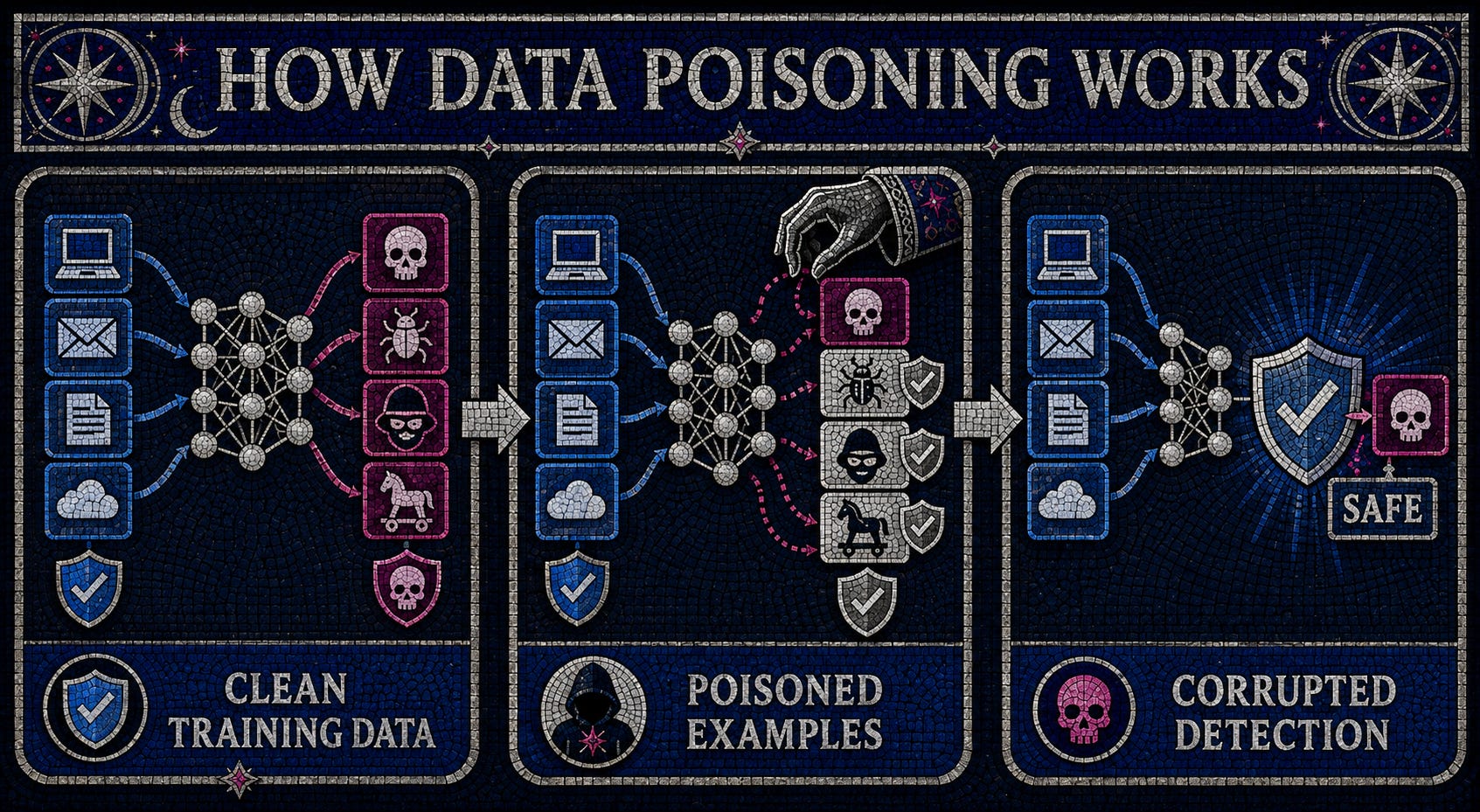
Data poisoning occurs when an attacker influences the information used to train or update an algorithm. Instead of directly disabling a defensive system, the attacker alters its understanding of acceptable behavior. A compromised account can gradually become associated with unusual activity until genuinely hostile actions no longer generate meaningful concern.
The risk extends beyond individual networks. Security vendors may depend on shared telemetry when refining detection models, creating potential supply-chain exposure. Organizations that treat algorithmic judgments as authoritative may therefore inherit vulnerabilities that remain hidden behind reassuring dashboards.
The strategic issue is straightforward: a defensive system cannot reliably identify malicious behavior when an adversary has influenced its definition of normal.
The Security Problem Inside Adaptive Detection
Traditional detection rules identify conditions specified in advance. A rule might flag an employee account that authenticates from geographically distant locations within an impossible travel window. The logic is visible and relatively easy to inspect.
Behavioral models operate differently. They study historical activity and estimate whether a new event resembles established patterns. An unexpected login might receive a higher risk score because it departs from an account’s previous behavior.
That approach helps identify attacks that do not match a known signature. A criminal using stolen credentials may appear legitimate to a password-based control while still behaving differently from the actual account owner.
The weakness emerges when the baseline itself becomes an attack surface.
The National Institute of Standards and Technology’s adversarial machine learning taxonomy identifies poisoning as a distinct category of attack against learning systems. Its 2025 guidance explains that adversarial activity must be assessed according to the stage of the system’s life cycle and the attacker’s practical access.
An attacker does not always need direct control over a model. In some environments, influence over the observations reaching that model may be sufficient.
Consider an employee who normally accesses internal resources during business hours. An attacker using the employee’s credentials begins authenticating occasionally at unusual times. Each event appears questionable but remains explainable.
If the system adapts to repeated observations, the account’s established pattern may slowly expand. Activity previously considered abnormal becomes familiar.
Whether this occurs depends on the product’s design. Some systems retrain periodically. Others update scoring thresholds or incorporate analyst feedback. The vulnerability is conditional rather than universal, but the underlying concern remains consistent: an adaptive model can inherit manipulated assumptions from its environment.
From Direct Poisoning to Hidden Backdoors
The most direct poisoning attack targets training data before deployment.
Suppose a security vendor builds a classifier using examples of legitimate network traffic and known malicious activity. If an attacker can alter the labels attached to selected samples, the model may learn that particular hostile behaviors belong in the harmless category.
A successful attack does not require the entire dataset to become unreliable. Carefully chosen samples may influence the model’s treatment of a narrow behavior while leaving its overall performance largely intact.
That selective outcome is strategically attractive. A detection system that fails constantly attracts investigation. A system that misses one carefully prepared intrusion can continue appearing effective.
The United Kingdom’s National Cyber Security Centre guidance on machine learning supply chains explains that poisoned datasets can degrade model performance or introduce targeted backdoors.
A backdoor operates through a hidden trigger. During training, the attacker conditions the model to associate a particular feature with a benign outcome. Later, that feature appears inside otherwise suspicious activity.
The model responds as trained.
A malicious script might contain a characteristic that repeatedly appeared in harmless training examples. If the model assigns excessive importance to that characteristic, the script could receive a favorable classification despite performing hostile actions.
The dangerous behavior may remain invisible during standard testing. A model can score well against conventional benchmarks while failing when the attacker introduces the specific trigger.
This creates a difficult procurement problem. A customer reviewing published accuracy figures may learn little about whether the model contains narrow weaknesses deliberately embedded during development.
Behavioral Baselines as a Target
Postdeployment poisoning can be more difficult to recognize because it occurs within ordinary operations.
Imagine a defense contractor using behavioral analytics to monitor access to sensitive engineering documents. An employee normally works within one project environment. An attacker compromises the employee’s credentials but avoids immediately reaching for protected material.
Instead, the account begins accessing a small number of files associated with an adjacent project.
The activity produces an alert. A security analyst finds a plausible business explanation and closes the case.
Several weeks later, the account accesses additional material. Again, nothing appears immediately damaging. If the product incorporates recent behavior into its baseline, the account gradually becomes associated with broader access.
By the time the attacker approaches genuinely sensitive documents, the activity may appear less unusual than it would have at the beginning.
This scenario is illustrative. It does not establish that every commercial behavioral analytics product updates its models in this manner. The practical risk depends on how a particular system weighs historical activity and whether analyst decisions influence future classifications.
The distinction is important because legitimate adaptation is necessary. An employee’s duties can change. A security tool that never adjusts would generate unnecessary warnings whenever normal work patterns evolve.
The problem arises when adaptation happens without adequate historical context.
A model that evaluates recent activity in isolation may mistake a carefully managed intrusion for ordinary professional development. The attacker exploits the system’s willingness to believe that repeated behavior deserves acceptance.
Poisoning the Human Feedback Loop
The learning system is only one part of the defensive structure. Human analysts also develop expectations about which alerts deserve attention.
An attacker can exploit those expectations even without directly modifying training data.
Suppose an account repeatedly triggers warnings through unusual but ultimately harmless activity. Each investigation consumes time. After enough repetitions, analysts may begin treating similar alerts as routine.
If the organization reduces the alert’s severity, an attacker benefits from the adjustment.
Where analyst decisions feed back into automated scoring, the effect may become more serious. Repeated dismissals can reinforce the conclusion that similar activity is acceptable.
The NCSC’s secure AI development guidance explicitly recognizes that attackers may corrupt training data or user feedback. This matters because feedback represents institutional judgment translated into machine-readable form.
A sophisticated adversary can attempt to shape that judgment gradually.
The problem becomes especially pronounced when different analysts handle related alerts across separate shifts. Each person may review a single event without seeing the larger pattern.
The immediate explanation appears reasonable.
The combined history tells another story.
A security team that fails to connect those cases effectively allows the attacker to distribute one operation across multiple isolated investigations.
Operational Consequences Beyond the Network
The consequences of poisoned detection can extend into physical operations.
Consider a water treatment facility using anomaly detection to monitor control commands. Under ordinary conditions, equipment operates within an established range.
An attacker seeking to alter chemical treatment could introduce small adjustments that remain technically permissible. If the monitoring system learns from recent behavior without adequate safeguards, its understanding of normal operating conditions may shift.
A later adjustment could appear less suspicious because the model has already accepted the direction of change.
This example describes a plausible mechanism rather than a documented case attributed to a specific facility. Its significance lies in the connection between algorithmic judgment and physical effects.
Independent engineering safeguards should prevent dangerous commands from succeeding even if a monitoring model misclassifies them. Where those safeguards are absent or poorly maintained, the consequences could become more serious.
Defense environments face a similar concern when automated monitoring protects information that shapes operational decisions.
If an attacker compromises a maintenance system after gradually conditioning its behavioral controls, the eventual harm may appear outside the network. Personnel could act on altered technical information while believing the underlying system remains trustworthy.
The cybersecurity incident then becomes an operational problem.
The danger comes from misplaced confidence rather than visible system failure.
Security Vendors and the Model Supply Chain
Most organizations purchase machine learning capabilities through commercial products. Customers may understand what a platform claims to detect without knowing how its models are trained.
That creates uncertainty around provenance.
A vendor might improve detection by analyzing telemetry collected across customer environments. If customer data influences shared models, a compromised environment could theoretically become a route for introducing misleading examples into a broader system.
Whether that risk exists depends on the vendor’s architecture. Some providers isolate customer-specific learning. Others aggregate observations while applying safeguards intended to reject unreliable inputs.
Customers cannot evaluate the exposure without understanding those design choices.
The NCSC’s 2026 assessment of adversarial attacks against machine learning places poisoning within a broader threat model for deployed systems. Its analysis emphasizes that organizations must consider how model vulnerabilities affect the surrounding operational environment.
This principle matters for procurement.
A security platform may contain no conventional software backdoor while still behaving dangerously because its training history was corrupted. Ordinary software assurance does not necessarily reveal that problem.
A model’s learned behavior represents another form of supply-chain dependency.
The customer inherits decisions made during data collection and subsequent retraining, even when those decisions remain invisible inside the product.
Defensive Architecture and Data Provenance
Training data should be treated as a protected security asset.
If unauthorized personnel can modify a dataset used to classify malicious activity, they may influence future detection outcomes without changing application code.
Organizations should maintain records showing where training examples originated and who assigned their classifications. Changes to sensitive datasets should receive the same scrutiny given to modifications of security configurations.
Suppose a repository contains samples previously identified as malicious. If those samples are suddenly relabeled harmless, investigators should determine whether the change reflects new evidence or unauthorized interference.
Model updates also require review.
A new version that stops flagging behavior identified by its predecessor may have a legitimate explanation. It may also reflect compromised training data.
The NIST guidance on adversarial machine learning warns that no universally reliable defense exists against every manipulation technique. That limitation argues for layered controls rather than confidence in a single protective method.
A behavioral score should not determine access independently.
If an employee lacks formal authorization to retrieve protected engineering files, the request should fail even when the model considers the activity familiar.
A machine can estimate whether an action appears suspicious. It should not decide whether policy permits the action.
Testing for Slow Manipulation
Conventional security testing often asks whether a system detects a known malicious sample.
That question matters, but it does not address whether the model can be conditioned beforehand.
An adversarial assessment should examine what happens when suspicious behavior changes gradually. A test account might slowly expand its access across a simulated historical dataset.
The central issue is whether the system identifies the cumulative change or simply updates its baseline until the final action appears ordinary.
Historical comparisons help answer that question.
A model evaluating recent activity should retain visibility into older behavior. If an account maintained one stable pattern for two years before drifting steadily over several weeks, that departure deserves attention even when individual events appear minor.
Organizations should also examine whether small input changes produce unexpectedly large changes in classification.
A suspicious script that becomes harmless after a trivial modification may expose an unstable model decision. Investigators should determine whether the behavior reflects an innocent training artifact or a hidden weakness.
MITRE ATLAS provides a framework for organizing threats against artificial intelligence systems. Security teams can use that framework to build threat scenarios around model-specific attacks rather than treating the model as an untouchable feature inside a larger product.
Strategic Assessment
Data poisoning changes the central question of cybersecurity monitoring.
The traditional concern is whether a defensive system can recognize hostile behavior. The emerging concern is whether an attacker can influence what the system recognizes as hostile in the first place.
That distinction has consequences for organizational trust.
A quiet dashboard may reflect genuine security. It may also reflect a model that learned the wrong lesson.
Defense organizations should examine how automated judgments shape operational decisions. Commercial buyers should demand greater clarity about model retraining and data provenance. Security teams should preserve historical context when evaluating behavior that changes gradually.
None of these measures eliminates the threat entirely. They reduce the chance that a manipulated algorithm becomes the sole authority over whether suspicious activity deserves investigation.
The machine guarding the network is useful because it learns.
Its greatest vulnerability begins when someone else decides what it learns.