Artificial intelligence is changing how satellite operators interpret spacecraft telemetry. As orbital constellations expand, automated systems increasingly help engineers recognize equipment anomalies before they interrupt a mission. These capabilities offer considerable operational advantages. They also create an emerging vulnerability when organizations accept algorithmic judgments without independently verifying the information behind them.
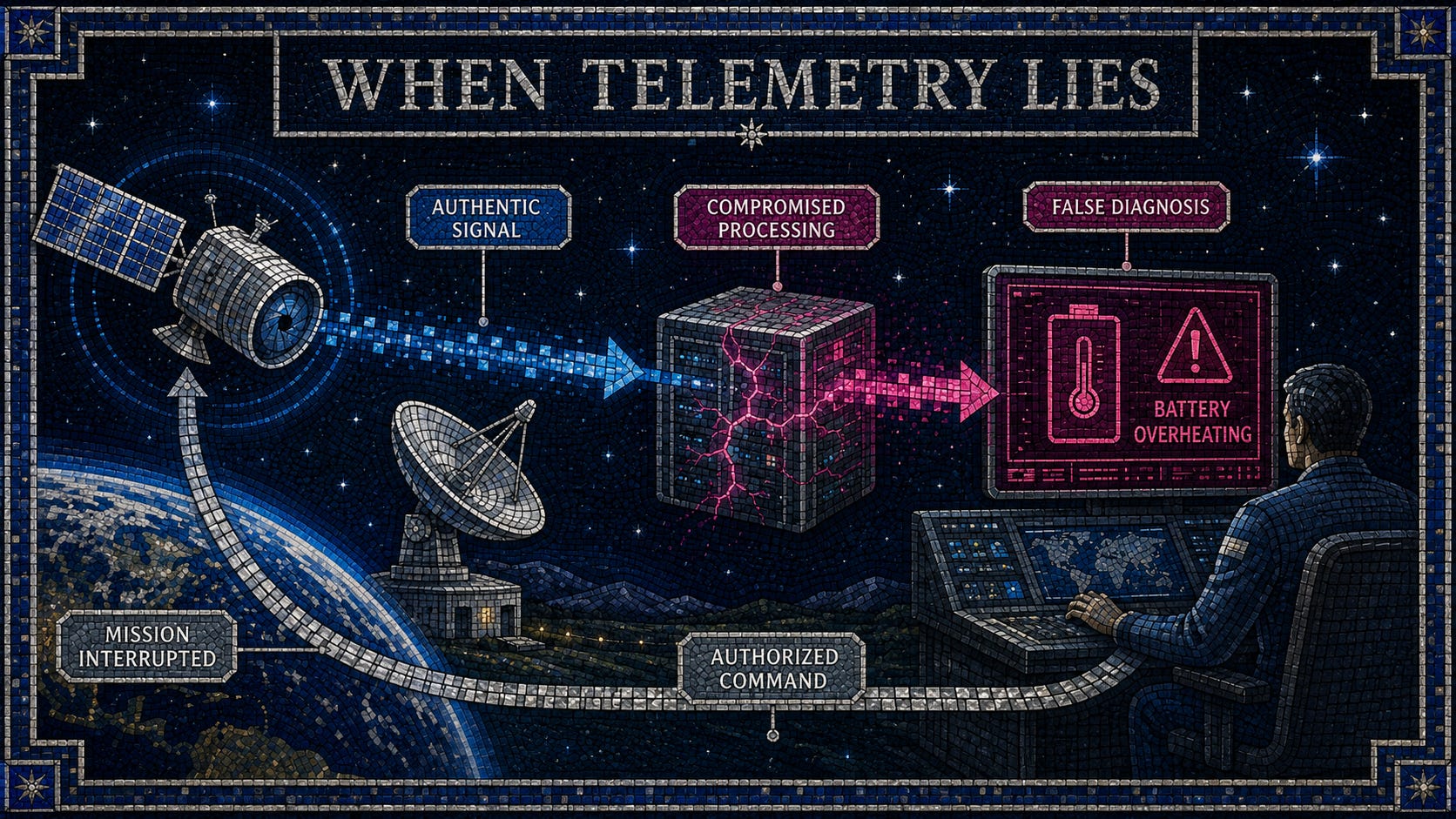
A hostile actor who compromises a terrestrial telemetry-processing system could alter the measurements reaching an automated diagnostic model. The model might then identify a nonexistent equipment problem and recommend protective action. If operators approve that recommendation, they could temporarily disable a healthy spacecraft through an otherwise legitimate command.
The strategic consequences depend on the satellite’s mission. An unnecessary interruption affecting a commercial imaging platform could become significant if military customers depend on its observations during an international confrontation. The spacecraft would remain physically intact. The damage would occur within the chain of trust connecting its reported condition to human decisions.
This scenario should be treated as a plausible analytical assessment rather than a description of a confirmed incident. Publicly available evidence establishes that adversaries target commercial satellite infrastructure and that machine learning already supports spacecraft anomaly detection. It does not establish that an AI-driven telemetry deception attack has caused a documented strategic satellite outage.
The Operational Pressure Behind Automation
The growing population of active satellites makes manual oversight increasingly difficult. The European Space Agency’s 2024 space environment assessment identified approximately 9,100 active payloads. Its 2025 assessment placed that figure near 11,000. The agency’s current orbital statistics report approximately 16,000 functioning satellites.
These figures represent different reporting snapshots rather than a continuous dataset. Their strategic significance is still apparent. More operational spacecraft generate more measurements that ground personnel must interpret correctly.
A satellite’s temperature reading does not explain itself. The significance of a change depends on orbital position and spacecraft activity. A value that appears alarming during one phase of a mission may be entirely ordinary during another.
Machine learning can identify relationships that conventional threshold-based alarms overlook. NASA distributes an LSTM-based anomaly detection system for spacecraft telemetry, demonstrating that automated spacecraft-health analysis has moved beyond theory. NASA research concerning automated anomaly detection for Mars Science Laboratory telecommunications likewise shows how machine learning can support interpretation of operational telemetry.
These systems can help operators recognize developing equipment problems before obvious failures occur. Their value depends on whether the information entering the model accurately represents the spacecraft’s actual condition.
The Ground Segment as a Strategic Vulnerability
Spacecraft telemetry begins with measurements collected onboard. Those measurements are transmitted to terrestrial infrastructure and processed by ground applications before reaching operators.
The National Institute of Standards and Technology addresses these dependencies in its guidance for commercial satellite cybersecurity. Its separate publication on satellite ground-segment cybersecurity focuses directly on the infrastructure supporting spacecraft command and control.
A secure transmission from the satellite does not guarantee that every subsequent processing step remains trustworthy.
Suppose a spacecraft transmits an authentic battery-temperature measurement. The ground station receives the message correctly. Cryptographic protections confirm its origin. A downstream application then modifies the value before presenting it to an AI-driven diagnostic platform.
The original telemetry remains legitimate. The information displayed to operators does not.
This distinction matters because many discussions of satellite security concentrate on preventing unauthorized access to the spacecraft itself. An adversary may instead target the terrestrial software responsible for interpreting spacecraft behavior.
The Aerospace Corporation’s Space Attack Research and Tactic Analysis framework documents potential pathways through which space systems can be compromised. Its usefulness lies in connecting terrestrial cyber activity to physical mission effects.
A compromised processing application may never issue commands directly. It can still influence spacecraft behavior if operators act on the misleading information it supplies.
Operational Deception and Adversarial Machine Learning
Attacks against artificial intelligence do not all occur at the same stage.
Training-data poisoning involves manipulating the examples used to develop a model. An adversary who influences those examples may alter how the system interprets future observations.
Operational deception occurs after deployment. The attacker modifies the information presented to an otherwise functioning model.
NIST’s adversarial machine learning taxonomy distinguishes attacks according to their position in the machine learning lifecycle. That distinction is essential for spacecraft operators because a model trained on reliable information can still reach a false conclusion when its live inputs are compromised.
Consider a diagnostic platform trained to recognize an overheating power component. An attacker who alters incoming telemetry to reproduce that pattern may cause the model to identify a failure that does not exist.
The system has not necessarily been retrained or directly compromised. It is responding correctly to misleading evidence.
This problem is particularly dangerous because realistic deception can exploit the model’s strengths. A system that accurately recognizes subtle equipment failures may also respond convincingly to a fabricated pattern designed to resemble one.
Why Algorithmic Confidence Can Produce False Assurance
Automated diagnostic platforms frequently express conclusions through confidence scores. A system might report a high probability that a spacecraft component is approaching failure.
That number can influence operators more strongly than the underlying evidence deserves.
The confidence score generally reflects how closely the available measurements match patterns associated with a particular condition. It does not necessarily measure whether the data remained trustworthy throughout the processing chain.
A model can therefore express substantial confidence in a false diagnosis.
NIST’s AI Risk Management Framework emphasizes that AI systems must be evaluated within their actual operating environment. Its guidance concerning human oversight of AI systems recognizes that personnel need clear responsibilities when interpreting automated judgments.
In spacecraft operations, that responsibility includes distinguishing diagnostic confidence from data authenticity.
An operator who sees a persuasive warning may assume that the supporting information has already been verified. If every display depends on the same compromised application, apparent agreement between systems can create false reassurance.
Two screens repeating the same corrupted reading provide presentation variety. They do not provide independent confirmation.
A Plausible Mission Disruption Scenario
Consider a commercial imaging satellite supporting military observation during an international crisis.
A hostile actor compromises a terrestrial application that prepares spacecraft telemetry for an automated diagnostic platform. The attacker gradually alters a reported temperature associated with the satellite’s power system.
The modified reading remains consistent with a plausible mechanical problem. The diagnostic model concludes that the spacecraft faces a developing thermal fault.
Operators review the warning and approve a protective response. The spacecraft changes its configuration. Its imaging payload becomes unavailable during an important collection window.
The attacker never transmits an unauthorized command. The spacecraft responds to an authenticated instruction issued by personnel following established procedures.
The consequences depend on available redundancy. Another satellite may provide equivalent coverage. The missed observation may carry limited strategic importance.
Under different circumstances, the interruption could delay awareness of military movement during a confrontation.
This scenario does not require sensational assumptions about an adversary taking full control of a satellite. Its significance comes from the ordinary appearance of every individual action within the operational chain.
Lessons From Documented Satellite Network Attacks
The strategic relevance of attacks against commercial satellite infrastructure is already established.
In 2022, the United States publicly attributed cyberattacks against commercial satellite communications networks to Russian state-sponsored actors. The Cybersecurity and Infrastructure Security Agency’s attribution statement connected the activity to Russia’s invasion of Ukraine.
CISA subsequently published guidance for strengthening satellite communications network cybersecurity.
The documented incident did not involve the specific AI-enabled telemetry deception scenario examined here. Treating it as proof of that mechanism would overstate the available evidence.
Its significance is narrower and still substantial. Commercial satellite services can become military targets during conflict. Terrestrial infrastructure can provide an avenue for disrupting services that governments depend on.
An AI-assisted diagnostic platform represents another potential point of influence within that terrestrial environment.
Establishing Telemetry Provenance
The central defensive requirement is the ability to trace an automated diagnosis back to the original spacecraft transmission.
If a diagnostic system reports that a component is overheating, operators should be able to compare the displayed value with protected records of the original telemetry.
That comparison must use a genuinely separate verification path.
A second monitoring platform connected to the same compromised processing application cannot establish independence. It merely reproduces the original failure in another interface.
Suppose an AI platform reports a dangerous battery temperature while an independent archive shows that the spacecraft transmitted a normal reading. The discrepancy identifies a problem somewhere within the terrestrial processing environment.
The finding may not immediately establish whether the cause is hostile interference or a software defect. It does prevent operators from automatically treating the warning as evidence of an onboard failure.
NIST’s ground-segment cybersecurity guidance supports the broader principle that terrestrial command infrastructure must be understood as part of spacecraft security. Applying that principle to AI-assisted diagnostics requires protecting the chain of custody surrounding operational data.
The objective is simple. Operators must know what the spacecraft actually reported before acting on what an algorithm believes the report means.
Command Approval and Operational Context
The significance of a corrective command depends on the mission environment.
A protective maneuver executed during routine operations may create little more than a temporary scheduling inconvenience. The same command could interrupt a time-sensitive observation during a military confrontation.
Technical procedures should account for that distinction.
When an AI-generated recommendation could affect a consequential mission, operators should verify the supporting telemetry before approving action whenever operational conditions permit. The threshold for additional review should reflect the potential consequences of an unnecessary interruption.
This approach does not require abandoning spacecraft autonomy. Some onboard protective functions must operate immediately when genuine equipment conditions threaten the vehicle.
The relevant distinction concerns externally generated recommendations that depend on terrestrial data processing.
A command arising from compromised ground software creates a different risk from an onboard protective response triggered directly by trusted spacecraft logic.
Mission leadership must therefore communicate when a satellite carries unusual operational importance. Engineers cannot account for strategic consequences they have never been told exist.
Shared Vendors and Common Failure Points
Satellite operators frequently rely on commercial software providers to process operational data.
When several organizations depend on the same diagnostic platform, a weakness affecting that platform could create shared exposure. The actual risk depends on customer architecture and the access retained by the vendor.
The existence of a common supplier does not automatically establish that an attack would spread across multiple operators.
It does create a procurement question concerning the authority that outside providers hold over mission-related software.
If a vendor can remotely modify model behavior or change telemetry-processing logic, customers must understand how those changes are approved.
NIST’s AI governance guidance addresses the need to evaluate outside AI systems used in consequential settings.
For satellite operators, the concern extends beyond ordinary software availability. A vendor-controlled change can influence how personnel interpret spacecraft behavior even if the vendor never directly accesses the satellite.
The more spacecraft depend on a centralized diagnostic platform, the greater the potential consequence of misleading information produced by that platform.
Adversarial Testing and Human Oversight
Testing a diagnostic model against historical equipment failures establishes whether it can recognize known faults. It does not establish whether operators can identify deliberate manipulation.
An effective exercise should examine what happens when fabricated telemetry resembles a familiar spacecraft malfunction.
The human response matters as much as the model’s output.
Operators should recognize that a convincing diagnostic recommendation does not independently establish data authenticity. They should know how to retrieve protected telemetry records before approving commands that could interrupt consequential missions.
NIST’s adversarial machine learning research supports evaluations that distinguish attacks against training data from interference with deployed systems.
For spacecraft operators, the practical test is whether personnel can identify disagreement between the diagnostic platform and the original spacecraft transmission.
A model may perform exactly as designed while the organization surrounding it fails to ask whether its evidence is trustworthy.
Strategic Implications
Military customers should examine how commercial providers verify spacecraft telemetry before executing commands that could affect mission availability.
Commercial operators should recognize that a false diagnosis can damage customer confidence even when the spacecraft remains healthy.
Policymakers should understand that unexplained satellite outages can create uncertainty during international crises without any visible physical attack.
The central challenge is preserving reliable judgment as orbital operations become more automated.
The growth documented in ESA’s current orbital statistics makes continued reliance on automated analysis increasingly likely. NASA’s existing spacecraft telemetry anomaly-detection capability demonstrates why that reliance offers genuine operational value.
The strategic risk appears when an algorithm’s interpretation becomes more trusted than the evidence supporting it.
A healthy satellite can be removed from an important mission by authorized personnel acting on manipulated information. The spacecraft may remain entirely functional while its operators lose confidence in what their own systems are telling them.
Future space security will depend partly on whether organizations can preserve the distinction between an authentic spacecraft message and a persuasive machine-generated explanation.
An adversary may never need to seize the satellite.
Influencing what its operators believe could be enough.