WeatherSaver Pro is the next Professional Standard for Texas Real Estate Agents — the Weather & Intelligence Tools that separate serious agents from part-timers only looking to make pocket change! Are you one of them?
About six o’clock on the morning of April 17, 1897, the early risers of Aurora, Texas looked up and saw something that had no business in the sky.
It came in low and slow — a long, cigar-shaped craft, wobbling, trailing smoke, moving north at maybe ten or twelve miles an hour. This was six years before the Wright brothers got a machine off the ground at Kitty Hawk. There were no airplanes. There were no airships. And yet here was one, sinking toward the rooftops of a sleepy farming town northwest of Fort Worth, clearly in trouble.
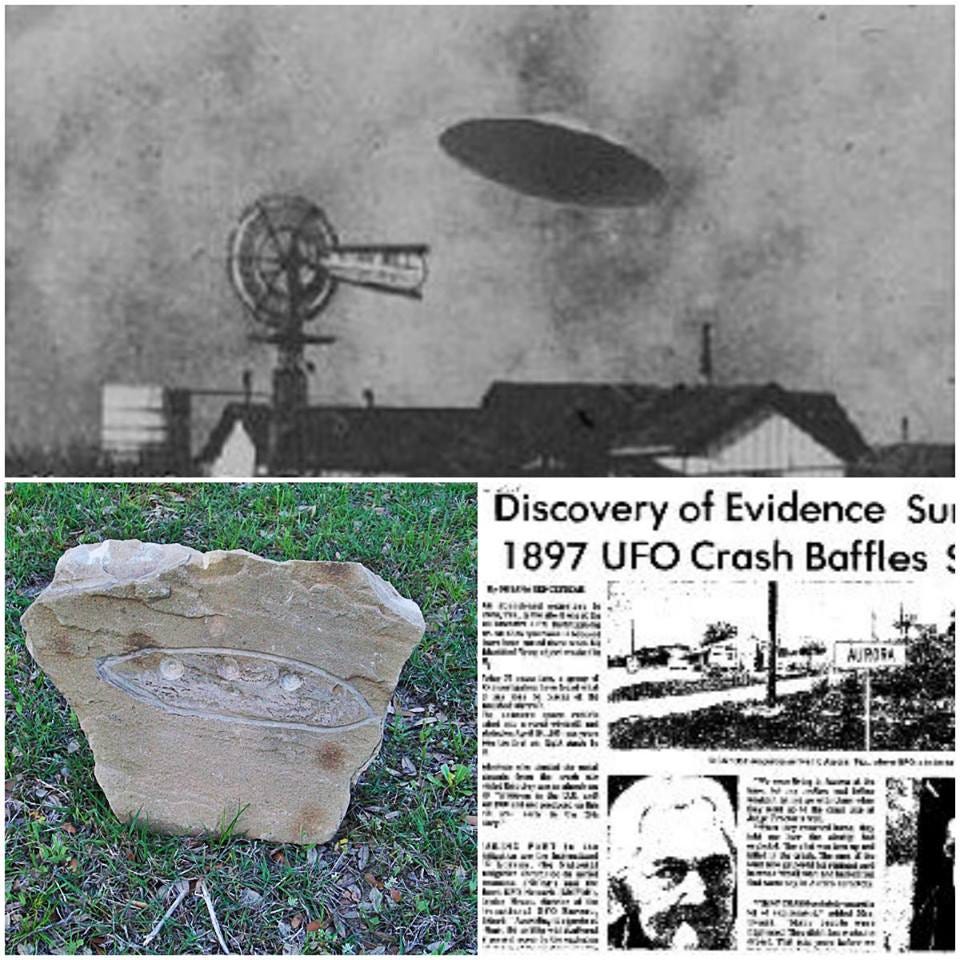
According to the story that has haunted Aurora for more than a century, the craft never made it past Judge J.S. Proctor’s property. It clipped his windmill, exploded, and came down in a shower of burning debris that tore through the judge’s flower garden and scattered strange metal across the field.
And when the townsfolk came running, they found a body in the wreckage.
“Not an inhabitant of this world”
The remains, witnesses said, were small. Disfigured. And unmistakably not human. The newspapers of the day, reaching for the only frame of reference they had, called the pilot a Martian.
Two days later, on April 19, 1897, The Dallas Morning News ran the account on its pages. The reporter, a local man named S.E. Haydon, wrote that the airship “was not a artificial construction of the human race” and that papers found on the pilot were covered in unknown hieroglyphics no one could read.
That detail is the one that keeps people up at night. This wasn’t a campfire legend whispered down through generations with no paper trail. It was printed. In a real newspaper. The clipping still exists. You can read it today.
The people of Aurora did what decent people in 1897 did with the dead, no matter how strange. They gave the pilot a Christian burial in the Aurora Cemetery, under a scrub oak, and they marked the grave with a rough headstone. Onto that stone, someone carved a simple shape — the outline of the airship itself.
Over the years, the town gave the unknown pilot a name. They called him Ned.
The decades that wouldn’t let it die
A story like this should have evaporated. Most tall tales do. This one didn’t.
In 1973, a reporter named Jim Marrs went looking for anyone who’d actually been alive in 1897. He found an 83-year-old man named Charlie Stephens, who had been a ten-year-old boy on a Texas cattle farm that April morning. Stephens told Marrs that he and his father watched the cigar-shaped craft pass low overhead with a bright light, saw it head toward Aurora, and then heard an explosion. Fire lit the northern sky. Young Charlie wanted to run and see — but his daddy said the chores came first.
That same era brought investigators with metal detectors and lab equipment. Some pulled fragments from the old Proctor property and from the well where, the story goes, much of the wreckage had been dumped. A few samples raised eyebrows — odd metallurgy, hard to explain. Others turned up nothing but ordinary debris.
And the State of Texas itself put a stamp on the legend. To this day, a Texas Historical Commission marker stands at the cemetery, and it mentions — right there in official state language — the belief that a spaceship crashed nearby in 1897 and its pilot was buried within.
The case for the hoax
Now — before you go booking a flight to Mars, you should hear the other side. Because it’s a strong one.
In 1897, Aurora was dying. The railroad that had been promised to the town never came; the line was routed elsewhere, and a town without a railroad in those days was a town on borrowed time. Cotton, the local lifeblood, had been ravaged. Fire and illness had thinned the population. Aurora was fading off the map.
And there sat S.E. Haydon — a newspaperman who needed a story, in a town that needed attention to survive.
In 1980, Time magazine tracked down an 86-year-old Aurora resident named Etta Pegues, who had no patience for any of it. She flatly called the article a fabrication — a bit of invention Haydon cooked up to drum up publicity and put his fading town back on the map. She even claimed Judge Proctor never had a windmill at all.
Then there’s the detail that cuts both ways. In the 1970s, a former Aurora mayor admitted he had quietly removed the alien’s grave marker — the one with the airship carved into it — and kept it in his garage. His reason, he said, was to protect it from souvenir hunters and vandals. He also said he’d never seen a shred of real evidence that anything had crashed.
But here’s what gnaws at the believers: if there was nothing in that grave… why did the marker keep disappearing? Why did people keep coming? And why, more than 125 years later, are folks still leaving coins and small trinkets on Ned’s resting place?
You decide
That’s the thing about Aurora. Every answer hands you a new question.
A real newspaper printed it. A living eyewitness backed it. The state marked the spot. And a dying town had every reason in the world to make the whole thing up.
So which is it? An elaborate, beautiful hoax — the desperate last stand of a town that refused to be forgotten? Or did something truly fall out of the Texas sky that morning in 1897, fifty years before a word like “Roswell” meant anything to anybody?
The grave is still out there. Ned, whoever — or whatever — he was, is still keeping his secret.
And Texas is still keeping it with him.
Catch up on every Texas legend, mystery, and forgotten story at weathersaverpro.substack.com — a new one drops every week. And swing by weathersaverpro.com to explore all our free tools, nightly Texas weather, and trusted sponsors, all in one place.
Thanks for listening. If the alien grave of Aurora left you wondering what really fell out of that Texas sky in 1897, there's a new one every week — the legends, mysteries, and forgotten characters history left behind. Subscribe free at weathersaverpro dot substack dot com, and the next story lands right in your inbox. And be sure to visit weathersaverpro dot com to explore all our free services, tools, and trusted sponsors — everything we offer, all in one place.
TÍTULO: La Tumba Alienígena de Aurora, Texas
SUBTÍTULO: Cincuenta años antes de Roswell, una nave espacial supuestamente cayó del cielo de Texas sobre un pequeño pueblo moribundo — y el piloto sigue enterrado en el cementerio local. ¿Engaño, o el primer contacto de Estados Unidos?
WeatherSaver Pro es el nuevo Estándar Profesional para los Agentes de Bienes Raíces de Texas — las Herramientas de Clima e Inteligencia que separan a los agentes serios de los aficionados que solo buscan ganar calderilla. ¿Eres uno de ellos?
Alrededor de las seis de la mañana del 17 de abril de 1897, los madrugadores de Aurora, Texas, levantaron la vista y vieron algo que no tenía por qué estar en el cielo.
Llegó bajo y lento — una nave larga con forma de cigarro, tambaleándose, dejando una estela de humo, avanzando hacia el norte a quizás diez o doce millas por hora. Esto era seis años antes de que los hermanos Wright lograran levantar una máquina del suelo en Kitty Hawk. No había aviones. No había dirigibles. Y sin embargo, ahí estaba uno, hundiéndose hacia los tejados de un tranquilo pueblo agrícola al noroeste de Fort Worth, claramente en apuros.
Según la historia que ha perseguido a Aurora durante más de un siglo, la nave nunca logró pasar la propiedad del juez J.S. Proctor. Rozó su molino de viento, explotó y cayó en una lluvia de escombros ardientes que atravesó el jardín de flores del juez y esparció metal extraño por todo el campo.
Y cuando los habitantes del pueblo llegaron corriendo, encontraron un cuerpo entre los restos.
«No era habitante de este mundo»
Los restos, dijeron los testigos, eran pequeños. Desfigurados. E inconfundiblemente no humanos. Los periódicos de la época, recurriendo al único marco de referencia que tenían, llamaron al piloto un marciano.
Dos días después, el 19 de abril de 1897, The Dallas Morning News publicó el relato en sus páginas. El reportero, un hombre local llamado S.E. Haydon, escribió que la nave «no era una construcción artificial de la raza humana» y que los papeles encontrados sobre el piloto estaban cubiertos de jeroglíficos desconocidos que nadie podía leer.
Ese detalle es el que no deja dormir a la gente. No se trataba de una leyenda susurrada de generación en generación sin rastro alguno. Estaba impreso. En un periódico de verdad. El recorte todavía existe. Hoy puedes leerlo.
La gente de Aurora hizo lo que la gente decente hacía en 1897 con los muertos, por extraños que fueran. Le dieron al piloto un entierro cristiano en el cementerio de Aurora, bajo un roble, y marcaron la tumba con una lápida tosca. En esa piedra, alguien talló una forma sencilla — la silueta de la propia nave.
Con los años, el pueblo le dio un nombre al piloto desconocido. Lo llamaron Ned.
Las décadas que no lo dejaron morir
Una historia así debería haberse desvanecido. La mayoría de los cuentos exagerados lo hacen. Este no.
En 1973, un reportero llamado Jim Marrs salió a buscar a cualquiera que hubiera estado vivo en 1897. Encontró a un hombre de 83 años llamado Charlie Stephens, que había sido un niño de diez años en una granja ganadera de Texas aquella mañana de abril. Stephens le contó a Marrs que él y su padre vieron pasar la nave con forma de cigarro volando bajo sobre sus cabezas con una luz brillante, la vieron dirigirse hacia Aurora, y luego escucharon una explosión. El fuego iluminó el cielo del norte. El pequeño Charlie quería correr a ver — pero su papá dijo que primero estaban las tareas.
Esa misma época trajo investigadores con detectores de metales y equipo de laboratorio. Algunos sacaron fragmentos de la antigua propiedad de Proctor y del pozo donde, según cuenta la historia, se había arrojado gran parte de los restos. Algunas muestras levantaron sospechas — una metalurgia rara, difícil de explicar. Otras no revelaron más que escombros corrientes.
Y el propio estado de Texas le puso su sello a la leyenda. Hasta el día de hoy, una placa de la Comisión Histórica de Texas se alza en el cementerio, y menciona — ahí mismo, en lenguaje oficial del estado — la creencia de que una nave espacial se estrelló cerca en 1897 y su piloto fue enterrado allí.
El argumento del engaño
Ahora bien — antes de que reserves un vuelo a Marte, deberías escuchar la otra versión. Porque es contundente.
En 1897, Aurora se moría. El ferrocarril que le habían prometido al pueblo nunca llegó; la línea se desvió a otra parte, y un pueblo sin ferrocarril en aquellos días era un pueblo con los días contados. El algodón, el sustento local, había quedado devastado. El fuego y la enfermedad habían diezmado a la población. Aurora se borraba del mapa.
Y ahí estaba S.E. Haydon — un periodista que necesitaba una historia, en un pueblo que necesitaba atención para sobrevivir.
En 1980, la revista Time localizó a una residente de Aurora de 86 años llamada Etta Pegues, que no tenía paciencia para nada de esto. Llamó al artículo lisa y llanamente una invención — un invento que Haydon ideó para generar publicidad y volver a poner a su pueblo moribundo en el mapa. Incluso afirmó que el juez Proctor jamás tuvo un molino de viento.
Luego está el detalle que corta por ambos lados. En los años setenta, un exalcalde de Aurora admitió que había retirado discretamente la lápida del alienígena — la que tenía la nave tallada — y la había guardado en su garaje. Su razón, dijo, era protegerla de los cazadores de souvenirs y los vándalos. También dijo que nunca había visto ni una pizca de evidencia real de que algo se hubiera estrellado.
Pero esto es lo que carcome a los creyentes: si no había nada en esa tumba… ¿por qué la lápida seguía desapareciendo? ¿Por qué la gente seguía viniendo? ¿Y por qué, más de 125 años después, todavía hay quienes dejan monedas y pequeños recuerdos sobre el lugar donde descansa Ned?
Tú decides
Eso es lo que tiene Aurora. Cada respuesta te entrega una nueva pregunta.
Un periódico de verdad lo publicó. Un testigo vivo lo confirmó. El estado marcó el lugar. Y un pueblo moribundo tenía todas las razones del mundo para inventárselo todo.
Entonces, ¿qué fue? ¿Un engaño elaborado y hermoso — la última y desesperada jugada de un pueblo que se negaba a ser olvidado? ¿O algo realmente cayó del cielo de Texas aquella mañana de 1897, cincuenta años antes de que una palabra como «Roswell» significara algo para alguien?
La tumba sigue ahí. Ned, quienquiera — o lo que quiera — que haya sido, sigue guardando su secreto.
Y Texas lo sigue guardando con él.
¿Te atrapó esta historia? Suscríbete GRATIS en weathersaverpro.substack.com y recibe una nueva leyenda, misterio o personaje olvidado de Texas cada semana, directo en tu correo. Y visita weathersaverpro.com para todas nuestras herramientas gratuitas, el clima nocturno de Texas y nuestros patrocinadores de confianza — todo en un solo lugar.