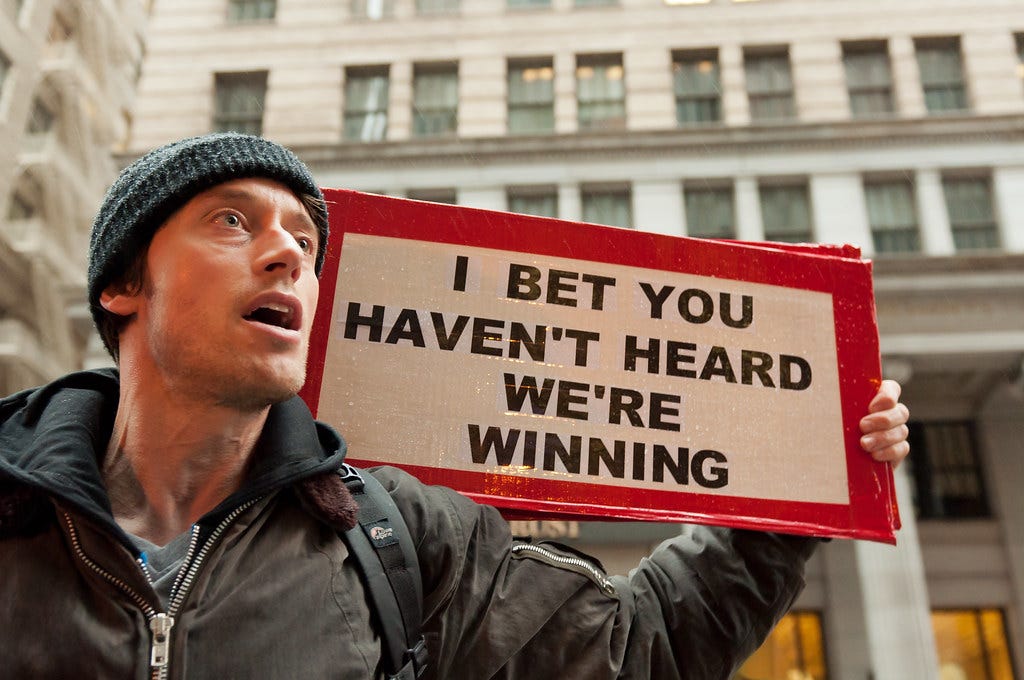
My guest on the show today is Jeffrey Lawrence, professor of English at Rutgers University and the author of an excellent essay in the most recent issue of The Point, “We Were the 99 Percent.” It’s an unusually thoughtful reflection on the legacy of Occupy Wall Street, which Jeff was a participant in, and observer of, from the very beginning.
I asked Jeff to come on the show because I enjoyed the essay, which genuinely altered my perspective on a movement that I thought, in retrospect inaccurately, I more or less understood. Also, though, because he was someone who’d been popping up in my Substack feed recently in a way that I’d noticed, and it was striking to me that he’d gone in the space of a month or two from someone I’d never heard of to someone I now knew from both Substack and The Point, which are two of the key ingredients in my personal intellectual diet.
There’s nothing magical about this. Big world, small tax bracket, as someone once said to me. Jeff I overlap in terms of background and interests in all sorts of ways. But I like to pay attention to these signals anyway. They often end up meaning something.
One of the thing that turns out to be interesting about Jeff’s case, as you’ll see in the conversation, is that for all that we do share, intellectually, he’s also coming from a substantively different place, in terms of his scholarship and political experiences, than many of the rest of us, and it’s that difference – his grounding in both Spanish and English language literature, and his personal connections to activists from Latin America and Europe – that has a lot to do with what makes his work surprising.
Hope you enjoy this conversation as much as I did. And keep an eye on Jeff. He’s a comer.
Also keep an eye on my the new logo for the show, designed by Arc magazine intern Mina Fujii. It is, as the kids say 🔥. It jazzes up the whole joint. I feel at least 46.6% cooler than I did last week.
Eminent Americans is produced in collaboration with the John C. Danforth Center on Religion and Politics at Washington University in St. Louis and distributed through its publication, Arc. You can read more articles and listen to more podcasts at their website.
Peace.
Show notes for this ep:
[0:00] Intro: Host Dan Oppenheimer welcomes listeners and introduces Jeffrey Lawrence, Professor of English and Director of Creative Writing at Rutgers University, author of the essay “We Were the 99 Percent” in *The Point* magazine.
[0:33] Dan explains why he invited Jeff on the show — the essay genuinely altered his perspective on Occupy Wall Street, and Jeff has been appearing across Substack and *The Point* as a rising intellectual voice.
[2:33] Dan notes Jeff’s unique background in both Spanish and English literature and his connections to Latin American and European activists, which shaped his path to Occupy.
[4:00] The “people’s mic” at Occupy — Jeff explains how it worked, its visceral power, and its limitations as a kind of physical Twitter.
[6:11] Dan admits the essay forced him to reconsider his “easy, stereotypical, condescending” views on Occupy and raises the broader question of whether there’s always something cringe about movements.
[7:30] Jeff’s origin story at Occupy — he was in his late 20s, a grad student in comparative literature in New York, connected to Spanish organizers involved in the Indignados (15-M) movement.
[9:05] Jeff’s frustration with how left media outlets (Jacobin, N+1) claimed the Occupy narrative after late September 2011, missing the movement’s international prehistory.
[10:25] The Spanish Indignados movement as a key influence — 40% of people at Occupy planning meetings in Tompkins Square Park were non-Americans, many from Spain, bringing conviction that a similar movement could work in the US.
[12:30] Dan draws a parallel to Black Lives Matter’s internal narrative battles (DeRay Mckesson vs. the hashtag’s founders) and asks what’s at stake in who controls the story.
[16:06] Jeff critiques the “Jacobin narrative” and Musa al-Gharbi’s *We Have Never Been Woke* for framing Occupy as purely a project of symbolic elites — and concedes he himself is one.
[23:06] Dan argues the professional managerial class critique is potent but not a catch-all delegitimization of movements, citing the civil rights movement and gay rights as movements led by educated middle-class people who did profound good.
[24:12] Jeff tells his Occupy story: a heterogeneous, international group suspicious of existing left organizations, experimenting with whether to issue demands or build a constituency. Early debates included a Tobin tax on financial transactions.
[27:15] The “We Are the 99%” slogan’s populist power — Jeff traces its origins to his Spanish friends Begonia and Luis, Chris from Food Not Bombs, and David Graeber assembling it together.
[29:30] The core insight of early Occupy: the left-right partisan axis wasn’t capturing the fundamental problem of massive wealth redistribution toward elites — a framing that remains powerful.
[32:00] The encampment at Zuccotti Park lasted about two months (September 17 – late November 2011). Jeff identifies two competing currents: the autonomous/horizontal current and the institutional left current.
[33:30] The institutional narrative won: Occupy as a rebirth of the left, to be articulated into institutional political power. Jeff argues this proved self-defeating — reducing everything to “is this left or not?”
[36:00] Tracing the autonomous current forward: Occupy Sandy (mutual aid after Hurricane Sandy in 2012), Strike Debt (buying up student debt, later pushing Biden on debt cancellation), the 16 Beaver reading group, connections to BLM, Standing Rock, and Gaza.
[39:00] The institutional side: N+1’s “Left Populism” editorial, Jacobin, Astra Taylor’s involvement, the Occupy Gazette, Bernie’s campaign, the DSA, and the Squad.
[42:00] Dan and Jeff dig into the theory of left populism via Laclau and Mouffe — the “chain of equivalences” approach linking disparate group demands into a coalition, versus older economic populism.
[46:00] Mid-roll break: Dan highlights new writing at *Arc* Magazine — essays by Amelia Morris on motherhood, Lydia Dugdale on illiteracy, and Travis Alexander on Zionism and queerness.
[47:30] Two definitions of populism: (1) economic populism rooted in broad shared material interests (”We are the 99%”), and (2) Laclau/Mouffe’s “chain of equivalents” populism linking the distinct demands of different identity groups. Jeff argues the left conflated the two.
[50:00] Latin American populist governments (Chávez in Venezuela, Morales in Bolivia, the Kirchners in Argentina) as the laboratory for left populism. Jeff argues this paradigm is now exhausted — right-wing governments have won the last several elections across the region.
[55:00] Dan pushes back: Wasn’t Latin American populism largely about petrodollars and payoffs rather than genuine chain-of-equivalences politics? Jeff partially agrees but argues there were real redistributive achievements for a period.
[1:08:00] Jeff’s key argument: When people like Matt Karp or Benjamin Kunkel say “we need populism,” they’re often confusing two very different things. The left needs fine-grained theoretical clarity about which populism it means.
[1:12:00] Dan asks: What’s the difference between chain-of-equivalences populism and old-fashioned Democratic coalition politics? Jeff’s answer: populism requires an antagonism — a defined enemy — which Democratic coalition politics doesn’t.
[1:16:00] The problem of subdivided antagonisms: instead of one universal “people vs. elites,” the chain-of-equivalences approach slices the antagonist into multiple enemies (whites, straights, cis people, Israel), creating more political opposition than it can overcome.
[1:19:00] Jeff on the abolitionist movement’s refusal to answer basic questions (e.g., “What do you do when someone commits a murder?”) — he sees this as fundamentally unserious and unwilling to win politically.
[1:23:00] Mamdani as a potential new model: recognizing that anti-Trump politics is played out, focusing on affordability with concrete examples, maintaining a consistent approach on Israel/Palestine, and not antagonizing for the sake of scoring points with liberals.
[1:28:00] Jeff’s own vision: he still believes in unions, collective bargaining, and redistribution, but acknowledges the left failed spectacularly on racial justice and messaging. He calls for more experimentation and creative solutions rather than ideological rigidity.
[1:29:00] The messaging problem: cancel culture and the left’s procedural dysfunction weren’t successful in preventing Trump. Jeff argues the left needs to rethink both messaging and substance.
[1:35:00] Dan’s closing reflections: he hopes that 20–40 years from now, the energies traceable to Occupy will have borne genuinely positive fruit, even if many offshoots were misguided. He praises Jeff’s essay and encourages listeners to follow him on Substack.
[1:44:30] Credits: *Eminent Americans* is produced in collaboration with the John C. Danforth Center on Religion and Politics at Washington University in St. Louis, distributed through *Arc* Magazine. Edited by David Sugarman.