Despite being over 50 years old, The Camp of the Saints reads as if it was written only yesterday. It’s basically the story of the West since the end of World War II, condensed into a roughly two-month farce, set in the Spring of 1973.
It’s not a novel in the traditional sense; it’s more like a collection of sketches and vignettes depicting the reactions (and non-reactions) of various people throughout the West to an impending catastrophe. There are a few recurring characters, but none are really developed or undergo any meaningful changes. The main characters really aren’t any of the individual people depicted in the story, but rather the zeitgeists of two competing cultures: that of the ravenous, locust-like Global South, and that of the decadent and suicidal West.
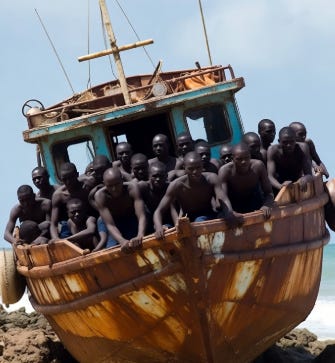
The overarching story is simple. An armada filled with migrants sets sail from India, bound for Western Europe, a land overflowing with milk and honey. The Western countries do nothing but dither and discuss possible responses. What little they do, the Western leaders do half-heartedly, either with a spirit of dour resignation or with the zeal of naive liberal lunacy. The West is like a termite-infested tree, where the termites are either the practitioners of a suicidally “compassionate” churchianity, or the adherents of a suicidally malignant Marxcissism. As soon as the migrants crash like a tidal wave of raw sewage onto the southern coast of France, the termite-infested tree collapses. Then, upon seeing that the West is unwilling to defend herself, innumerable more migrant armadas set sail from the Global South, their hearts set on pillaging the fresh carcass of Western Europe. Soon, a provisional government is established, comprised of murderous migrants and suicidally co-dependent Europeans, and the new government uses the military equipment and the misguided loyalties of remaining troops (who have been conditioned to obey any order from those wearing the emblems of authority) to wage war against the remaining “racist” holdouts. Of course, in The Camp of the Saints, as in our world, the word “racist” means nothing more than a white person who prefers to live amongst those with whom he shares a common culture. Eventually, all the “racists” retreat to Switzerland, the final holdout, but international pressure and internal sabotage from Marxcissists combine to break the country. The novel ends as Switzerland agrees to open her borders.
The Camp of the Saints raises some interesting questions. Who organized so many hundreds of boats and made them all available for the migrants to use? Who put the migrants up to it? Who coordinates the conspiracy of silence, and even of outright inversion of reality, adhered to by Western media? (Similar to the conspiracy of silence and inverted propaganda about post-apartheid South Africa that has only recently begun to come apart as the reality has grown too horrible for the Globohomo regime to keep it under wraps.) A “great manipulator-in-chief” is hinted at, but never explicitly named; however, the title of the book, and the passage from the Book of Revelation quoted in its opening pages, make clear who this ultimate rabble-rouser really is:
And when the thousand years are expired, Satan shall be loosed out of his prison and shall go out to deceive the nations which are in the four quarters of the earth, Gog, and Magog, to gather them together to battle: the number of whom is as the sand of the sea. And they went up on the breadth of the earth, and compassed the camp of the saints about, and the beloved city. (Revelation 20: 7-9.)
Here’s a tangential consideration. The characters of the book believe themselves to be living in the year 1975, just as we believe it to be (as of this writing) 2025. But we really don’t know what year it is, and we may very well be deep into the timeline described in Revelation 20: 1-10 — i.e., the era of satanic deception.
Below is a passage from the book that speaks to the demonic spirit that has been revealing itself with ever increasing openness throughout the past several decades:
The world seems to be controlled, not by a single orchestra conductor, but by a new apocalyptic beast, a sort of anonymous, omnipresent monster who has vowed, first and foremost, to destroy the West. The beast has no specific plan. It takes advantage of the opportunities that present themselves . . . Perhaps it is of divine or, more likely, demoniacal origin? Dostoevsky analyzed this unlikely phenomenon, born two centuries ago. So did Péguy, albeit in other forms. As also did one of our earlier popes, Paul VI, after finally opening his eyes in the waning days of his pontificate. Nothing can stop the beast. Everyone knows it. Among the initiates, this lends a certain triumphalism to their way of thinking, whereas those who still struggle within themselves perceive the futility of their fight. A fallen archangel himself, Ballan immediately recognized the lackeys of the beast and offered them his services. (The Camp of the Saints, Chapter IX.)
As the grand cosmic drama, and all the innumerable smaller dramas playing out fractally within it, reach their climax, the various types of Evil will collapse into their basest form: a Sorathic Evil of sheer nihilism, so full of devouring hatred that it can’t even pretend to be anything else. It’s a universal solvent that seeks to disintegrate and blot out all life and finally consciousness itself.
In this episode, I read a few of the many (too many to include them all in a single episode!) quotable passages from the book and discuss their significance in light of our civilization’s present conflicts. These conflicts are superficially political in nature, but they are really, at bottom, ultimately spiritual. In The Camp of the Saints, as in our world today, the West is only conquered by the locust-people after it has first been spiritually conquered by a demonic parasitic infection that initially manifests as egoic pride, then as a subtle and persistent existential malaise, thereafter as an overwhelming desire to numb self-awareness with empty palliatives, and finally as a nakedly suicidal self-hatred and hatred of Life itself. We can (and should) seal the borders, sink the migrants’ ships, and send the invaders back, but much more than that, we need to connect with the true God and rekindle the spiritual vitality that will bring moral clarity and a willingness to protect and promote our own interests. The West has not been charitable. Charity is a Christian virtue, and the West has become thoroughly antichristian. Rather than being charitable, the West has been selfless, which is the negative counterfeit of charity. It is the spirit of suicide masquerading as compassion for others — but only distant and abstract others, never neighbors near and like oneself. (It is this selflessness that serves as the basis for that anti-human “moral” philosophy known as Utilitarianism.) To love one’s neighbor as oneself, one must actually love oneself, that is, one must desire that which is good, rather than that which is harmful, for oneself.
I highly recommend this book (which is back in print again after actually having been a banned book for many years, unlike the purportedly “banned books” on display at public libraries and on mandatory reading lists in public schools). You can get it from Books a Million, Barnes & Noble, or Amazon.
And if you’re listening to this on a podcast app or streaming platform, check out the Substack page for this episode to see embedded content, leave a comment, or subscribe if you would like to do so.
A Ghost in the Machine is a reader and listener supported publication. To receive new posts and support my work, consider becoming a free or paid subscriber.