Episode Description
We’ve spent a lot of time discussing Human Middleware: the invisible work people do to keep organizations running. But what happens when that invisible work falls disproportionately on women? And what happens when the people doing it aren’t recognized for their contributions?
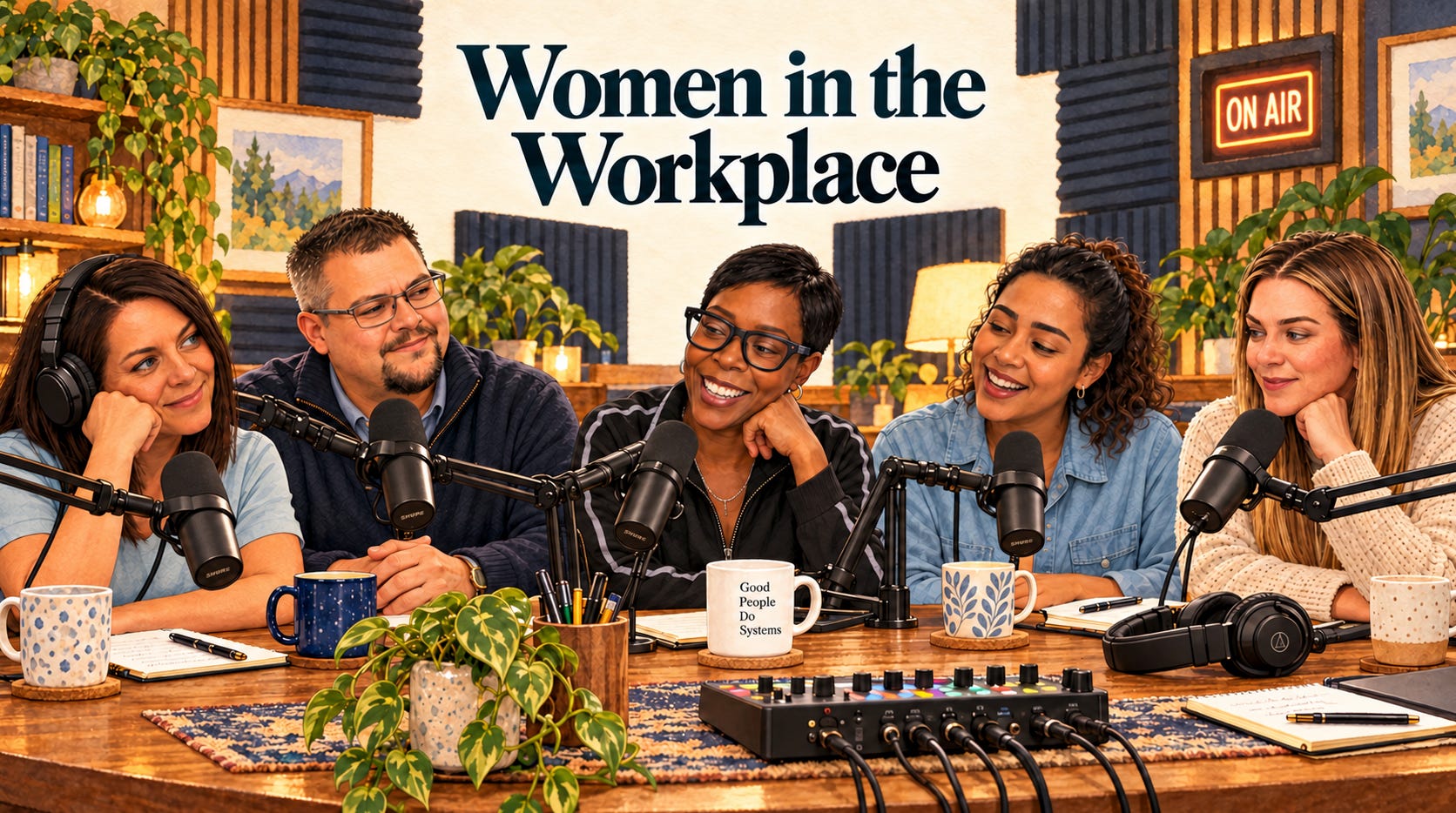
For this episode of the Organizational Gravity Podcast, Gabe and Kelly join Audrey Johnson and Kay Turner for a personal conversation about women in the workplace, leadership, motherhood, compensation, professional expectations, and AI's growing influence.
These women have worked together across multiple organizations and bring years of experience in project management, operations, and organizational change.
Rather than simply discussing workplace statistics, they share their own experiences, including the moments that shaped their careers, the obstacles they’ve encountered, and the opportunities they see ahead.
Kelly Sheahan — The Hidden Expectations of Being Dependable
Invisible work and unequal expectations
Kelly opens the conversation by describing how women often take on extra responsibilities without being asked whether they belong to them. She recalls an executive requesting a presentation at 4:59 PM, due by 8 AM the next morning.
Her question: Why was she the person expected to take care of it?
Navigating male-dominated industries
Kelly discusses the differences between working in female-dominated and male-dominated industries, particularly the expectations surrounding assertiveness, communication, appearance, and professional behavior.
She describes the fine line women often navigate between speaking their minds and being perceived as aggressive or difficult.
Motherhood and returning to work
Kelly shares the challenges of returning from maternity leave, balancing professional responsibilities with motherhood, and keeping pace with rapidly changing technology.
She also questions why maternity and paternity leave remain so inconsistent.
Pay equity and professional recognition
Kelly recounts discovering that a less-experienced employee reporting directly to her earned about the same salary, despite her additional management responsibilities.
She questions how organizations evaluate experience, determine compensation, and account for subjective judgments in promotion decisions.
AI as an opportunity to do more valuable work
Kelly sees AI as an opportunity to move beyond repetitive tasks and toward higher-value contributions. She also challenges the assumption that lower recognition of women’s AI use necessarily means women use it less.
Audrey Johnson — Making Invisible Work Visible
Recognizing the value of work that happens behind the scenes
Audrey challenges the idea that invisible work is somehow less valuable.
Much of project management involves connecting people, solving problems, coordinating activities, and keeping work moving.
Her central question is how women can make those contributions visible and demonstrate their value.
Executive presence versus authenticity
Audrey discusses feedback on her executive presence and reconsiders what the phrase actually means.
Was she being encouraged to become a stronger leader, or being asked to behave in a way that matched someone else’s expectations?
She argues that authenticity matters because maintaining a professional persona that isn’t genuinely yours is ultimately unsustainable.
Visibility, promotion, and communicating business value
Audrey reflects on the importance of discussing accomplishments, communicating financial impact, and ensuring leadership understands the value of work being performed.
She also acknowledges that promotion decisions often involve visibility and relationships, not simply performance.
Motherhood and career decisions
Audrey shares how having a daughter influenced her willingness to travel as a project manager.
She describes feeling less visible on her own projects when colleagues traveled more frequently and wondered whether those differences would affect her advancement.
AI, learning, and career opportunity
Audrey encourages women to become curious about AI, invest time in learning it, and use it to reduce repetitive work.
She sees AI proficiency as a potential path toward better roles, greater responsibility, and improved compensation.
Finding your voice in the room
Audrey discusses learning when to interrupt, redirect a conversation, and insist on finishing a thought.
She argues that women should feel comfortable exercising authority in meetings rather than automatically yielding the floor.
Kay Turner — Recognition, Opportunity, and the Cost of Speaking Up
When other people receive credit for your work
Kay argues that much of women’s work isn’t invisible. Rather, organizations have become accustomed to expecting women to perform it.
She describes how women can contribute substantially while someone else receives the recognition, and how that experience can undermine confidence.
Assertiveness and unequal standards
Kay reflects on being a direct, outspoken woman in corporate environments and the professional consequences of refusing to back down.
She questions whether the same traits that can advance a man’s career sometimes limit a woman’s opportunities.
The career opportunities women sacrifice
Kay shares a pivotal moment when a female executive recognized her potential and offered her a director position that required relocating.
She declined because of her responsibilities as a mother and still wonders how her career might have developed had she accepted.
A serious accident and unequal compensation
One of the episode’s most difficult stories comes when Kay describes a car accident that left her unable to work for three months.
Despite managing a project for 14 months before the accident and returning to complete it, she received only 15% of the project bonus, while the colleague who temporarily replaced her received 85%.
Kay discusses the humiliation, frustration, and lasting effects of that decision.
Race, bias, and advancement
Kay shares her experiences navigating corporate America as a Black woman and discusses how personal relationships, unconscious bias, and expectations about who fits a leadership role can affect career progression.
She challenges the assumption that promotions are always determined primarily by skill and performance.
AI access and opportunity
For Kay, the question isn’t simply whether women are willing to use AI.
It’s whether they have the access, exposure, training, and opportunities to develop meaningful capabilities with it.
Leadership is a collective effort
Kay closes with a reminder that productive disagreement is not an attempt to undermine leadership.
Teams succeed when people challenge one another constructively, recognize their shared responsibilities, and work toward collective success.
The Gravity Beat — What Are We Actually Recognizing?
Throughout the discussion, one question continues to surface:
If organizations depend on invisible work, why do they struggle to recognize the people performing it?
The conversation explores how performance expectations, leadership behaviors, career interruptions, and organizational structures can create additional burdens that aren’t always reflected in job descriptions or compensation.
AI creates an interesting possibility. Some of the repetitive and administrative work that has historically occupied employees may become easier to automate.
But removing the task doesn’t automatically correct the organizational assumptions that made the work invisible in the first place.
And without equitable access to technology and career opportunities, organizations risk carrying those same problems into a new generation of work.
A Personal Thank You
Gabe closes by reflecting on the women who shaped his life and career.
From his grandmother, who taught him to read, to his aunt, whose career helped shape his understanding of business, to Star, whose continued support makes so much of his professional and creative work possible.
He also thanks Kelly, Audrey, and Kay for years of collaboration, honest feedback, and their willingness to challenge him.
The conversation ends with a reminder from Kay that nobody succeeds entirely alone. Behind successful people are often partners, friends, colleagues, and families whose contributions deserve recognition.
Join the Conversation
Are organizations recognizing the people who keep work moving, or simply rewarding the outcomes?
As AI takes on more administrative and coordination work, will it create better opportunities for women, or will the same patterns of recognition and advancement continue?