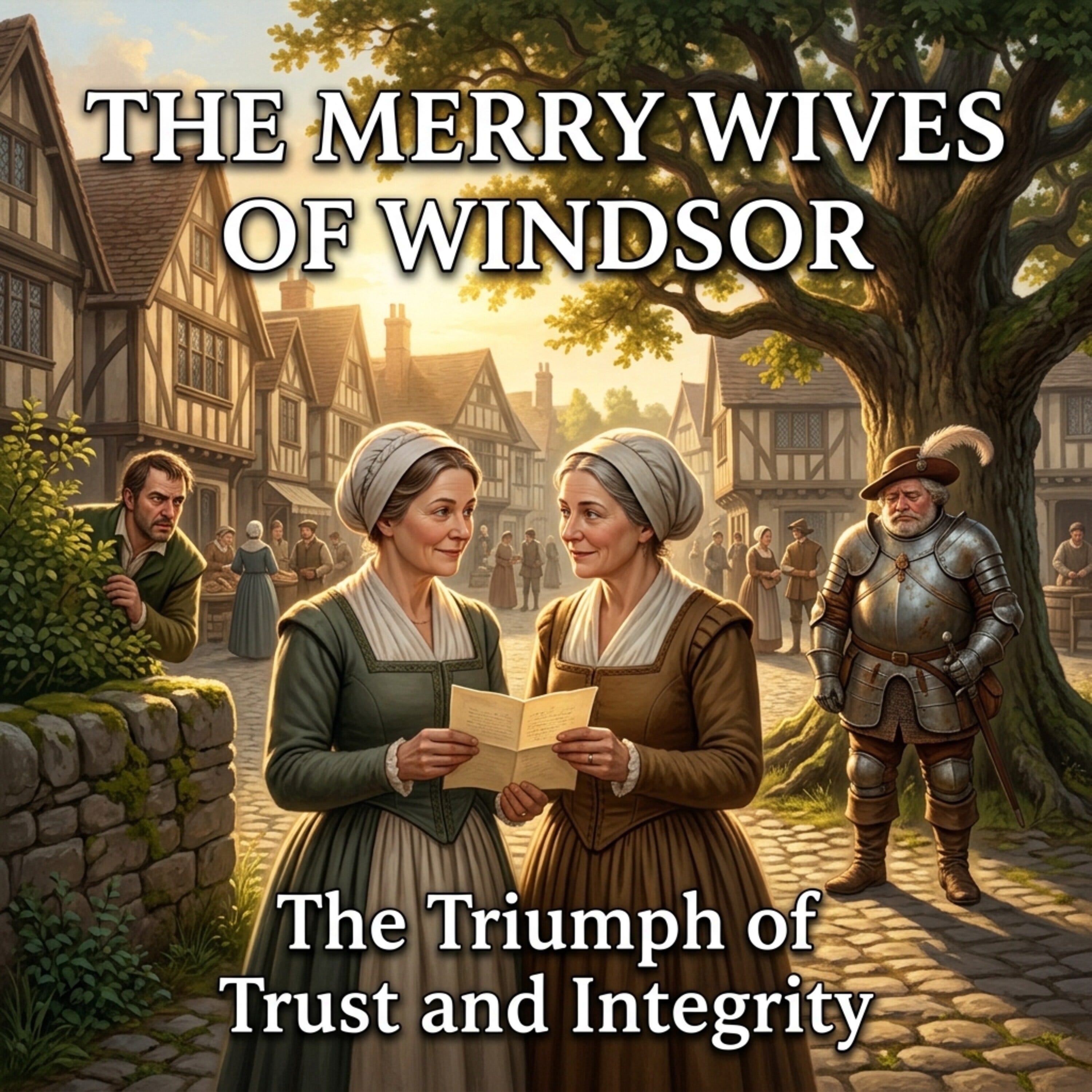
In Shakespeare's "The Merry Wives of Windsor," we witness the spectacular downfall of a brilliant knight, Sir John Falstaff, who usually dominates any room with his wit. Yet, here he finds himself in the most undignified of situations: crammed into a foul-smelling laundry basket, dumped into a freezing river, and later pinched and burned by a mob in a dark forest while wearing deer horns. This episode of "Wisdom for the Present" dissects not just the sheer physical comedy, but the ruthless psychological architecture beneath this dismantling of dignity, turning the mirror outward to ask: how often do we orchestrate our own "laundry basket moments"?
The play meticulously examines the mechanics of human foolishness, driven by two central pathologies: unchecked, monumental ego and totally consuming, weaponized paranoia. Falstaff embodies the former, believing his magnetism is irresistible, while Master Frank Ford manifests the latter, convinced of his wife's betrayal. Though seemingly opposite, both men suffer from the same cognitive failure: an absolute detachment from reality, constructing elaborate fictions and demanding the real world bend to accommodate them.
Falstaff's "identical letter"—sending the same generic love letter to two different women—reveals an intellectual laziness born of profound pride, assuming his status alone guarantees success. He tragically underestimates the agency and intelligence of others, providing the "blueprints" for his own destruction. Conversely, Ford's "Master Brooke" alter ego exemplifies the destructive power of confirmation bias, as he actively funds Falstaff to seduce his own wife, not to prevent betrayal, but to confirm his paranoid suspicions and assert control over his own devastation.
The Elizabethan context amplifies these pathologies; the fear of becoming a "cuckold" (a betrayed husband) carried existential social stakes, publicly signifying a man's incompetence. This explains the wives' "elemental cruelty" in their "cures" for Falstaff, which escalate from water to earth and fire—a systematic, ritualistic torture designed to shatter his identity. This uncomfortable theatrical public severity was necessary, the play posits, because polite intervention would have been mathematically useless against such a thick armor of narcissism. The Anne Page subplot further complicates the societal landscape, exploring how marriage itself can become a transaction of social survival, weighed against decaying prestige, aggressive social climbing, or authentic human connection.
Ultimately, "The Merry Wives of Windsor" is a comedy of restoration, where fractured communities heal once truth is dragged into the cold light of day. Forgiveness, however, only arrives after complete accountability. Falstaff is only welcomed back after he admits, "I do begin to perceive that I am made an ass." This powerful narrative invites us to apply three rigorous practices: auditing our own "identical letters" to check ego's laziness, conducting a "Master Brooke audit" to refuse funding our own paranoia, and "dropping the vizard"—choosing authenticity over societal expectation. The play's final image—Falstaff paralyzed by "fairies" who are merely children in masks—serves as a potent reminder that we do not see the world as it is, but as we are, often projecting our internal shadows onto ordinary challenges.
In This Episode
* Shakespeare's "Merry Wives of Windsor" as a dissection of self-inflicted humiliation and human foolishness.
* The twin pathologies of unchecked ego (Falstaff) and weaponized paranoia (Ford).
* How both men construct elaborate fictions, detaching from reality and underestimating others.
* The "identical letter" test and "Master Brooke" audit as metaphors for ego-driven laziness and paranoia.
* The high social stakes of reputation and "cuckoldry" in Elizabethan England, driving extreme responses.
* The systematic, elemental "cures" administered to Falstaff, questioning the necessity of radical intervention for deep-seated narcissism.
* The play's ultimate message: restoration and forgiveness are possible, but only after complete accountability.
Practical Reflection
Am I sending "identical letters" in my life, underestimating others or relying on past success instead of genuine engagement?
Where am I playing "Master Brooke," manufacturing my own misery or testing others due to paranoia and a need for control?
In what areas of my life am I pursuing "vizards" (societal expectations) instead of dropping the mask and choosing genuine unadorned joy?
Suggested Substack Excerpt
Unpack Shakespeare's "Merry Wives of Windsor" to reveal how unchecked ego and weaponized paranoia lead to spectacular self-sabotage, and discover ancient wisdom for modern self-awareness.
AI Disclosure
This episode was created using Google NotebookLM Audio Overview, based on human-curated source material, structured guidance, and editorial review. AI is used as a tool for clarity and delivery, not as a replacement for thoughtful study or engagement with the original texts.
Copyright
© 2026 Wisdom for the Present / Kamashcu Production Studios. All rights reserved.