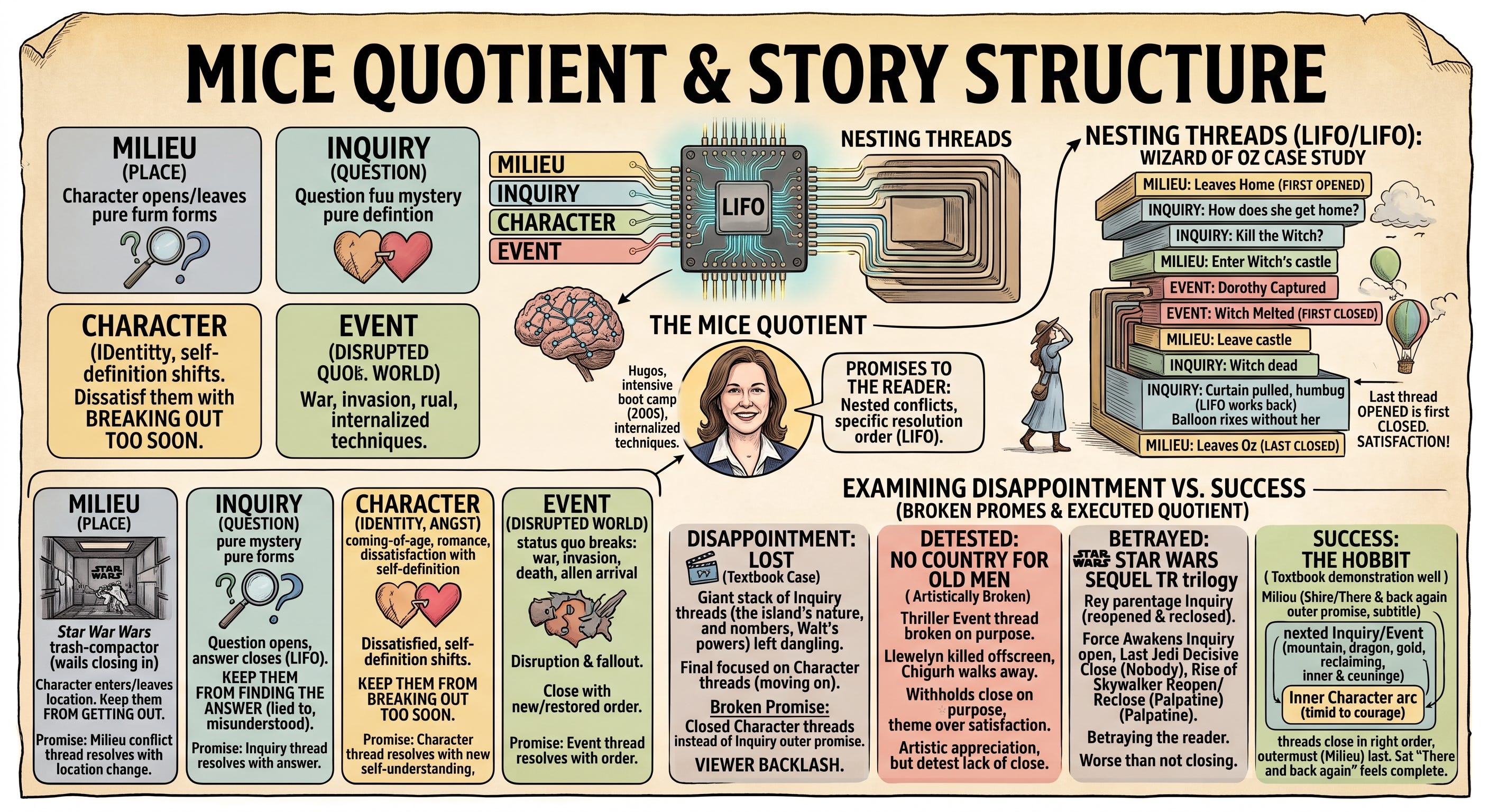
Why Writers Should Understand MICE
This week, what rodents have to do with writing and why understanding MICE can improve your story.
* Podcast audio files are AI generated using Gemini Notebook based off articles and content written by Jon C. Sulek, Creative Synthesis Editorial.
Works Referenced
On craft
Block, Lawrence. Telling Lies for Fun & Profit: A Manual for Fiction Writers. New York: Arbor House, 1981. A selection from Block’s monthly fiction column for Writer’s Digest, which he wrote for roughly fourteen years beginning in 1976.
Card, Orson Scott. How to Write Science Fiction and Fantasy. Cincinnati: Writer’s Digest Books, 1990. The origin of the MICE Quotient; in Card’s original framing the “I” stands for Idea.
King, Stephen. On Writing: A Memoir of the Craft. New York: Scribner, 2000.
Kowal, Mary Robinette. Talks and workshops on her expanded version of the MICE Quotient, in which the “I” becomes Inquiry. Also discussed on the Writing Excuses podcast (see episode 6.10, “Scott Card’s M.I.C.E. Quotient”).
Works discussed as examples
Star Wars (Episode IV: A New Hope). Directed by George Lucas. Twentieth Century-Fox, 1977.
The Wizard of Oz. Directed by Victor Fleming. Metro-Goldwyn-Mayer, 1939.
Lost. Created by J.J. Abrams, Jeffrey Lieber, and Damon Lindelof. ABC, 2004–2010.
No Country for Old Men. Directed by Joel and Ethan Coen. Paramount Vantage and Miramax, 2007. Adapted from the novel by Cormac McCarthy (Alfred A. Knopf, 2005).
Star Wars: The Force Awakens (2015), The Last Jedi (2017), and The Rise of Skywalker (2019). Lucasfilm / Walt Disney Studios.
Tolkien, J.R.R. The Hobbit, or There and Back Again. London: George Allen & Unwin, 1937.