“Spheres of influence” are hot again these days. Here’s what Secretary of State Anthony Blinken had to say about the controversial geopolitical concept, as it regards the showdown with Russia over Ukraine:
But look, the President’s been extremely clear for many, many years about some basic principles that no one is moving back on: the principle that one country does not have the right to change by force the borders of another; that one country does not have the right to dictate the policies of another or to tell that country with whom it may associate; one country does not have the right to exert a sphere of influence. That notion should be relegated to the dustbin of history.
And he’s right, it should be! The problem is that when you sift through that dustbin you find that U.S. power was built on all the things Blinken mentioned. That is especially true in America’s original—and still primary—“sphere of influence”: Latin America. (The U.S.’s continued dominance over the hemisphere is obvious to everyone outside our borders, including Vladimir Putin, which is why he appears so eager to seed discord in the region).
Take Panama. The Central American republic was created by the U.S. military (including, of course, Smedley Butler). In short, we intervened there on behalf of Panamanian separatists, hewing the isthmus Crimea-style from Colombia for the purpose of building the Panama Canal—the waterway through which much of America’s global military and commercial power would ultimately be established. Over the century since, U.S. presidential administrations have most certainly dictated our de facto client state’s policies, as well as deciding “with whom it may associate.” When Panamanian dictator Manuel Noreiga tried to pivot toward the Soviet bloc, President George H. W. Bush (who was, not for nothing, Noriega’s former boss at the C.I.A.), ordered a full-scale invasion to overthrow him in 1989.
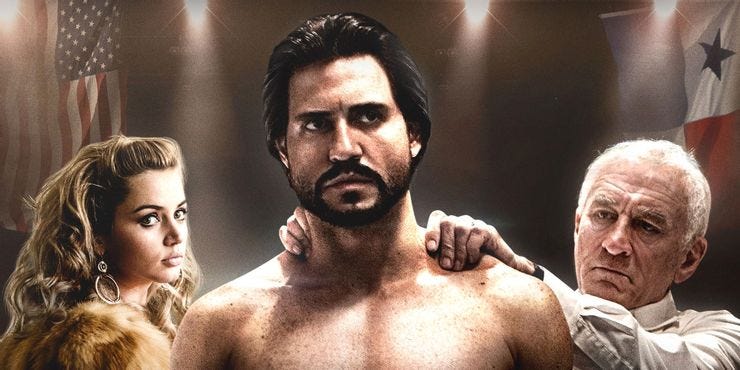
This week on Gangsters Movie Nights we discuss that history and more through the lens of … a boxing movie. Namely, Jonathan Jakubowicz’s 2016 drama Hands of Stone. A biopic of famed Panamanian boxer Roberto Durán, the film tries to divine the complex interior life of a man who grew up on the wrong side of U.S. imperialism (and the Canal Zone) and fought his way to becoming a four-time champion of the world. In so doing, the movie deals with—and in some cases re-enacts—some of the themes and scenes I talk about in Gangsters of Capitalism.
I’m joined for the conversation by my friend and political scientist Michael Paarlberg, a terrific thinker on Latin American policy and migration who spent much of his childhood living in Panama City.
To listen, just click the play button above. You can also download it, as well as past episodes, by searching for The Racket wherever you get podcasts (and please leave us a review if you do). A transcript is below. Thanks for listening.
The Racket is a reader-supported publication. To receive new posts and support my work, become a free or paid subscriber.
Thanks to everyone who has spread the word about Gangsters of Capitalism: Thanks to you, the book has now appeared for two straight weeks on the American Booksellers Association’s national bestseller list, as reported by independent stores nationwide. Please help keep the momentum going by buying the book from your favorite local indie.
The book is also being noticed by policymakers, including Rep. Ro Khanna, a Democratic congressman from California, who had this to say:
Episode transcript (may contain transcription errors)
Marine: Get off the fence.
Ray Arcel (Robert De Niro): Excuse me?
Marine: Get off the fence.
Arcel: Ah. Shut up, schmuck.
Marine: Who do you think you are, old man?
Arcel: I'm Ray Arcel from Harlem, USA. You know who that is? This is the future world champion you're talking to. [Beat] He's in a jail and he thinks he's in charge.
Roberto Durán (Edgar Ramírez): We in jail.
Arcel: No, he's in jail.
Durán: They put jail. Here.
Arcel: No, he, it's all in the head. Boxing is a mental sport.
Jonathan M. Katz: Que xopa, raqueteros. This is The Racket, a podcast and newsletter that you can find at theracket.news. I am Jonathan M. Katz. My book, Gangsters of Capitalism: Smedley Butler, the Marines, and the Making and Breaking of America's Empire is out in stores. Please go buy it. Tag me @katzonearth on Twitter and Instagram to share your photos of yourself and the book, or you and your dog in the book, or you and the kid in the book, or just you and multiple copies of the book, whatever you like.
The book is built around a biography of the imperialist Marine turned anti-war activist, Smedley Butler. It's gotten some great reviews, and Jacobin, Jonah Walters calls it an exhilarating hybrid of studious history and adventuresome travel log. Thank you, Jonah. Yes, that's what I tried to do for five years. I split my time between the archives and the airports traveling around the world, following in the footsteps of Butler and his generation of Marines and trying to explore the ways in which the memory of that era still influences attitudes and events today. Around the rollout, we here at The Racket are holding what we call Gangsters Movie Nights, in which I and a guest talk about a movie that deals with some of the themes and some of the places that I went in the book.
Today, we are going to Panama, a country that Smedley Butler not only went to, and not only lived in with his family, but helped create, as the United States helped Panama secede from Colombia in 1903, for the purposes of building the Panama Canal. As part of that deal, the American conspirators and one French guy wrangle control of a 10-mile wide colony surrounding the canal in which the United States would have all the rights, power, and authority, that's a quote from the treaty, as if it were "the sovereign of the territory." This new American colony essentially split the new country of Panama in half and it also created a deep sore in the Panamanian psyche, which is still in many ways open today.
To explore that history, we are of course watching a film about boxing. What other topic could you use to explore the issues of sovereignty and nationalism and imperialism? This one is Hands of Stone, a 2016 movie about the career of the legendary, and somewhat infamous, world champion boxer, Roberto Duran. The movie was directed by Jonathan Jakubowicz, a Polish-Jewish-Venezuelan. It stars Edgar Ramirez as Roberto Duran, Robert de Niro as his trainer Ray Arcel, Ana de Armas, as the love interest and Duran's wife, and the great leftist salsero Ruben Blades as a wealthy Panamanian backer. The Panamanian government actually helped finance the creation of the movie, which I think influenced the way that it got made and some of the content, as we will be discussing soon.
It's a boxing movie, but it deals with a surprising amount of Panamanian-American, Panama-US history in the 20th century, although a bit sloppily. To talk about it, I have invited Mike Paarlberg. Mike is an assistant professor in the Political Science Department at Virginia Commonwealth University in Richmond and an associate fellow at the Institute for Policy Studies in Washington, DC. He's written for a whole bunch of places, including the Guardian, Washington Post, and Foreign Policy on immigration, Central America, and topics like that.
He is currently writing a book on transnational elections and diaspora politics in Mexico, El Salvador, and the Dominican Republic. Mike is an old friend of mine who I know from when I lived in Washington many decades ago. He helped me with Gangsters because he helped introduced me to some people when I went down to Panama to do the research, because he lived in Panama for a time. Mike, welcome to The Racket.
Michael Paarlberg: Yeah. Thank you. It's a real pleasure to be here.
Jonathan: Can you tell us a little bit about your time in Panama, what you were doing there, and how you identify and what your relationship is with the country?
Michael: Yeah. Sure. I'm a political science professor. I do focus on Latin America and Central American, in particular. I lived in Panama as a kid. My father was a foreign service officer. He was a posted US Embassy, Panama. I was there for middle school and part of high school. I have to say, I am not Panamanian. I am American. I'm Korean-American, if that matters. I am coming at this as someone who has lived there, has some lived experience in Panama, but also as an outsider and someone who studies the region from a researcher's perspective. That's where I'm coming from and that's my interest. I'm glad I was able to help out in a small way with your book. It's really fascinating. Congrats on that.
Jonathan: You did. As I noted, my entire experience at Panama was going there for the book, other than I think once before that, I connected through the Panama City airport, as one often does. But when I was there, I traveled around. In my travels, I went to the neighborhood of El Chorrillo, which is the neighborhood that Roberto Duran grew up in. It's featured in this movie in Hands of Stone. I actually went to the gym that he trained in, which I believe I recognized, I think made a cameo, that gym in this movie.
Real fast, just to get everybody up to speed, and again, blanket warning, spoilers, if you want to go see Hands of Stone and not have it ruined for you, and you don't know anything about the history of Roberto Duran or the Panama Canal, go watch that. Hit pause. Come back. We're moving forward with some spoilers here. The plot of the movie is not particularly intricate. Basically, Roberto Duran grows up in El Chorrillo, which is a working class, poor neighborhood of Panama City, right next to the canal. And Ray Arcel, Robert de Niro sees him boxing, is enamored with his ring sense and his fighting style, chooses to help train him.
Duran initially refuses because he refuses to work with an American, but he eventually accepts de Niro's help. He becomes a champion of the world. He defeats Sugar Ray Leonard, who's played by Usher, and then Sugar Ray, Usher challenges him to a rematch. He's not ready for it because he's entered his decadent period of life. Most notoriously, the one thing that some people, at least people who don't remember him in his prime maybe know about Roberto Duran, is that he quits in the middle of that fight and says, or is said to have said, "No más," like he doesn't want to fight anymore. Then he redeems himself at the end, and there's an epilogue, and the movie is over.
Look, we could talk about the boxing, and I think there are actually some things to talk about there. But one of the more interesting things about the movie is that... And this surprised me. I knew that it would touch at least indirectly on themes of colonialism and American imperialism and Panama, but it does it very, very blatantly. There's a flashback at the beginning of the movie to January 9th, 1964. Mike, I don't know, for people who either haven't read Gangsters, I talk about the events of that day in the book, or seen the movie or know about it, tell us a little bit about what happened that day. Then let's talk about the way the movie dealt with it.
Michael: Yeah. That is, I'd say, the most notable event in the mid 20th century history of Panama and Panamanian relations with the US, because it is the event that led to the handover of the Panama Canal to the Panamanians. It is at this point not particularly controversial, but at the time, especially around the Carter administration, beginning the Reagan administration, it was a controversy. It was something that was seen as, I don't know, decline of US empire. Why is the US giving away this thing that they built?
In retrospect, it isn't a controversy, mostly, because the Panamanians at this point run the canal much better than it was ever run under the Americans. I think that's not just me saying this. I think any objective observer would say so. They actually improved the canal. They widened it so that larger ships can go through it. But what precipitated all this was famous moment in 1964, which is butchered, rather, by the movie, in which a number of patriotic Panamanian high school students went to raise a Panamanian flag on what was then US territory, the Panama Canal Zone.
A fight ensued between them and a number of American high school students who we would call Zonians—well, we can get into this—who did not want them to raise a flag on this territory. In the process, the Panamanian flag, which is a historic flag that had been used in previous protests, was torn. This became a huge controversy, led to an uprising by many Panamanians that did lead to a number of deaths, including of civilians, but also some Americans on the American side as well. As a result of this, the United States entered into negotiations with the Panamanian government, which eventually resulted in the signing the Panama Canal treaties between President Carter and Omar Torrijos, who was the military dictator of Panama at the time, but also a populist, and well-loved to this day by many Panamanians.
Jonathan: Let's talk really fast about Zonians. It's a really interesting thing. It's something that you see in other colonial spaces all over the world, the Pieds-Noirs war, the French in Tunisia, British Hong Kongers. I think that there are cousins of this elsewhere. During the lead-up to these flag riots, the US Army general who's in charge of the canal zone, Major General Robert Flemi