This is a free preview of a paid episode. To hear more, visit uncompressedintel.substack.com
Uncompressed Intel. Monday, October 19, 2026
The Map that Concentrates the Cash
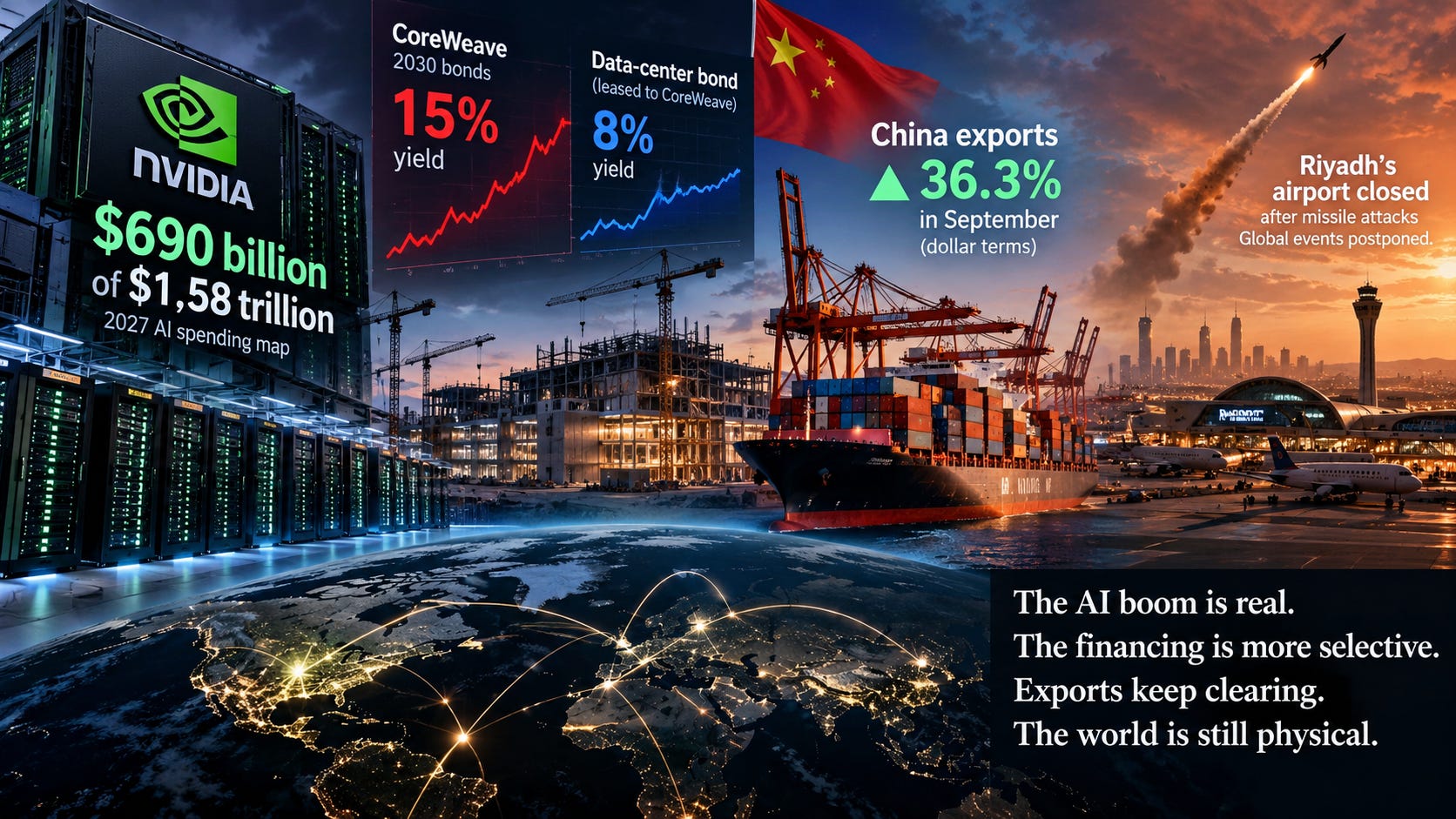
A chart mapping 2027 estimated hyperscaler and neocloud capital spending of $1.58 trillion into supplier revenues shows Nvidia set to receive $690 billion. The other 499 companies in the S&P 500 are set to receive $340 billion combined. Semiconductors and servers take $672 billion. Networking and optical take $215 billion. U.S. memory and storage take $217 billion. The figures are cash capex. Leases are aggregated separately. Certain high-bandwidth memory sales are excluded to avoid double counting what is already captured in AI chips.
One company is set to take twice what the rest of the index takes combined. The chart is a map of where the cash is going. It is not a map of who can pay it back.
Write down the $690 billion next to the $1.58 trillion. That is the concentration the bond market is now starting to price.
Fifteen Percent Versus Eight Percent
CoreWeave bonds due in 2030 now yield close to 15%. A bond issued last year to finance Applied Digital’s build-out of a North Dakota data center leased to CoreWeave currently yields around 8%. Lotfi Karoui, multiasset strategist at Pimco, said the AI trade in credit is not one big trade. There is going to be differentiation.
Data-center issuers have raised more than $100 billion in the U.S.-dollar bond market this year through October 16, about 25% of AI-related gross issuance in U.S. currency, up from around 16% the prior year. When the data center is leased to a hyperscaler like Microsoft, which remains one of the few triple-A rated companies, the financing bonds still trade at a higher yield than the tenant’s own bonds because the building might not be completed. CoreWeave’s own bonds are junk-rated. The data-center bonds that depend on its leases still trade tighter than CoreWeave’s corporate paper.
The market is more worried about the company that rents the building than about the building itself. 15% is the price of the tenant. 8% is the price of the lease. The gap is the size of the argument.
Write down the 15% next to the 8%. That spread is what the bond market is saying about who holds the residual risk.
Four Point Five Percent and the Parts that Leave
China’s National Bureau of Statistics reported third-quarter growth of 4.5% from a year earlier, up from 4.3% in the second quarter. Economists had forecast 4.4%. Growth for the first nine months was 4.6%. Exports of goods rose 16.4% in the first three quarters. Mechanical and electrical products grew 23.7%. September exports rose 29.6% in yuan terms. In dollar terms, September exports jumped 36.3%, and the month’s trade surplus set a new high of $133.5 billion. Demand for components used in data centers and AI infrastructure helped drive the gain. The cumulative surplus for January through September was $938 billion.
Domestic indicators were weaker. Fixed-asset investment contracted 7.2% over January through September. Investment in real estate development fell 20.6%. The value of newly built commercial building sales fell 13.9%. The bureau said domestic demand is still notably short.
The export number is the one that clears. The real estate number is the one that does not. 4.5% is the growth that is still being shipped. 20.6% is the investment that is still falling at home.
The part worth writing down is the distance between the components that are leaving the country and the buildings that are not being started inside it.
The Events that Require an Airport
Houthi ballistic missile attacks on Saudi Arabia have become almost daily. Riyadh’s international airport has remained closed. Flight suspensions have had a domino effect. Strikes out of Yemen have killed at least 20 people and injured almost 400 since October 6. The kingdom has been forced to cancel or postpone a series of high-profile events. The EU-Gulf summit set for October 24 in Riyadh was postponed with no new date. The FIFAe Finals esports tournament was postponed. The Six Kings Slam tennis exhibition with Novak Djokovic and Carlos Alcaraz was pushed from October to late December. The Red Sea International Film Festival was postponed to late 2027. The Future Investment Initiative, still set for October 26-29, is moving to a hybrid format so executives can join remotely. Saudi Arabia’s sovereign wealth fund plans to drop five proposed new stadiums for the 2034 World Cup.
Vision 2030 was the plan to diversify away from oil. The missiles are the constraint that is still arriving. 20 dead is the human number. The postponed summit is the commercial number.
If this is your calendar, the practical question is whether the hybrid format is a temporary patch or the new baseline for events that require a physical airport.
I. Macro Reality
Nvidia is set to take $690 billion of the $1.58 trillion. CoreWeave bonds yield near 15%, while the data center bond that depends on its lease yields around 8%. China grew 4.5% on exports, while real estate investment fell 20.6%. Riyadh’s airport is still closed.
If you price a building, underwrite a lease, or run a system that still has to clear a real number, the paid half is the $10 trillion infrastructure boom that is starting to fray, the agents that have 9 million downloads in the U.S. and Canada but may widen the gap where only 36% of people are online, and the 5% of shares Anthropic is putting into a public benefit fund.
👉 [Upgrade to Uncompressed Intel Daily & Join the Mastermind Cohort]