This is a free preview of a paid episode. To hear more, visit uncompressedintel.substack.com
A $20B star AI hedge fund unwinds its public equities portfolio; DeepSeek’s founder admits Chinese labs remain years behind on compute, and SpaceX targets America’s mobile carriers.
This is the uncompressed data wire for Thursday, July 30, 2026.
We open today’s briefing tracking an unprecedented leverage collapse across AI equity positions, alongside a landmark move by SpaceX to disrupt traditional mobile telecommunications.
I. The Macro Reality: The $20B Leverage Unwind & DeepSeek’s Hardware Confession
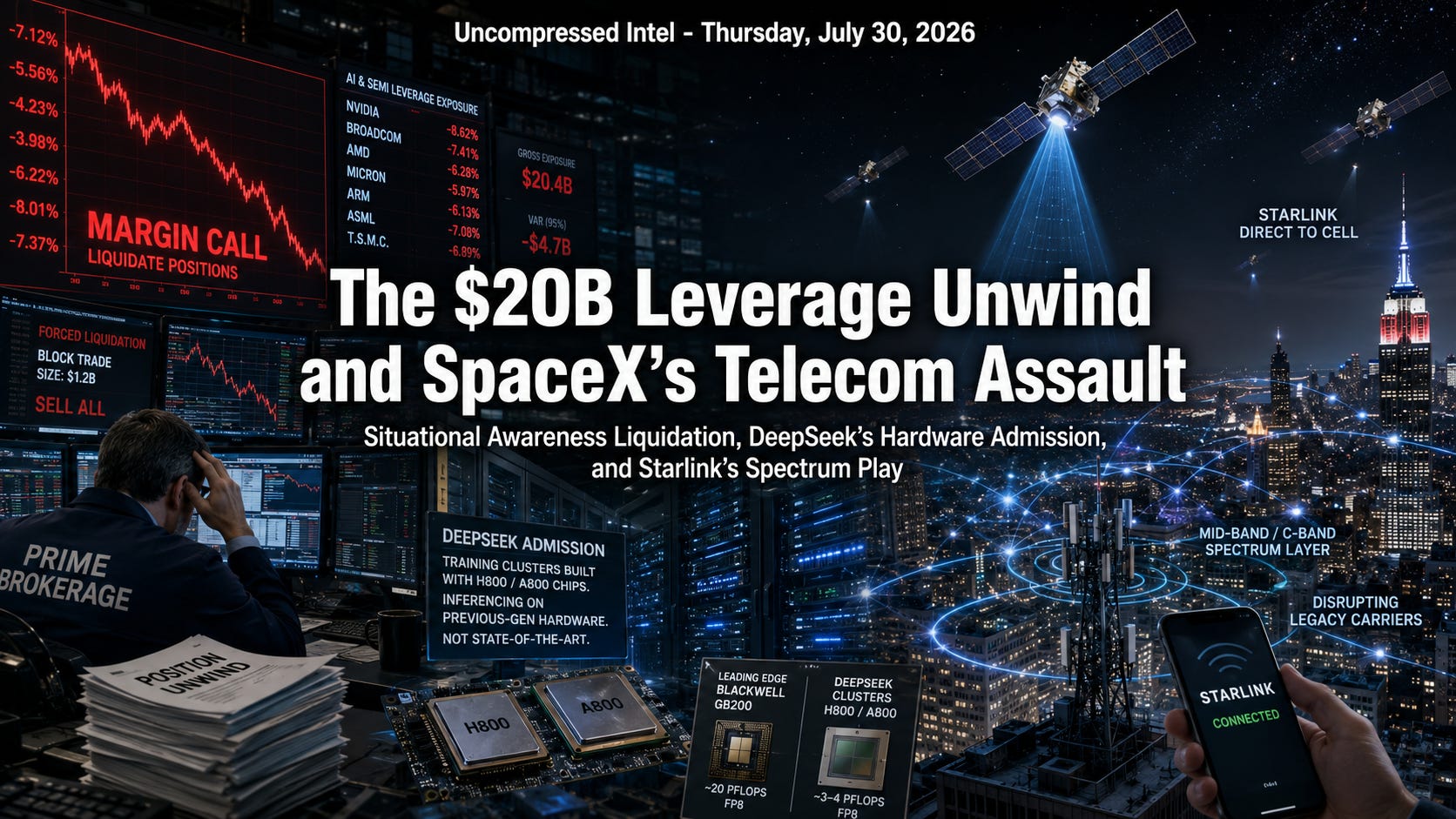
Look at the extraordinary liquidation event unfolding across Wall Street’s prime brokerage desks. Situational Awareness—the $20 billion AI-focused hedge fund launched by former OpenAI researcher Leopold Aschenbrenner—liquidated its entire public stock portfolio in a single massive block trade to satisfy prime broker margin requirements.
Prime brokers including Goldman Sachs, Bank of America, and JPMorgan Chase executed the trade after the fund suffered drawdowns exceeding 50% month-to-date. Core holdings in AI infrastructure providers collapsed under Total Return Swap (TRS) leverage, including Nebius Group (-48%), Sandisk (-56%), and SK Hynix (-45%). To raise emergency liquidity, Aschenbrenner has even begun seeking buyers for private stakes, including the fund’s early position in Anthropic.
The TRS Leverage Trap:
TRS Swap Leverage ==> Hyperscaler CapEx Panic ==> Hedge Fund Margin Calls ==> Multi-Billion Block Liquidation
Simultaneously, the “DeepSeek Efficiency Myth” has unraveled. Chinese AI startup DeepSeek abruptly paused its $7.4 billion fundraising round (at a $74B valuation) after a leaked transcript of founder Liang Wenfeng’s private investor briefing hit GitHub.
Liang admitted that Chinese AI developers operate 1 to 2 years behind US rivals with only 1/20th of the compute capacity. Crucially, Liang disclosed that DeepSeek was forced to acquire “noncompliant” (smuggled) Nvidia chips to train its models, noting that Huawei’s Ascend 950 processors are so inefficient that it takes four Huawei chips to match a single Nvidia GPU.
II. The Telecom Disruption: SpaceX Targets AT&T, Verizon, and T-Mobile
While traditional financial institutions struggle with tech debt, SpaceX is preparing a direct assault on America’s mobile carriers.
According to an exclusive scoop by Semafor, SpaceX is actively hunting for mid-band and C-band airwaves to fill the city and indoor coverage gaps in its Starlink Direct-to-Cell network. The company is evaluating competitor acquisitions and preparing to bid aggressively in next year’s federal spectrum auction to build out a full-service, hybrid satellite-terrestrial cellular network.
SpaceX Mobile Disruption:
Starlink Orbit + Terrestrial Spectrum ==> Lower Cost of Capital ==> Auction Bidding Pressure ==> Carrier Disruption
Shares of AT&T, Verizon, and T-Mobile slid 4% following the report. Legacy carriers—already burdened by massive debt loads and high capital costs—face an existential choice: absorb unsustainable debt to outbid Elon Musk for C-band spectrum, or be forced into strategic asset sales.
This move directly connects to Alphabet’s recent SEC disclosure of its $94.1 billion (6%) stake in SpaceX, as well as prototype mobile handset demonstrations led by SpaceX President Gwynne Shotwell.