This is a free preview of a paid episode. To hear more, visit uncompressedintel.substack.com
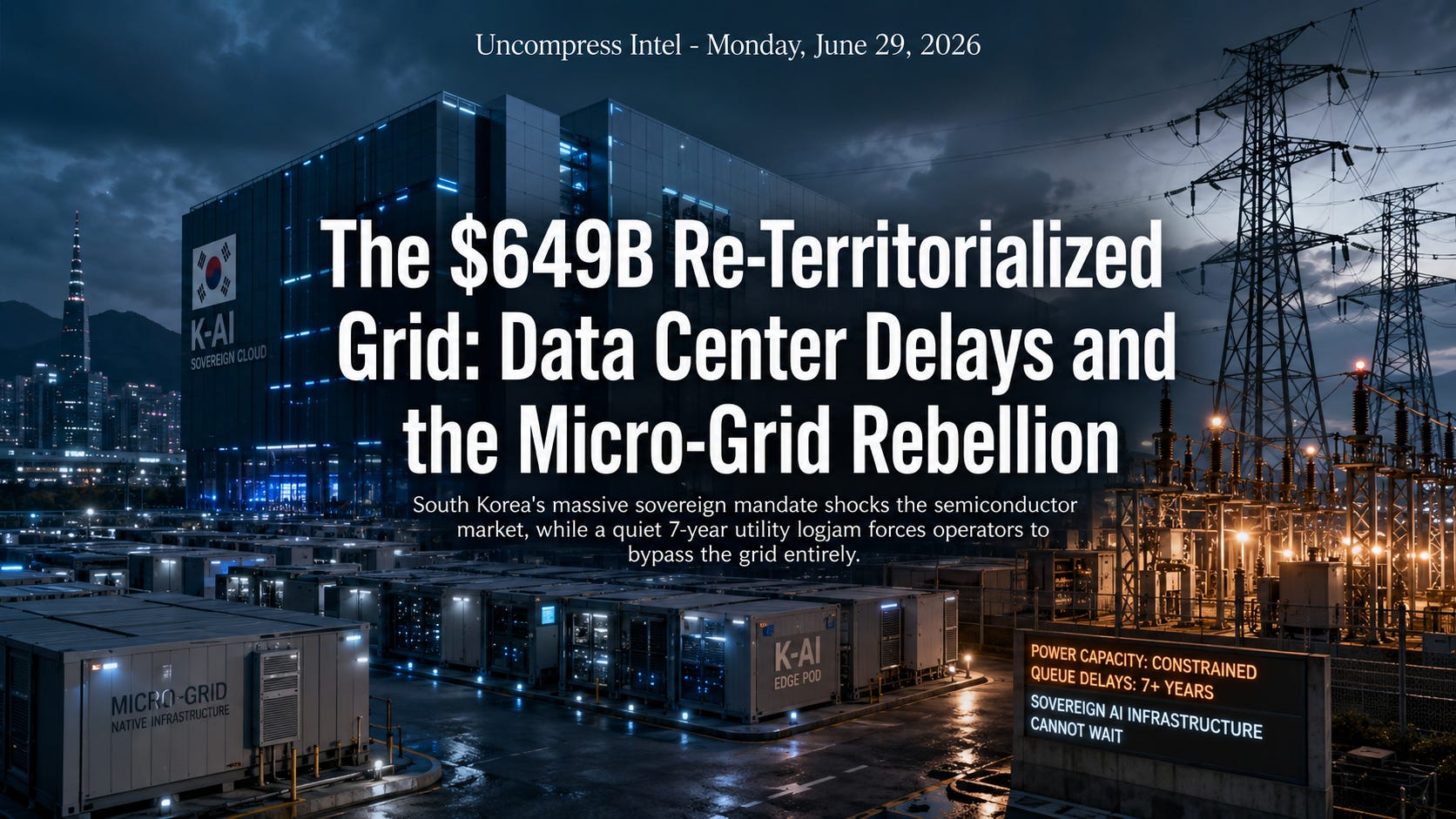
South Korea’s massive sovereign mandate shocks the semiconductor market, while a quiet 7-year utility logjam forces operators to bypass the grid entirely.
This is the tracking data for Monday, June 29, 2026.
We are opening the operational week with an absolute house fire in the global tech markets. If you are still running your company under the illusion that the cloud is a borderless, infinite digital utility, today’s news is a violent wakeup call.
I. The Macro Reality: The Re-Territorialized Grid
Over the last twelve hours, the concept of borderless computing was officially dismantled by a massive, nation-state technology mandate.
South Korean President Lee Jae-myung shocked the markets by unveiling a staggering, 1,000 trillion won—that’s $649 billion—public-private mega-project. Orchestrated alongside chip giants Samsung and SK Group, this massive initiative is explicitly engineered to build a hyper-localized semiconductor, AI data center, and advanced robotics hub in the Honam region.
The market reaction was immediate and brutal. Samsung shares plummeted 4.8%, and SK Hynix fell 1.7% in a single trading session as international investors panicked over the sheer scale of physical capital expenditure required to survive.
Governments are moving completely past standard corporate subsidies—they are actively nationalizing and re-territorializing the raw physical stack to insulate their sovereign economies. The global cloud is fracturing into heavily armed geographic fortresses.
But the sovereign border war is only half the crisis hitting your runway this morning. While governments lock down the physical stack abroad, a quiet, devastating infrastructure failure has just paralyzed the domestic enterprise pipeline.
A newly released industrial study by Sightline Climate confirms that 30% to 50% of all utility-scale AI data centers scheduled to open globally in 2026 are officially delayed. Out of 16 gigawatts of announced compute capacity, a meager 5 gigawatts is actually under construction.
In critical enterprise hubs like Northern Virginia, Phoenix, and Dallas, grid interconnection wait times have ballooned to a crushing four to seven years. The core constraint isn’t capital allocation or chip design—it is raw electrical infrastructure, transmission capacity, and utility grid inertia.
If you are relying on standard multi-tenant cloud providers right now, you aren’t just lagging behind—you are trapped in a multi-year waiting queue.
👉 [Upgrade to Uncompressed Intel Daily & Join the Mastermind Cohort]
II. The Enterprise Flank: Bypassing the Interconnection (Premium)