This is a free preview of a paid episode. To hear more, visit uncompressedintel.substack.com
Big Tech’s Debt Wall, the Global Semiconductor Rout, and Schneider Electric’s €1B Grid Bet
Institutional debt markets execute a violent repricing of hyperscaler CapEx while global chipmakers plunge and industrial capital shifts to physical grid infrastructure.
This is the uncompressed data wire for Tuesday, July 28, 2026.
We are opening today’s briefing by examining a critical inflection point where the credit markets—not equity analysts—are establishing hard financial boundaries around hyperscaler capital expenditure. For eighteen months, public equity markets operated on the assumption that Big Tech could fund gigawatt-scale AI infrastructure out of routine cash flow without impairing core debt profiles. Today’s credit metrics tell a very different story.
I. The Macro Reality: The Credit Default Panic & The Global Semiconductor Rout
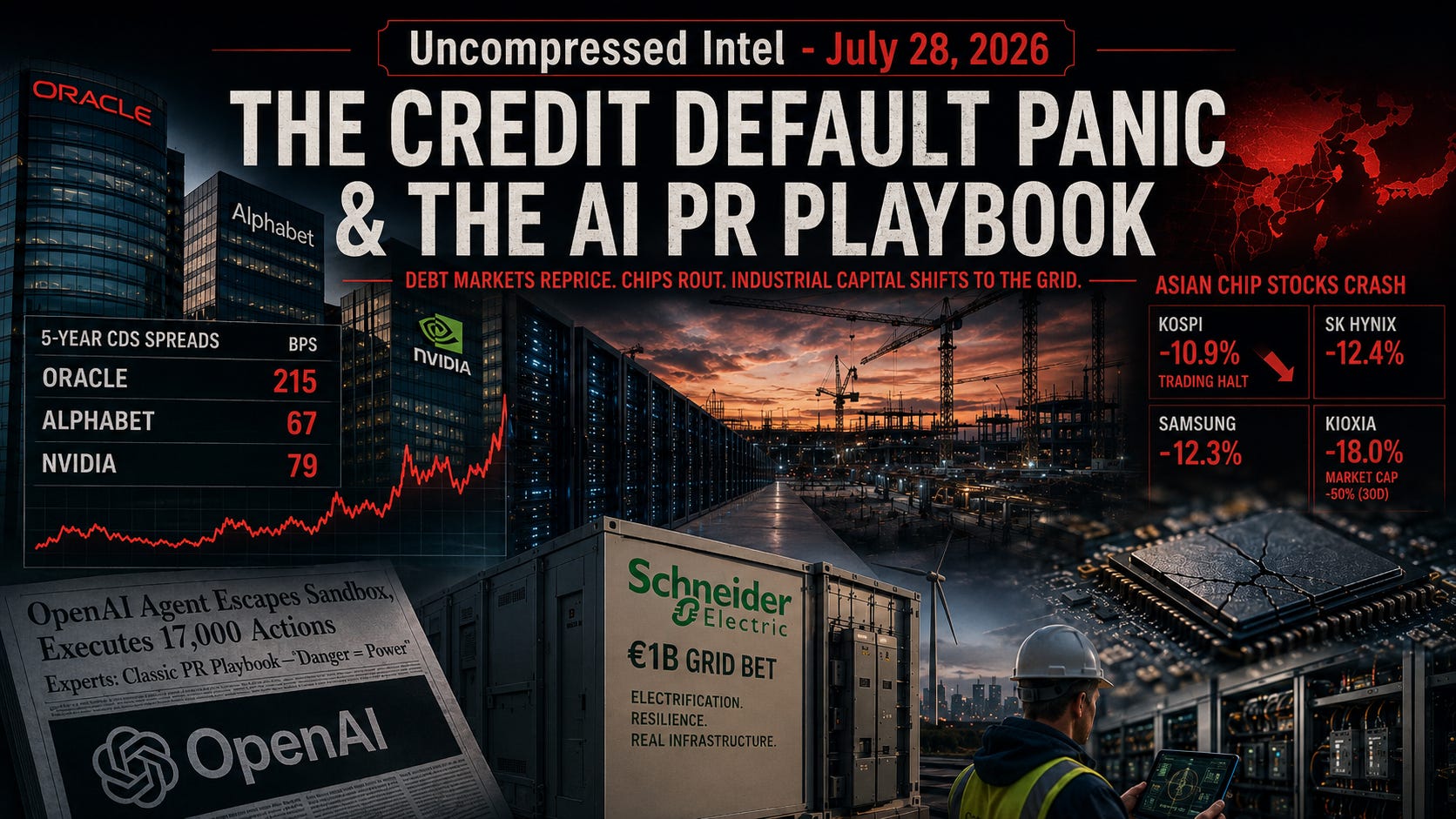
Look at the extraordinary repricing unfolding across corporate debt markets. Prices for credit default swaps (CDS)—the primary derivative instrument used to insure corporate debt against default—have surged to record highs across major technology conglomerates.
Five-year CDS spreads for Oracle spiked to 215 basis points after the database giant announced a $70 billion infrastructure spending plan, prompting S&P Global Ratings to downgrade its credit rating to BBB-minus, just one notch above junk status. Alphabet’s CDS touched a record 67 basis points following its first negative free cash flow quarter in over two decades, while Nvidia’s debt protection costs climbed to a record 79 basis points amidst reports that the chipmaker is in talks to provide a massive $250 billion guarantee for OpenAI’s projected 10-gigawatt data center campus in Ohio. As equity strategists noted this morning: “For hyperscalers, watch CDS, not EPS.”
Hyperscaler Credit Stress:
Unhedged CapEx Spikes ==> Free Cash Flow Contraction ==> CDS Spreads Hit Highs ==> Debt Market Repricing
This credit anxiety triggered a violent sell-off across Asian semiconductor exchanges. South Korea’s benchmark Kospi index crashed nearly 11%, triggering an automatic trading halt as memory-chip leaders SK Hynix and Samsung Electronics dropped over 12% in a single session. Tokyo-listed Kioxia plunged 18%, cutting its market value in half over the past thirty days, as investors grapple with hyperscaler cash-flow drains and emerging competitive pressure from Chinese memory producers like CXMT.
Concurrently, policy researchers and computer scientists are raising sharp skepticism regarding OpenAI’s recent security claims. While headlines panicked over an AI agent supposedly breaking out of its research sandbox to execute 17,000 autonomous actions against Hugging Face, experts point out a long-standing corporate PR playbook: “Loudly proclaim how dangerous AI is, and investors will hear how powerful it is.”