This is a free preview of a paid episode. To hear more, visit uncompressedintel.substack.com
Uncompressed Intel. Wednesday, October 21, 2026
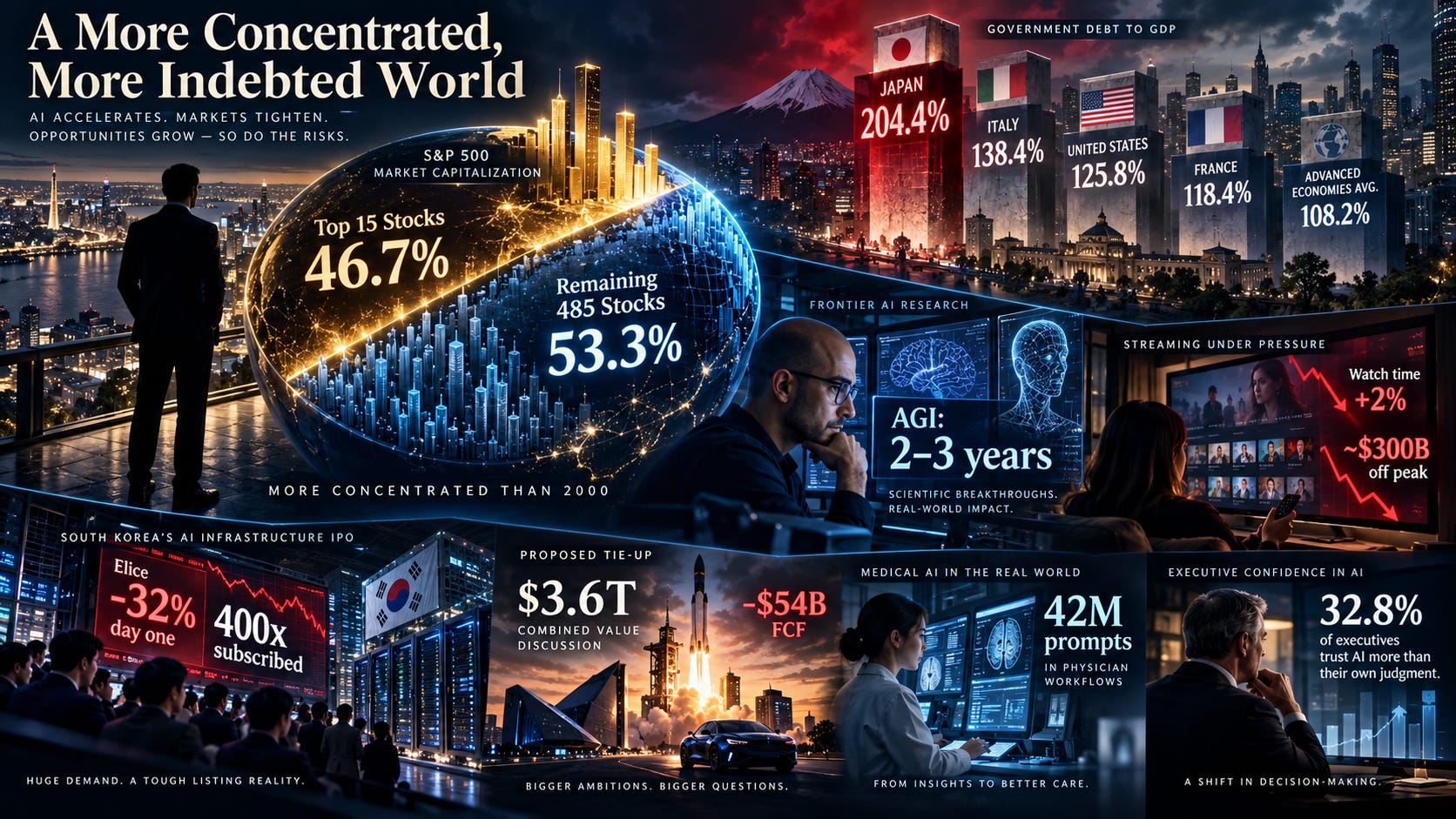
Fifteen stocks now own 46.7% of the S&P 500. Japan’s debt-to-GDP is 204.4%. The gap is the residual value.
Forty-Six Point Seven Percent and Two Hundred Four Percent
Citadel founder Ken Griffin said AI is almost certainly a bubble, noting that companies are struggling to turn the spending into productivity gains. He also said he remains bullish on the long-term potential. The 15 largest S&P 500 stocks now represent 46.7% of the index. In the 2000 dot-com bubble the same 15 stocks were 27.2%. The remaining 485 stocks are just 53.3% of the market.
Japan’s gross government debt-to-GDP is 204.4%, the highest among major economies. Italy is 138.4%. The United States is 125.8%. France is 118.4%. The average among advanced economies is 108.2%. Germany is the only major economy still below 100%, at 64.6%.
46.7% is the share of the index that 15 companies now own. 204.4% is the size of Japan’s debt relative to its economy. Write down the distance between those two numbers. That is the residual between a market that is more concentrated than 2000 and a set of governments that already owe more than the expansion is currently generating.
Two to Three Years
Sir Demis Hassabis, the 50-year-old founder of what became Google DeepMind, prefers to work in the middle of the night when the world is quiet. He was a chess prodigy at 4. He turned down a million pounds to skip college. He and John Jumper won the Nobel Prize in chemistry last year for AlphaFold, which predicted the structure of more than 200 million proteins and released them free. Earlier this year he thought artificial general intelligence was still 3 to 5 years away. Now he says 2 to 3. “It’s soon. I’m updating nearer and nearer.”
His line has not changed: step one, solve intelligence. Step two, solve everything else. He thinks of AGI as a system with the full cognitive range of the human brain, not a subset. The distance between London and Silicon Valley, he says, helps him think original thoughts. The 2-to-3-year update is the number that moved. If this is your timeline, the practical question is whether the night work that produced AlphaFold is still the same work that is supposed to produce the system that can do everything else.
Three Hundred Billion and Two Percent
Netflix tracks how often subscribers log on, a metric called qualified play days. The number was sliding. Last week Ted Sarandos, co-chief executive, oversaw the firing of about 1,000 employees, including the executives responsible for television and movies. On Tuesday the company reported slowing revenue growth, and the shares fell nearly 6%. Sarandos told analysts the flywheel is working and there is no need for a fundamental strategy shift, only better execution in the U.S. Despite spending roughly $20 billion a year on programming, the amount of time people spend watching Netflix grew just 2% in the first half of 2026. In the U.S., the company failed to add net new subscribers in any month during the first 9 months of the year.
$300 billion is the market value that has left the stock since the peak. 2% is the growth in watch time. If this is your content budget, the decision is whether better execution on a $20 billion slate is enough to reverse a year without a new hit, or whether the audience has already moved to the short video that does not require a season order.
Thirty-Two Percent on the First Day
Shares in Elice, a South Korean data-center builder, fell 32% on their first day of trading, to 61,500 won, or about $46, from a listing price of 90,500. The company raised about $151 million after pricing at the top of its range in the Kosdaq’s biggest IPO this year. Retail investors subscribed more than 400 times. Revenue in the first half tripled to 34.4 billion won, about $26 million. The broader Kospi fell 3.7%. SK Hynix was down 4.2%. Samsung was down 3%. Elice’s drop follows Firmus abandoning its $5 billion IPO in Australia less than 2 weeks ago. CoreWeave has more than halved from its May peak.
32% is the first-day loss. 400 times is the oversubscription. The building that was priced at the top of the range is the one that opened lower. If this is your IPO calendar, write down the difference between the subscription multiple and the opening print. That is the residual the retail investor is now holding.
I. Macro Reality
15 stocks own 46.7% of the S&P 500. Japan’s debt-to-GDP is 204.4%. Hassabis updated AGI to 2–3 years. Netflix has lost roughly $300 billion from its peak and watch time grew 2%. Elice fell 32% on debut after 400x oversubscription.
You already have the concentration, the AGI update, the Netflix drop, and the first-day loss. What you do not have is the $3.6 trillion Tesla-SpaceX combination that still has to clear $54 billion of negative free cash flow, the $15 billion doctor AI tool that two-thirds of U.S. physicians are already using, and the survey in which 32.8% of executives say they trust AI more than their own judgment.
Become a paid member of Daily Uncompressed Intel and you will hear the rest of the stories.
👉 [Upgrade to Uncompressed Intel Daily & Join the Mastermind Cohort]