This is a free preview of a paid episode. To hear more, visit uncompressedintel.substack.com
While the software layer panics over exploding multi-turn agent bills, the ultimate competition has moved to a raw, kinetic land grab for grid-tied real estate.
This is the uncompressed data wire for Tuesday, July 14, 2026.
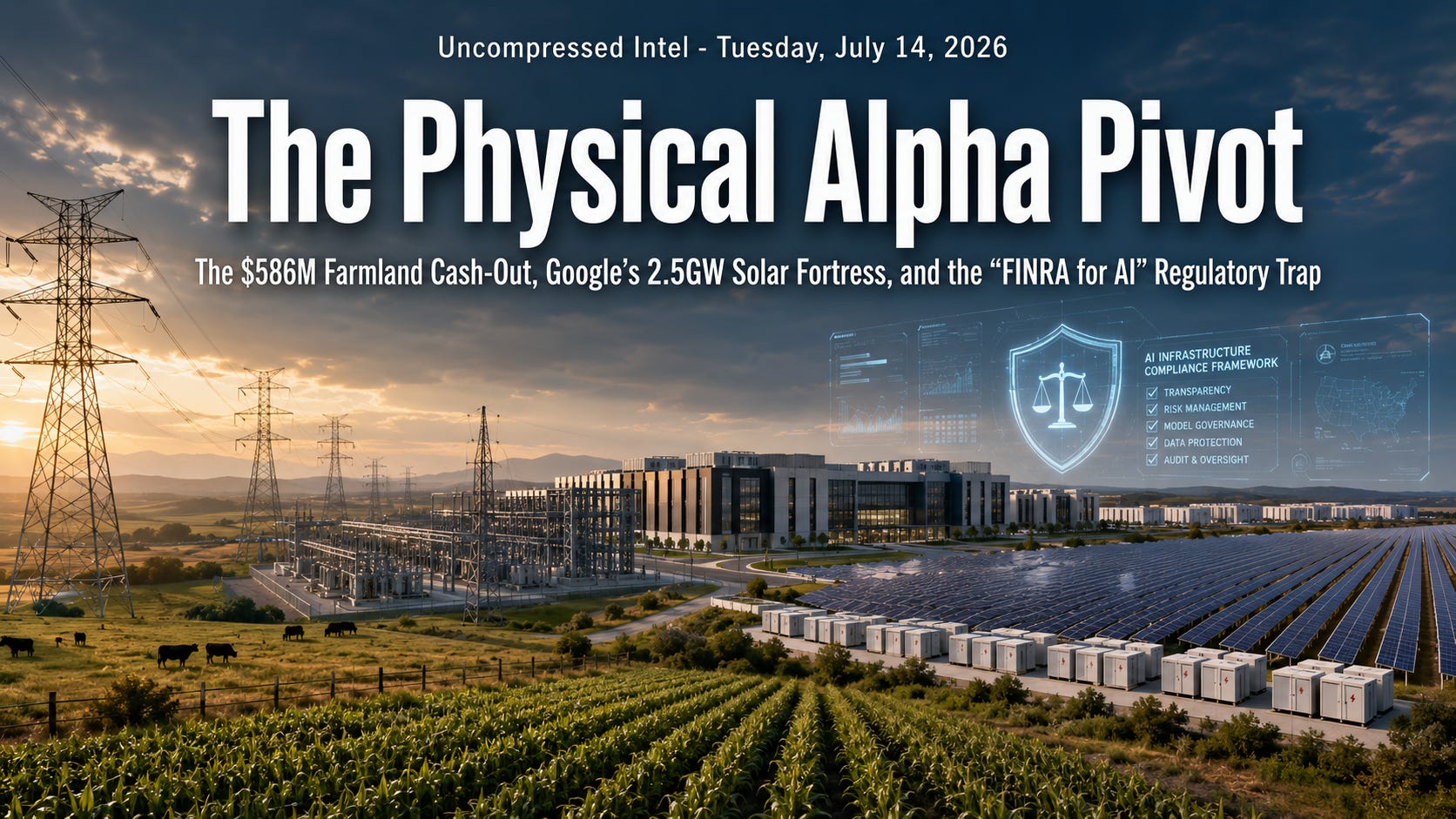
The mainstream consensus has spent the last three years treating artificial intelligence as an abstract game of borderless code and digital software iteration. But behind the marketing smoke and mirror benchmarking, the actual playground has silently transformed into a fierce, kinetic struggle to lock down physical acreage, localized grid attachments, and sovereign energy inputs. If your long-term operational map doesn’t calculate the skyrocketing fixed costs of the physical stack, you are measuring your runway on a ghost asset class.
I. The Macro Shock: The Grid Real Estate Bonanza
Consider the raw capital realignment taking place in America’s industrial interior. In Salem Township, Pennsylvania, an unassuming group of 96 rural families—many living in modest double-wide trailers and managing struggling livestock farms—just collectively finalized the sale of 1,700 acres of agricultural land to data-center developer QTS, an arm of Blackstone, for a staggering $586 million. The deal values simple fields at an average of $330,000 per acre, completely independent of underlying oil or natural gas reserves.
This dirt commands a premium entirely because of its structural grid positioning. The tract is uniquely situated within a sloping valley directly bordered by ultra-high-voltage transmission corridors and substation infrastructure built to feed a neighboring natural gas facility and a major nuclear plant. By assembling this contiguous pocket, the buyers bypass the catastrophic local bureaucratic bottlenecks that tie up new power approvals for years. The land rush is expanding exponentially: right next door, an organized syndicate of 200 additional property owners has already consolidated their holdings to eye a massive, follow-up $1.3 billion cash-out.
The ultimate leverage belongs to the operators who recognize that brilliant software means nothing if you can’t guarantee the physical juice required to run the cluster.