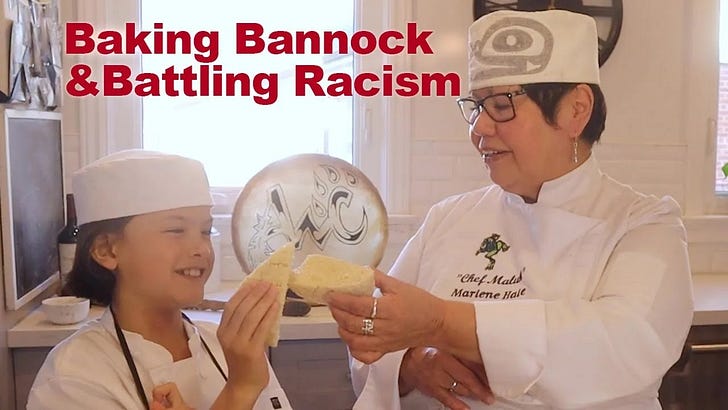
In this episode of Habibti Please, Nashwa was joined in person by Wet’suwet’en Matriarch, activist, filmmaker, chef, and community organizer Marlene Hale, in Montreal last May. Marlene is the founder of Our Decision, Our Future, now evolving into Beyond the Ballot, and is currently working on a documentary film examining systemic racism, land defense, and Indigenous resistance across so-called Canada.
The conversation centres Matriarchy as a lived role, shaped through mentorship, listening, and accountability to land, people, and future generations. Moving between Wet’suwet’en feast house protocols, food sovereignty, climate justice, youth political organizing, and Bannock as pedagogy, Marlene offers a grounded vision of leadership rooted in care instead of hierarchy.
Rather than treating matriarchy as symbolic or historical, this episode understands it as active governance, survival, and responsibility, carried through everyday practices and intergenerational relationships.
This episode offers many learnings. Marlene generously explains that becoming a matriarch is not automatic or symbolic, it is a lifelong process of being mentored by grandmothers, mothers, and aunties. Knowledge is passed through observation, correction, and presence, beginning in childhood and continuing throughout life. She also describes feast houses as places where governance is learned through protocol, seating, service, and respect. Young people learn by watching elders closely, understanding roles, and asking questions when guided to do so. As mentioned in the episode, I first met Marlene in May 2025 during a rally at Montreal’s Cabot Square to honour missing and murdered Indigenous women and girls.
Although I have long been honoured to do work with and alongside Indigenous people I had rarely heard the kinds of connections Marlene made to pipelines and Missing and Murdered Indigenous women. Marlene connects resource extraction projects and, increased violence against Indigenous women. logging roads, and man camps to broader forms of harm: disrupted animal migration, food insecurity, environmental risks These are not separate issues, but interconnected outcomes of extractive systems.
Marlene reflects on how families once lived off the land year-round through hunting, fishing, drying, and berry picking,canning while today, forest fires, industrial development, and ecological destruction have made those practices difficult, forcing people far from their territories. To close we talk about a project Marlene spearheads Our Decision, Our Future and how it grew into Beyond the Ballot Box after witnessing deep political alienation among young people. Voting, she emphasizes, is only one step, while real democracy requires ongoing accountability to youth whose futures are most at stake.
Throughout the conversation, Marlene stresses that Youth and Elders. Elders create time and space and experience; Youth bring urgency serious issues and imagination, and each share stories. Marlene returns often to awareness: ofLand, Food Systems, and people, and as a form of survival and responsibility in a rapidly changing and often hostile political environment.
Film & Ongoing Work
Marlene is currently filming a documentary film grounded in years of organizing, The film examines systemic racism across health, education, justice, and environmental systems, while situating Wet’suwet’en struggle within global Indigenous movements.
Furthermore, since the pandemic hit,she has been raising awareness through her weekly webinar series, “Marlene Webinars Solidarity Action Group”. She has created this space for youth, elders, activists and more to share news and support each other through the many issues to its depth.
Follow & Support Marlene Hale
● Website: www.ourdecisionourfuture.ca
* https://chuffed.org/project/126670-our-decision-our-future
● Instagram: @OurDecisionOurFuture
● Bio: Marlene Hale - Our World
● Webinar: Marlene Solidarity Webinar
● Film: chefmaluh.ca
Video Interviews, Talks & Panels
Baking Bannock & Battling Environmental Racism with Marlene Hale.
POP Symposium – Day 3: Marlene Hale & Stefan ChristoffThe Artist’s Role in Indigenous Land Struggles.
Marlene Hale Solidarity Update.
Additional Talk on Indigenous Struggle & Resistance.
Wet’suwet’en Chef, Turned Activist in Quebec Ready to Take on the Politicians.(APTN News – video)
https://www.aptnnews.ca/national-news/wetsuweten-chef-turned-activist-in-quebec-ready-to-take-on-the-politicians-to-get-answers-for-her-people-in-b-c/
Further Reading & Viewing
A curated list to deepen the themes of matriarchy, Indigenous feminism, land defense, food sovereignty, and political accountability discussed in this episode.
Indigenous Matriarchy & Women’s Leadership
Reid, Teela. “The Power of the First Nations Matriarchy: Warrior Women Reckoning with the Colony.” Griffith Review.https://www.griffithreview.com/articles/the-power-of-the-first-nations-matriarchy/
Murray, Roxann. “The Healing Power of Matriarchs.” YES! Magazine, 2024.https://www.yesmagazine.org/opinion/2024/04/22/women-native-healing-matriarch
“Indigenous Matriarchal Traditions: A Tribute for Women’s History Month.” Owamniyomni.https://owamniyomni.org/2024/03/21/indigenous-matriarchal-traditions-a-tribute-for-womens-history-month/
Hale, Marlene. “The Making of a Matriarch.” BILD-LIDA.https://bild-lida.ca/blog/uncategorized/the-making-of-a-matriarch-by-marlene-hale/
Indigenous Feminism, Care, & Knowledge Practices
Tuck, E., Stepetin, H., Beaulne-Stuebing, R., & Billows, J. (2022).“Visiting as an Indigenous Feminist Practice.” Gender and Education.https://poche.mdhs.unimelb.edu.au/__data/assets/pdf_file/0009/4740723/2022-Tuck,-E.,-_Stepetin,-H.,-_Beaulne-Stuebing,-R.,-_-_Billows,-J.-2022.-Visiting-as-an-Indigenous-feminist-practice.-Gender-and-Education,-1-12.pdf
“An Indigenous Feminist Commemoration of Canada 150.” University of Winnipeg — Weweni.https://www.uwinnipeg.ca/indigenous/weweni/past-wewenis/an-indigenous-feminist-commemoration-of-canada-150.html
Palmater, Pamela. “#MeToo and the Secrets Indigenous Women Keep.” The Walrus.https://thewalrus.ca/metoo-and-the-secrets-indigenous-women-keep/
Law, Governance & Indigenous Feminist Frameworks
This section brings together Indigenous feminist scholarship that interrogates how law, governance, and state systems shape and often enable violence against Indigenous women, girls, Two-Spirit, and gender-diverse people. These works are essential for understanding why extractive projects, policing, and jurisdictional gaps continue to produce harm, and how Indigenous feminist legal thought offers pathways toward accountability, relational governance, and land-based justice.
Deborah McGregor — Indigenous Feminisms, Environmental Justice, and the Law
In this work, Deborah McGregor advances Indigenous feminist approaches to law and environmental governance. McGregor demonstrates how settler legal systems and extractive governance models marginalize Indigenous women’s authority, responsibilities to land, and knowledge systems, while reproducing colonial and gendered violence. Her work is foundational for understanding how environmental decision-making, resource extraction, and legal regimes intersect with the MMIWG2S crisis.https://digitalcommons.osgoode.yorku.ca/scholarly_works/2924/
Cherry Smiley — Indigenous Feminism, Colonial Violence, and Resistance
In her doctoral research, Cherry Smiley offers a rigorous critique of how colonial governance, state feminism, and liberal legal frameworks obscure and perpetuate violence against Indigenous women. Smiley centers Indigenous feminism as a site of political resistance, challenging racialized and patriarchal narratives while foregrounding Indigenous women’s leadership in struggles against sexual violence, disappearance, and state harm.https://spectrum.library.concordia.ca/id/eprint/990510/
Pipelines, Man Camps & Violence Against Indigenous Women
Content note: The following resources discuss colonial and gender-based violence, sexual violence, disappearance, and murder of Indigenous women, girls, Two-Spirit, and gender-diverse people. We share these readings to deepen understanding of the structural conditions that create harm and to honour the leadership and analysis of Indigenous communities.
This set of readings explores how resource extraction projects, particularly pipelines and associated “man camps” intersect with the ongoing crisis of Missing and Murdered Indigenous Women, Girls, Two-Spirit, and gender-diverse people (MMIWG2S). Together, these pieces show how extractive economies, colonial jurisdictional gaps, and temporary industrial workforces create conditions that heighten risk and violence for Indigenous communities.
Selected Readings & Resources
• Pipeline of Violence: The Oil Industry and Missing and Murdered Indigenous WomenThis legal and human rights analysis examines how oil and pipeline projects intensify violence against Indigenous women through jurisdictional failures, lack of accountability, and the social impacts of extractive economies on Indigenous lands.https://lawblogs.uc.edu/ihrlr/2021/05/28/pipeline-of-violence-the-oil-industry-and-missing-and-murdered-indigenous-women/
• Pipeline Fighters – Missing & Murdered Indigenous Persons Resource HubA community-based resource linking pipeline resistance with MMIWG2S advocacy. This page connects extractive infrastructure to patterns of violence and offers pathways to further reports, inquiries, and Indigenous-led organizing.https://pipelinefighters.org/resources/indigenous-resources/missing-murdered-indigenous-persons/
• Pipelines, Man Camps and Murdered Indigenous Women in Canada (Al Jazeera)This feature centers Indigenous voices describing how pipeline construction and transient work camps have led to increased harassment, intimidation, and violence in nearby communities, echoing findings from Canada’s National Inquiry.https://www.aljazeera.com/features/2020/5/5/pipelines-man-camps-and-murdered-indigenous-women-in-canada
• What Do Pipelines Have to Do with Sexual Violence? (Vancouver & District Sexual Violence Prevention Alliance)A clear, accessible overview explaining how pipeline projects and man camps can contribute to sexual violence, particularly in rural and Indigenous territories, and why prevention must be built into project planning and policy.https://vsdvalliance.org/press_release/what-do-pipelines-have-to-do-with-sexual-violence/
• For Indigenous Women, More Pipelines Mean More Threats of Sexual Violence (The Revelator)An environmental justice perspective highlighting how fossil fuel infrastructure projects increase risks of sexual violence for Indigenous women, drawing on community testimony and land-based resistance.https://therevelator.org/fossil-fuel-indigenous-women/
• Wet’suwet’en Isn’t Just About a Pipeline, but Keeping Indigenous Women Safe (VICE)Reporting from Wet’suwet’en territory that situates land defense as a form of community safety, emphasizing how opposition to pipelines is also about protecting Indigenous women and girls from violence.https://www.vice.com/en/article/wetsuweten-isnt-just-about-a-pipeline-but-keeping-indigenous-women-safe/
• Missing and Murdered Indigenous Women, Girls and 2SLGBTQI+ People – Resource Guide (Canadian Human Rights Commission)A comprehensive guide to reports, inquiries, community organizations, and educational materials — including Reclaiming Power and Place — offering broader context on the MMIWG2S crisis in Canada.https://humanrights.ca/resource-guide/missing-and-murdered-indigenous-women-girls-and-2slgbtqi-people
P.S.
I also want to name that today feels politically important. Last year I attended Avi Lewis’ NDP leadership launch in Ottawa, and it left me feeling something I haven’t felt in a long time in formal political spaces: a sense of movement, seriousness, and possibility.
As many of you know, including from my essay Voting Is Not Harm Reduction I’m not someone who believes party politics will resolve our crises, or that electoral wins replace organizing, mutual aid, land defense, or movement work. I don’t see voting as the horizon of change.
But I do think moments like this can be openings. A leadership race like this one is a chance to push a mainstream party toward bolder climate justice, anti-war politics, and accountability to movements including Indigenous land defense and feminist struggles against violence. For me, this feels less like an endorsement of party politics, and more like a strategic intervention: an attempt to widen what’s politically sayable and possible.
If this resonates, you can sign up for an NDP membership (as little as $10) to be able to vote for Avi Lewis before before midnight PST/3 am EST today, on January 28.. I’m sharing the link here for anyone who wants to join me. An invitation, offered in the spirit of collective experimentation and hope.
For further context on why this leadership race matters strategically for the broader left, I recommend Martin Lukacs’ article “The left case for joining the NDP — and voting for Avi Lewis,” which lays out how building party membership now can expand space for movement politics.
As always, thank you for listening, for thinking alongside me, and for holding these conversations with care.