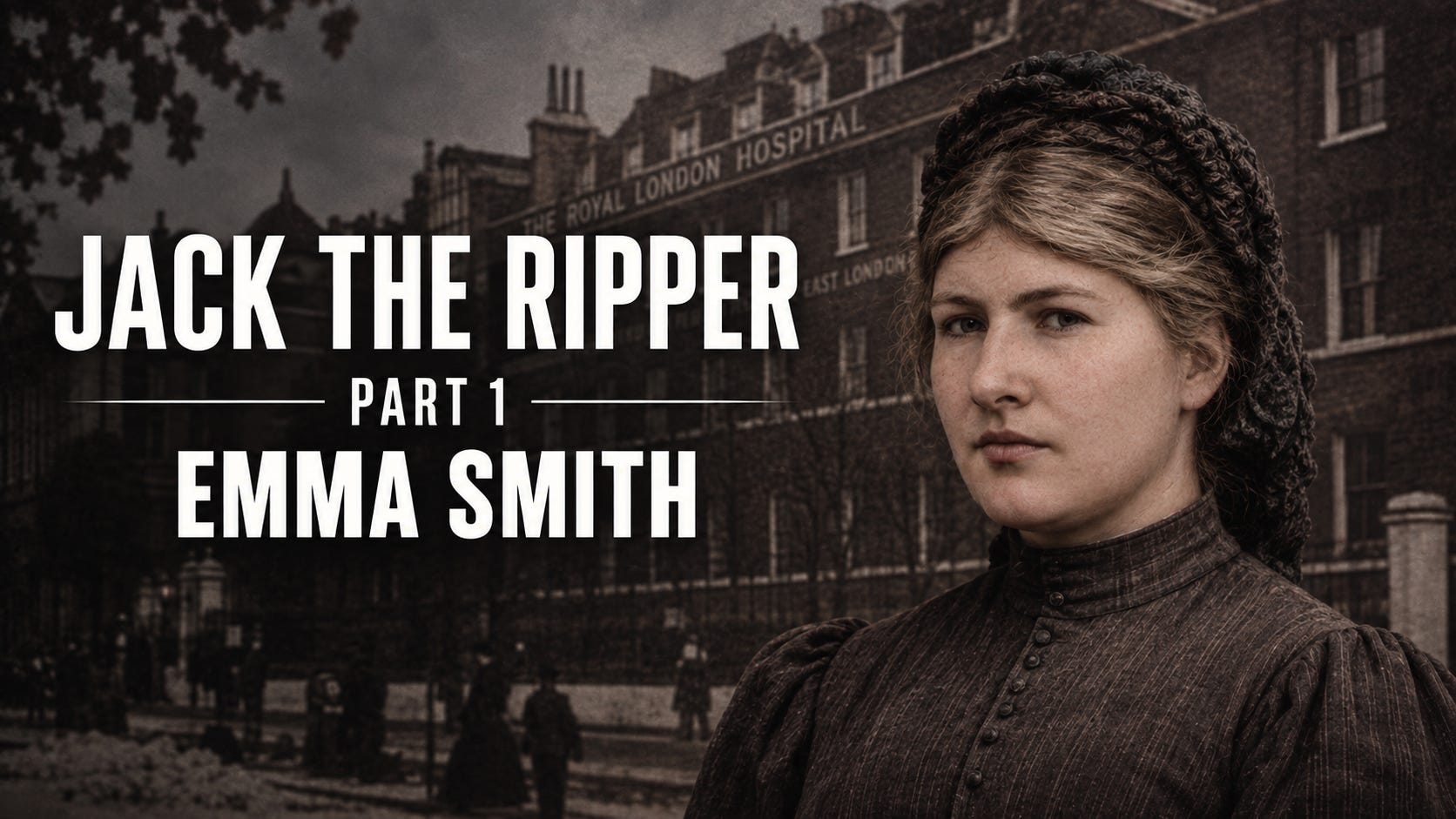
Jack the Ripper is probably the most famous unidentified murderer in history.
More than 130 years after his crimes, books are still being written about him. Documentaries are still being made. And people still walk the streets of Whitechapel trying to work out who he was.
But that’s not where I want to start.
Before we get anywhere near suspects, I want to look at the crimes.
That’s how I approached murder investigations during my career. The crime scene came before the suspect, not the other way around.
So, over this series, I’m going to take you through the murders associated with Jack the Ripper.
What happened.
What the witnesses said.
What the police knew.
And what I make of the evidence.
Who he may have been.
Then you can make your own mind up.
And our story doesn’t begin with one of the five women most commonly associated with Jack the Ripper.
It begins four months earlier.
With a woman named Emma Smith.
Whitechapel
To understand what happened to Emma, and the women who followed her, you first need to understand Whitechapel.
In 1888, London was the most populated city in the world and the capital of the British Empire, but those living in Whitechapel saw little benefit from that.
Sitting immediately to the east of the old City of London, it was one of the poorest parts of the capital.
There was a lack of housing, severe overcrowding and high unemployment.
Those fortunate enough to find regular employment could expect long working days for little money.
For others, work was casual. You might earn something that day, you might not.
And without money, finding somewhere to sleep became another problem.
For a few pence, a common lodging house provided somewhere to spend the night.
Conditions varied, but at the bottom end that could mean little more than a filthy mattress, packed into a room with dozens of others.
If you couldn’t afford that, there was the workhouse.
Or the street.
Poverty brought with it all the problems you might expect.
Crime.
Alcohol.
Violence.
Prostitution.
The population was also changing. Large numbers of immigrants had settled in the East End, including Jewish families fleeing persecution in the Russian Empire.
The Whitechapel of 1888 was a hard place to live.
And for women like Emma Smith, it could be an incredibly dangerous one.
Whitechapel is also an area I know well.
Before I joined the murder teams, I spent several years policing this part of London.
And although more than a century had passed, in many ways the Whitechapel I knew still had echoes of the place these women lived in.
Poverty.
Overcrowding.
Crime.
Addiction.
Prostitution.
I saw all of them first-hand.
I also led teams investigating robberies and later rapes in the area, so I got to see a side of Whitechapel that most people never do.
That experience matters when I look at these murders. I know the streets. I know the area. And I know that many of the problems we associate with Victorian Whitechapel didn’t simply disappear with time.
Emma Smith
We don’t know a great deal about Emma.
She was over forty and described herself as a widow.
She had two children, a son and a daughter, who were living in the Finsbury Park area of London.
Even those who knew Emma seem to have known little about the life she’d had before Whitechapel.
She told friends that more than ten years earlier she’d left her husband and broken away from her previous life.
When asked why, she apparently said that the people she’d left behind wouldn’t understand.
Whatever had happened, by the spring of 1888 Emma was living at 18 George Street, a common lodging house in Whitechapel.
On the evening of Easter Monday, 2 April, Emma went out.
For most of that night, we don’t know where she went or what she did, but shortly after midnight, another woman from the lodging house saw her.
Her name was Margaret Hayes, who saw Emma talking to a man.
Margaret didn’t know who he was. All she could later say was that he was of medium height, dressed in dark clothing and wearing a white scarf around his neck.
It was the last known sighting of Emma before she was attacked.
And when you’re investigating a murder, the last person known to have been with the victim is someone you’re going to want to find.
The man with the white scarf was never identified.
There was something else about Margaret’s account that stands out. She herself had already been attacked that night.
Two men had approached her. One asked her the time before another struck her in the mouth.
Margaret got away.
She later described there having been some “rough work” in the area that night, which gives us some idea of the streets Emma was walking through.
At around 1.30 in the morning, Emma was making her way through Whitechapel.
Ahead of her were two or three men.
One appeared to be a youth of about nineteen.
Emma crossed the road.
She never explained why.
Perhaps there was something about the men that worried her. Perhaps a woman alone in Whitechapel in the early hours needed no other reason. We don’t know.
What we do know is that the men followed her and, not far from where she lived, they caught up with her.
And they set upon her.
Emma said she was assaulted and robbed of all the money she had.
But the worst of the attack was still to come.
A blunt object was forced deep into her vagina.
And then, for several hours, we lose track of Emma.
The attack happened at around half past one, but she didn’t make it back to George Street until hours later, even though the distance she had to travel wasn’t far.
So where was she?
We don’t know.
She may have been unconscious for some of that time.
She may simply have been unable to move because of the pain she was in.
Or the timings may not be as accurate as they appear.
There is no way of knowing.
What we do know is that Emma eventually made it home.
When she arrived at George Street, there was no hiding what had happened to her.
Her face was bleeding, her right ear was cut, and she was in terrible pain.
Mary Russell, the deputy keeper of the lodging house, and another woman, Annie Lee, came to her aid.
Emma told them she’d been attacked by several men. They had assaulted and robbed her.
And inflicted the injury that was now causing her so much pain.
The women could see she needed a doctor; however, Emma didn’t want to go to hospital.
But eventually they persuaded her.
And so, having somehow made it back to George Street, Emma now had to walk
another half a mile to the London Hospital. Now that may not sound that far, but with the injury she’d sustained, it must have been an agonising journey.
Mary and Annie went with her and, as they walked, Emma pointed out the place where she said she’d been attacked.
And they passed police officers, but Emma didn’t stop.
She didn’t tell them what had happened.
Neither did the women with her.
Why, we don’t know.
The London Hospital
Eventually, Emma reached the London Hospital where she was examined by a doctor.
Despite what she’d been through, she was still able to talk. She told him she’d been attacked by several men and explained what they had done to her.
The examination revealed just how badly she’d been injured.
There were injuries to her head and face.
Her right ear had been cut.
But it was the internal injury that was most concerning.
That blunt object had been forced into her vagina with enough force to rupture the peritoneum, the membrane lining the abdominal cavity.
That led to peritonitis, a serious inflammation of the lining inside the abdomen.
Sadly, there was little the doctors could do to help her.
Emma’s condition deteriorated and at 9 a.m. on the following day she died as a direct result of those internal injuries.
I can’t help but think about what she’d been through.
She had been attacked and robbed.
She had suffered horrendous internal injuries.
Yet, somehow, she had made it back to the lodging house.
Then she’d walked another half a mile to hospital.
And less than two days later, she was dead.
You might imagine that by now the police were already hunting the men responsible.
They weren’t.
The police had no idea that the attack had happened.
Scotland Yard
Before we get t…