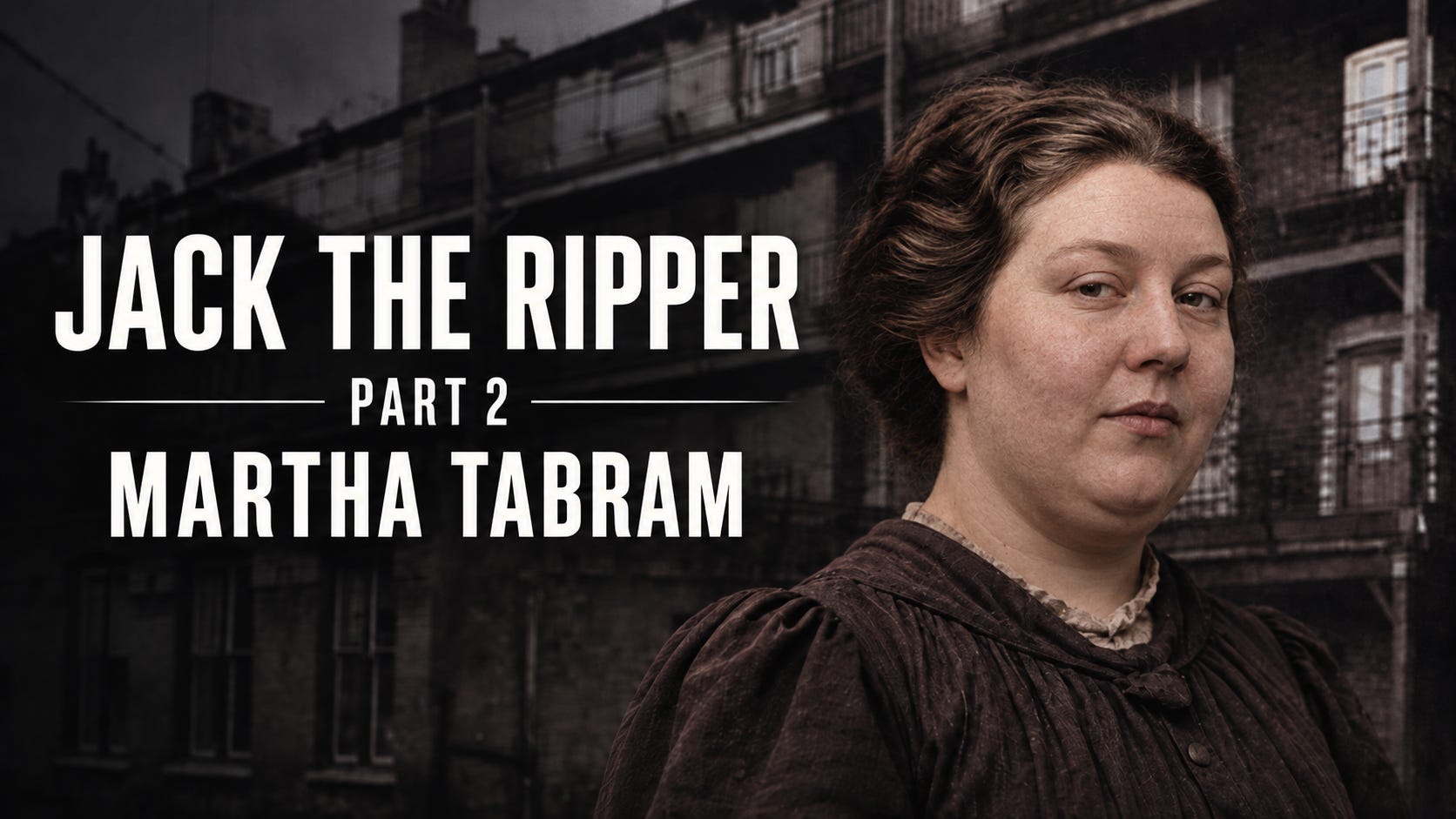
Four months after the death of Emma Smith, another woman was murdered in Whitechapel.
Her name was Martha Tabram.
And although her murder would later become tangled up in the story of Jack the Ripper, I want to resist doing what history so often does with these women: reducing them to a name on a list.
Before Martha became a murder victim, she’d already lived quite a life.
Martha
Martha was born in Southwark on 10th May 1849, the youngest of five children.
In 1869, she married Henry Samuel Tabram, a furniture warehouse foreman. They went on to have two sons: Frederick, born in 1871, and Charles the following year.
But the marriage wasn’t a happy one.
Martha drank heavily and, by 1875, Henry refused to continue living with her. For several years he continued to give her money, but their relationship deteriorated. Eventually, when Martha began living with another man, Henry stopped supporting her altogether.
That other man was William Turner.
Martha lived with Turner on and off for around nine years but, again, alcohol caused problems.
William later told the inquest into Martha’s murder that whenever he gave her money, she spent it on drink. He said they would continually split up and get back together again until, around three weeks before Martha died, they broke up for the final time.
By August 1888, Martha was living at a common lodging house, 19 George Street in Spitalfields.
She tried to make money selling trinkets and other small items on the street. For women living as Martha was, there was often no single way of making an income. She needed money for drink, for food and, crucially, for somewhere to sleep. When selling stuff wasn’t enough, prostitution could be another way of finding the few pence needed to get through the night.
Martha was five feet three inches tall, with dark hair and a dark complexion.
She was 39 years old when she died.
On Monday 6th August 1888, Martha went out into Whitechapel.
It was Bank Holiday Monday.
And it would be the last night of her life.
The Murder
Much of what we know about Martha’s final hours comes from another woman, Mary Ann Connelly, who was more commonly known as Pearly Poll.
According to Pearly Poll, she had known Martha for around four or five months, and the pair would sometimes go out together looking for men willing to pay them for sex.
That evening, she said they met two soldiers.
One was a corporal and the other was a private.
From around ten o’clock until shortly before midnight, the four drank together in several pubs around Whitechapel. Their final stop was the White Swan.
At around 11.45 p.m., they separated.
Pearly Poll went off with the corporal, while Martha went with the younger soldier.
That was the last time she was seen alive.
It’s worth keeping one thing in mind here.
Pearly Poll’s account became central to the police investigation, but it was never independently verified.
Detectives later visited the pubs where she claimed the group had been drinking but couldn’t find anyone who remembered seeing them together. Martha’s sister-in-law did remember seeing Martha going into the White Swan, but said she appeared to be alone.
That doesn’t mean Pearly Poll was lying. The soldiers may already have been inside.
But it does mean we should be careful about treating her account as fact.
What we do know is that sometime during the early hours of Tuesday morning, Martha ended up inside George Yard Buildings, a large block of cheap rented rooms and home to dozens of working-class families and lodgers.
At around 1.40 a.m., Elizabeth Mahoney returned home to Geroge Yard Buildings with her husband. Shortly afterwards she went back downstairs to buy some food.
She noticed nothing unusual.
At around two o’clock, PC Thomas Barrett was nearby when he saw a soldier.
Barrett asked what he was doing and he told him he was waiting for a friend who had gone off with a girl.
That may be important.
Or it may have had absolutely nothing to do with Martha.
At around 3.30 a.m., another resident, Alfred Crow, came home.
As he made his way upstairs, he saw somebody lying on the first-floor landing.
It was dark.
And in a building like George Yard, finding someone sleeping in a communal area wasn’t unusual, so Alfred assumed the person was homeless or drunk and carried on to his room.
More than an hour passed.
Then another resident, John Reeves, came down the stairs on his way to work.
By then there was more light.
And this time there was no mistaking what was there.
A woman lay on her back on the landing.
And underneath her was a large pool of blood.
John went looking for a policeman and found PC Barrett, the same officer who had spoken to the soldier a few hours earlier.
PC Barrett made his way to George Yard Buildings where he could see that the woman appeared dead.
Her hands were clenched.
Her clothes had been pushed up towards the middle of her body.
Her lower body was exposed.
Her legs were apart.
The position gave Barrett the impression that sexual activity might recently have taken place.
As per procedure, he sent for a local doctor, Dr Timothy Killeen.
Killeen examined Martha and, having confirmed she was dead, instructed for her body to be taken to the local mortuary where he would later carry out a post-mortem examination.
There was nothing to suggest Martha’s body had been moved there. Everything pointed to her having been killed on that landing.
The soldiers remained the obvious line of enquiry.
Barrett was later taken to the Tower of London to see if he could identify the soldier he had spoken to. He eventually picked out two men, but both had alibis.
There were problems connecting that soldier to the men described by Pearly Poll. She later said the soldiers she and Martha had been with were Coldstream Guards, while Barrett had seen a Grenadier.
Pearly Poll was also taken to identification parades. She eventually picked out two Coldstream Guards she said she was quite positive were the men she and Martha had been drinking with.
Again, both had alibis.
So, despite considerable effort, the police were never able to identify the soldiers described by either witness.
Post-Mortem
Before we get to what Dr Killeen found, there are two things worth knowing.
First, the doctors carrying out these post-mortems were not forensic pathologists in the way we would understand that role today. They were ordinary doctors, working with the medical knowledge and techniques available at the time.
Second, the mortuary was nothing like the sort of place we might picture today.
Martha’s body was taken to the Whitechapel mortuary, a very basic facility that could better be described as a shed.
So, Dr Killeen’s examination was very different from anything we would expect today.
What he found was that Martha had been stabbed 39 times.
They were spread across her body. Her lungs had been stabbed several times. So had her liver, spleen and stomach. There were also wounds to her neck and her genital area.
But one wound was different.
A blade had been driven through her breastbone and into her heart.
And Dr Killeen didn’t think that wound had been caused by the same weapon as the others.
He believed most of the injuries had been inflicted with a small knife. Something like a penknife.
But the stab wound to the heart he believed was made by a much stronger blade, maybe a dagger or a bayonet.
And if Dr Killeen was right, two different weapons had been used during the same attack, which is important.
That stab wound to the heart would have been fatal.
He also said he found no indication that sexual intercourse had taken place.
He also found no signs of a struggle.
Those are the medical findings.
Now we come to the part that interests me most.
What do they actually tell us about the crime?
What I think happened
Whenever I investigated a murder, I was always trying to understand what may actually have happened.
Not just how somebody died, but what was happening between the victim and the killer.
How did they come together?
What happened first?
How was the victim controlled?
What was the killer trying to achieve?
And what does th…