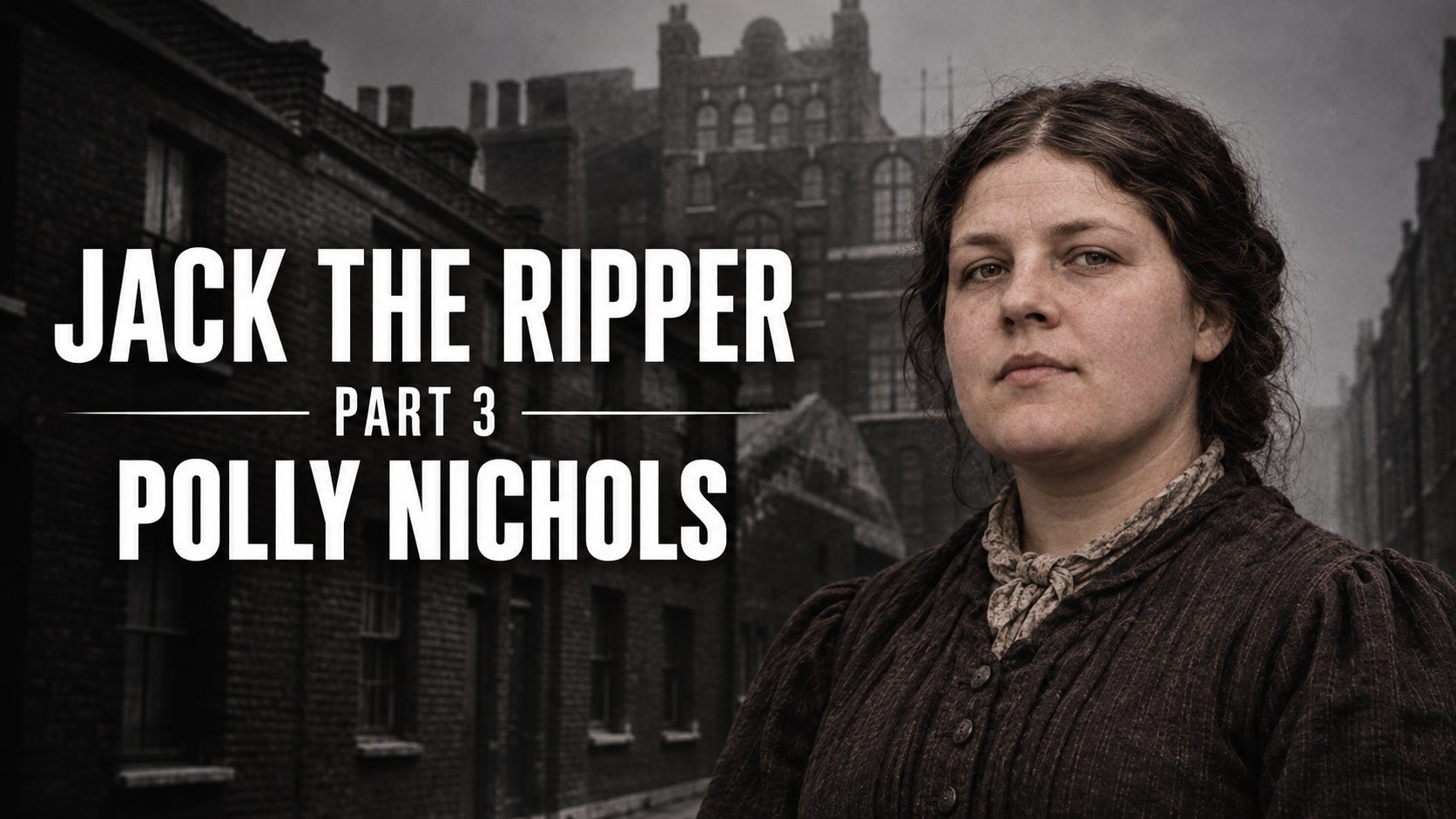
Just over three weeks after Martha Tabram was murdered, another woman was found dead on the streets of Whitechapel.
Her name was Mary Ann Nichols, but she was commonly known as Polly.
And as always, before we get to what happened to her, I want to start with the woman
herself.
Polly
Polly was born Mary Ann Walker in London in 1845.
Her father was a blacksmith and, at the age of eighteen, she married a printer called William Nichols.
They went on to have five children together.
For a time, they appeared to have something resembling a settled family life. But the marriage eventually broke down.
Exactly why depends on whose account you believe.
William later blamed Polly’s drinking. Her father accepted that alcohol had become a problem, but claimed William had started a relationship with the woman who had nursed Polly after the birth of their youngest child.
Whatever the truth, by around 1880 the marriage was effectively over.
The years that followed were difficult.
Polly moved in and out of workhouses and cheap accommodation. There were periods when she seems to have been homeless.
Her drinking continued.
And there is evidence that she was earning money through prostitution.
William had initially continued to support her financially after they separated but later stopped when he discovered she was working as a prostitute.
But Polly’s life wasn’t simply one long downward spiral.
There were attempts to start again.
Only a few months before she died, the matron at Lambeth Workhouse found her employment as a domestic servant with a family in Wandsworth.
And for a while, things seem to have gone well.
Polly even wrote to her father, telling him she had settled into her new job, that the family were nice people and that she wasn’t being worked too hard.
It sounds like a woman who believed she might finally be getting somewhere.
But it didn’t last.
A few weeks later, Polly left the house after stealing clothing from her employers.
By August she was back in the world of workhouses and common lodging houses.
By the end of that month, she was staying around Whitechapel.
Polly was about five feet two inches tall, with brown hair beginning to turn grey, brown eyes and high cheekbones.
Her friend Emily Holland described her as a clean woman who kept herself to herself.
She was 43 years old.
And on the night of Thursday 30 August 1888, Polly needed fourpence.
The price of a bed for the night.
The Last Night
It had been a wet night, with heavy rain, thunder and lightning over London.
Polly had been drinking and sometime around half past one in the morning, returned to a common lodging house at 18 Thrawl Street.
But when the deputy asked for the fourpence needed for a bed, Polly didn’t have it.
So, she was told she would have to leave.
You might imagine she’d have been worried, but apparently not.
Polly, who was wearing a new bonnet, laughed and told the deputy, “I’ll soon get my doss money. See what a jolly bonnet I’ve got now.”
And out into the night she went.
Around an hour later, Polly was seen again.
Emily Holland had been returning to the lodging house when she came across her near Whitechapel Church.
Polly was clearly drunk.
She was staggering and at one point slumped against the wall of a shop.
Emily tried to persuade her to come back with her, but Polly refused.
She told Emily that she’d already earned her lodging money three times that day and spent it.
She seemed confident she could earn it again.
Then Polly headed off along Whitechapel Road.
It was around 2.30 in the morning.
And that is the last confirmed sighting we have of her alive.
What happened over the next hour or so, we simply don’t know.
Where did Polly go?
Who did she meet?
Was she walking the streets looking for somebody willing to pay her for sex?
Given her history and the fact she was specifically looking for money to pay for a bed, I think that is likely.
But whatever happened during that missing hour, at some point Polly ended up in a narrow street called Buck’s Row.
And she wasn’t alone.
Buck’s Row
There is something we need to understand before going any further, because the movements of the policemen that night become important.
In 1888, uniformed constables didn’t simply wander around Whitechapel waiting for something to happen.
They worked beats.
A beat was a defined route through a particular area.
The routes were measured, recorded and allocated to individual officers. At night, beats were generally shortened because that was when most crime took place. More officers were put onto the streets, and the idea was that the same areas would be passed through more frequently.
The beats also fitted alongside one another.
That mattered because there were no radios.
If an officer suddenly needed help, he needed another policeman to be close enough to respond. They also carried whistles which could be used to summon assistance.
At night they also carried lamps and, as we are about to see, those lamps could be used to signal another officer nearby.
At around 3.15 that morning, PC John Neil passed through Buck’s Row as part of his beat.
There was nothing there.
Around the same time, another officer, Sergeant Kirby, also passed through.
Again, nothing attracted his attention, which is important.
Because roughly half an hour later, a man called Charles Cross walked into Buck’s Row on his way to work.
Charles was a carman, essentially a delivery driver, employed by Pickfords.
As he made his way along the street, he noticed something lying near a gateway.
At first, in the darkness, he thought it was a piece of tarpaulin.
Then he moved closer and saw it was in fact a woman.
As Charles stood there, he heard another man approaching, Robert Paul, also a carman on his way to work.
Robert later said his first reaction on seeing Charles standing in the dark was concern. This was an area where robberies and gang attacks happened.
But Charles called him over and the two men went to the woman lying on the ground.
Her clothes had been pulled up almost to her stomach.
Lying on the ground next to her was a bonnet.
Charles felt her hands, which were cold, and he thought she was dead.
Robert touched her face and then placed a hand on her chest.
He thought he might be able to feel some movement. Maybe she was still breathing.
The street was dark and neither man could see any injuries.
They were also late for work so, rather than stay, they decided to find a policeman.
A few minutes later they came across PC Jonas Mizen.
And Mizen happened to be doing something that sounds rather strange today.
He was knocking people up.
Before alarm clocks became commonplace, people still needed some way of getting up for work.
And one solution was to pay somebody to wake you.
Residents would sometimes pay a police officer a small amount each week, and he would remember which house needed waking and at what time.
It was officially allowed, provided it didn’t interfere with their police duties.
So in the early hours of 31 August 1888, while Charles and Robert were looking for help, PC Mizen was knocking on doors to wake local people for work.
The pair told him about the woman in Buck’s Row.
Then Charles and Robert continued on their way.
Meanwhile, PC John Neil was coming back through Buck’s Row on his beat.
Only this time, something had changed. There was now a woman lying beside the gateway.
Neil raised his lamp and, unlike Charles and Robert, he could see what had happened.
There was blood coming from her throat.
He touched her arm.
Although her hands were cold, her arm was still warm.
Neil knew another constable should be nearby. PC John Thain was working an adjoining beat, so Neil used his lamp to signal him.
Thain saw the signal and came across.
Neil then sent him for Dr Henry Llewellyn.
By the time the doctor arrived, there was nothing he could do.
The doctor could see that she’d had her throat cut.
Polly was dead.
He instructed the officers to remove her body to the mortuary so she could be examined more fully.
The Scene
Police checked the surrounding area.
There was no trail of blood suggesting she had been killed somewhere else …