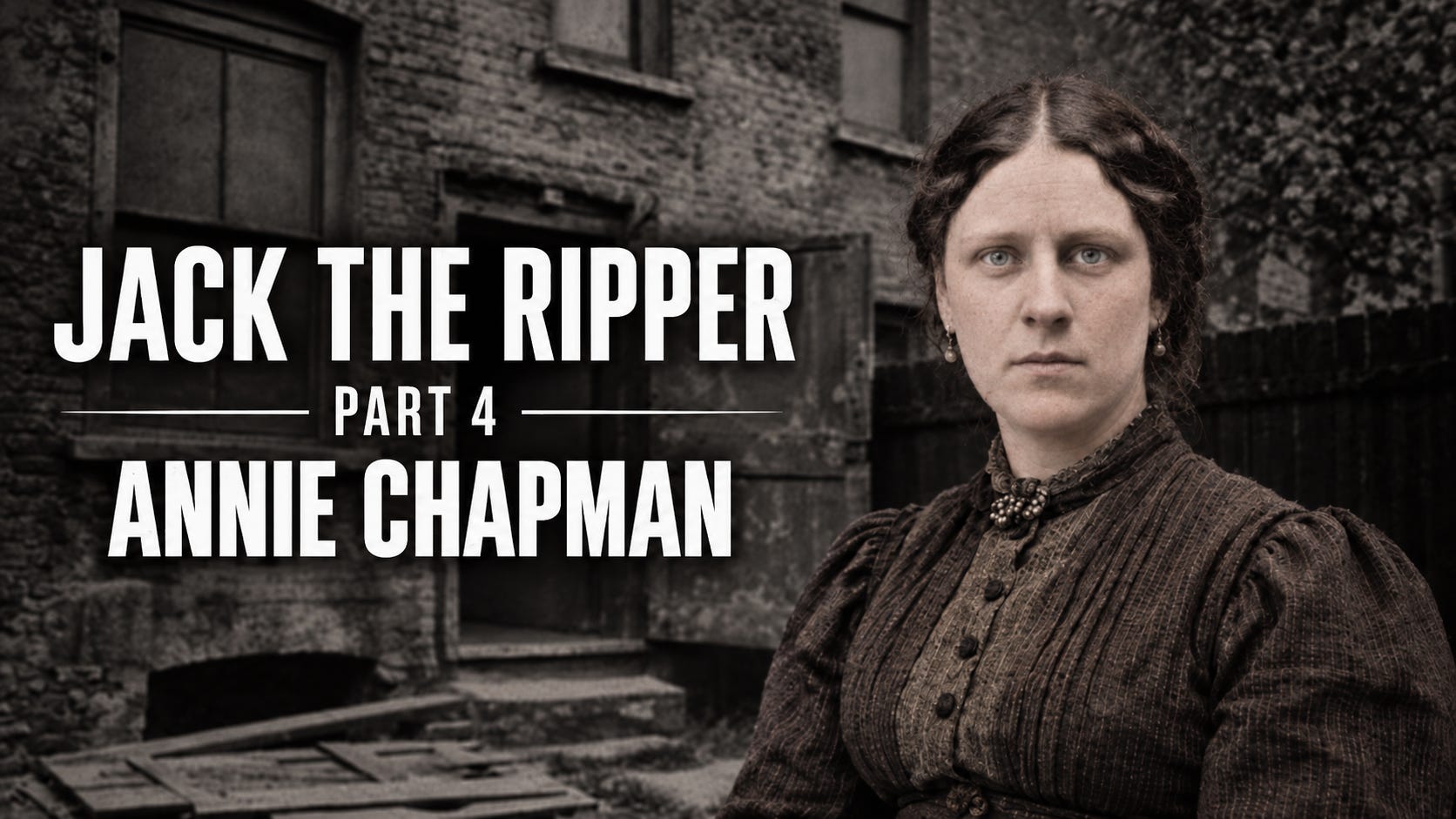
Eight days after Polly Nichols was murdered, another woman was found dead in Whitechapel.
Her name was Annie Chapman.
And as always, before we get to what happened to her, I want to start with the woman herself.
Annie
Annie was born Annie Eliza Smith in London around 1840 or 1841.
Her father had served in the Life Guards, an elite cavalry regiment of the British Army, and in 1869 Annie married a coachman called John Chapman. They went on to have children together and, for a time, appear to have lived something resembling a settled family life.
John found work as a coachman and domestic servant near Windsor and the family moved there.
But alcohol became a serious problem for Annie.
By around 1882, the marriage had broken down and Annie returned to London. John continued to support her financially, sending her ten shillings a week, while he remained in Windsor with the children. One of their daughters had already died young and their son was said to have suffered from serious health problems. Then, on Christmas Day 1886, John himself died and the money he had been sending Annie stopped.
By then Annie was moving through common lodging houses around Whitechapel and Spitalfields.
She became known to some as Annie Sivvey after a relationship with a man who made sieves. Later, she became involved with another man, Edward Stanley, although the two do not appear to have lived together permanently.
Her friend Amelia Farmer described Annie as very clever and industrious when sober. She made decorative cloth covers for chairs and sometimes sold flowers and matches on the street.
Prostitution does not appear to have been Annie’s regular way of earning money, but there is some evidence that she sometimes used it when she needed to.
Annie was around five feet tall, with dark brown wavy hair and blue eyes. She was around 47 years old when she died.
And by the beginning of September 1888, she was not well.
She had recently spent time in the Whitechapel Infirmary before she returned to Dorset Street on Friday 7 September. She was also involved in a fight with another woman and had visible bruising, including a black eye. Accounts differ as to what the fight was about, and I won’t go into them here.
That evening, Annie told Amelia Farmer that she felt too ill to work but had little choice.
She needed money for somewhere to sleep.
Later that night, she returned to Crossingham’s Lodging House at 35 Dorset Street.
The Last Night
Shortly after midnight, Annie was in the kitchen of the lodging house.
One of the other lodgers saw her drinking beer and eating potatoes.
She was also seen wrapping two pills in a piece of paper after the box they had been kept in fell apart.
At around 1.45 in the morning, Timothy Donovan, the deputy manager, asked Annie for the money for her bed.
She didn’t have enough.
Annie told him, “I have not sufficient money for my bed. Don’t let it. I shan’t be long before I am in.”
Tim pointed out to her that she’d found money for beer but not for somewhere to sleep.
Annie stood in the doorway for a couple of minutes before saying:
“Never mind, Tim: I shall soon be back. Don’t let the bed.”
She was drunk, but able to walk properly, and the night watchman watched her head towards Spitalfields Church.
For the next few hours, we don’t know where Annie went or who she met.
But we do know why she had gone back out.
She needed money for her bed.
Given her history and the fact she had left specifically to earn that money, I think it is reasonable to believe she may have been looking for a client to pay for sex.
At some point that morning, Annie ended up outside 29 Hanbury Street.
And if the witnesses who came forward afterwards were right, she wasn’t alone.
29 Hanbury Street
The location of Annie’s murder is important.
Number 29 Hanbury Street was divided between several occupants. The front door was not normally locked, and a passageway ran straight through the house to a small backyard.
That meant somebody could walk in from the street and reach the rear of the property without needing to knock or ask permission.
There is also evidence the yard had previously been used by couples for sex.
That matters because, from Annie’s point of view, this may not have felt like an unusual place to take a man.
When I policed Whitechapel more than a century later, I came across sex workers with clients in places that most of us would consider remarkably exposed.
Yards, passages and doorways were not unusual. I found one couple making out on an abandoned sofa.
So, if Annie had met a man willing to pay her for sex, taking him through an unlocked house into a backyard she knew would make sense.
The Witnesses
At around 4.45 that morning, John Richardson popped into 29 Hanbury Street.
His mother lived there and, after a recent break-in, he’d been checking to make sure everything was OK in the backyard.
John went through the house and opened the back door. While he was there, he sat on the step and used a table knife to cut an irritating piece of leather from his boot.
He didn’t see anything untoward while he was there.
Then we come to a very important witness, Elizabeth Long.
At around half past five, she was walking along Hanbury Street towards Spitalfields Market.
As she passed number 29, she saw a man and woman standing together on the pavement.
She later identified the woman as Annie Chapman.
The man had his back towards her, so Elizabeth didn’t get a proper look at his face, but she described him as follows:
· Dark appearance
· Looked like a foreigner
· Brown deerstalker hat
· Possibly a dark coat
· Shabby genteel appearance
· A little taller than Annie
· Looked over forty years old
As Elizabeth passed, she heard the man ask, “Will you?”
And Annie reply, “Yes.”
Elizabeth then carried on past the pair without looking back.
Not long afterwards, Albert Cadosch, who lived next door at number 27, went into his own backyard.
As he passed the fence separating the two properties, he heard voices from the yard of number 29.
The only word he could make out was a woman saying, “No.”
A few minutes later, Albert went back outside and this time heard something fall, or knock, against the fence.
He didn’t look over.
Shortly afterwards, he left for work.
At just before six o’clock, another resident at number 29, John Davis, got up and went to the backyard.
When he opened the door, he saw the body of a woman lying beside the steps.
It was a sight he would never forget.
The mutilated body of Annie Chapman.
The Scene
Inspector Joseph Chandler of H Division was among the first officers to arrive, and it was he who went through to the backyard.
What he discovered would have been shocking even for an experienced policeman.
Annie was lying in between the bottom of the steps and the fence.
Her legs were drawn up, her feet were on the ground, and her knees had fallen outwards.
Her throat had been cut deeply, the wounds extending around her neck.
But that wasn’t the worst of it.
Her abdomen had been cut open and part of her intestines removed, then placed over her right shoulder.
It was a truly horrific sight.
Later in his career, Chandler was demoted to sergeant after being found drunk on duty.
I have no evidence that Annie Chapman’s murder had anything to do with what happened to him later.
But I do wonder.
I spent years attending murder scenes and dealing with some horrendous things.
Today, we understand far more about trauma, welfare and the effect that repeated exposure to death and violence can have on people.
Many police officers today are diagnosed with PTSD, a diagnosis that didn’t exist in 1888.
Could Chandler have carried what he saw that morning with him later in his career?
We’ll never know, but it does make me think.
One of the tasks he carried out in the backyard was to make a plan of what he could see, including a log of any potential evidence.
He noted two pills wrapped in paper, part of an envelope bearing the seal of the Sussex Regiment, a comb and a piece of muslin.
Also found in the yard was a leather apron.
Chandler sent for Dr George Bagster Phillips to attend, a nam…