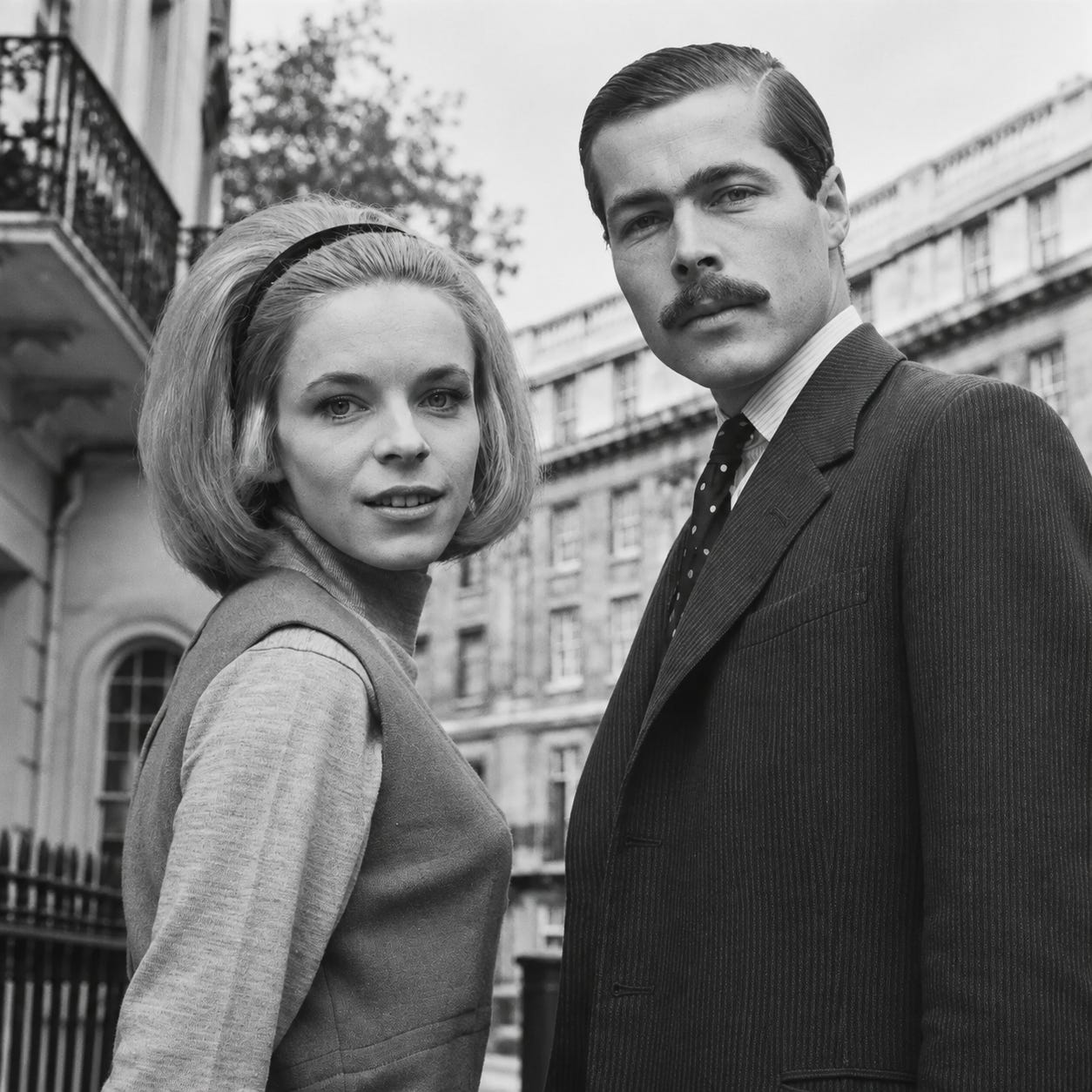
Lord Lucan. The aristocrat who disappeared.
Even if people don’t know why he’s famous, most know he disappeared.
His name has become synonymous with people who simply vanish.
Understandably, it’s that aspect of the case that generates the most discussion.
Where is Lord Lucan?
For me, as a detective, the mystery of his whereabouts isn’t the aspect I find most fascinating.
I want to understand the relationship that came before it.
If I were investigating this case today, that’s where I’d begin.
In 1963, Richard John Bingham, Lord Lucan, married Veronica Duncan. They had three children together and, to the outside world, were a happy, wealthy, aristocratic family.
As is often the case, though, what was happening behind closed doors was something very different.
Lucan had developed a gambling habit, a very expensive one, which over time cost him much of his wealth. By 1973, the marriage had broken down and the couple separated. Veronica and the children remained in their Belgravia home, while Lucan moved elsewhere.
The split became extremely acrimonious, resulting in a court battle for custody of the children.
The following account is based on Veronica’s police statement, given shortly after the murder that led to Lucan’s disappearance. As with any witness statement, it’s one person’s account, not established fact. But if we’re trying to understand both the relationship and what happened that night, there’s no better place to begin.
On the evening of 7th November 1974, Veronica and the children were at home with their nanny, Sandra Rivett. Sandra went downstairs to make tea in the basement kitchen but didn’t return.
Wondering why she’d been gone so long, Veronica went downstairs herself.
She found the basement in darkness.
She called down for Sandra but there was no reply.
Suddenly, someone appeared and struck her a number of times on the head with something heavy.
Veronica began to scream and the attacker told her to “shut up”. She immediately recognised that to be the voice of her husband, Lord Lucan.
Lucan put his fingers down her throat, so she bit him as hard as she could.
She then found herself lying face down on the floor with him strangling her.
Veronica thought he was going to kill her, so she fought back, including grabbing hold of his genitals.
The account then takes an unexpected turn.
The attack stopped and she found herself sitting in front of him. He said to her something like “there’s no room for two of us.”
Veronica asked him what had happened to Sandra, and he told her she’d gone out. She kept asking him the same question and he eventually admitted “I’ve killed her, she came down first, if it had been you, you’d have got it.”
Petrified, she decided her best way out of the situation was to appear to be on his side. She persuaded him to come upstairs with her.
They were in their bedroom, where Veronica lay on the bed. Lucan then went into the bathroom to wash his face. Seeing her opportunity, Veronica fled down the stairs, with Lucan shouting after her.
Having escaped the home, Veronica ran to a nearby pub, where someone called the emergency services and she was taken to hospital.
From a detective’s perspective, it’s an unusual sequence of events. According to Veronica’s account, the attack stopped, conversation followed, and they moved around the house before she eventually escaped. That’s not a sequence I’ve encountered before after one person has been killed and another has been subjected to such a sustained and violent attack.
By the time police arrived, Lucan had gone.
They forced entry to the home and found the children unharmed, before discovering the body of Sandra in the basement. Significantly, her body had been placed into a large canvas sack, and a light bulb had been removed in the kitchen and placed onto a chair, explaining why it wouldn’t turn on for Veronica.
Officers then went to Lucan’s nearby flat but found no trace of him.
Whether or not Lucan had set out to kill Veronica, the fact remains, if not for her determination to escape, she would likely have died that night. This would have made this incident a domestic murder, and, sadly, these account for around half of all female homicides in the UK.
Now, I want to let you in on something about me and my career. If I could have my time over again, there’s one thing I wish I knew at the beginning, which took me years to understand. And that’s what it is that drives domestic abuse.
Power and control.
You may well be thinking, that’s obvious. But trust me, the police have been very slow in catching up with this, and probably still have a fair way to go.
As a uniformed officer attending domestic abuse incidents, I, along with many of my colleagues, didn’t always handle them very well.
Very often we’d arrive, ask the victim, usually a woman, what had happened and what she wanted us to do.
The answer we mostly received? More often than not, nothing. We were told nothing had happened and she wanted us to do nothing about it.
So, with a shrug of the shoulders, we’d leave, updating the control room with, “No offences alleged. No police action required.”
Thankfully, policing has come a long way since then. We now understand that domestic abuse is fundamentally about one partner exerting power and control over the other.
Looking back, it’s hardly surprising so many victims didn’t want us to act. They were often under the complete control of the very person abusing them. But that control wasn’t always easy to identify because abusers often do all they can to hide it, and victims are often too frightened to tell anyone.
Another thing I wish I’d understood back then was what that control actually looked like.
The younger me associated domestic abuse with violence. Black eyes, split lips and, occasionally, much worse.
Yes, violence can be part of the armoury of a domestic abuser, but it goes much deeper than that.
An abusive partner may try to control every aspect of their victim’s life. Everything from what they wear, to who they see, where they go and how they spend their money. They may isolate them from friends and family, make them financially dependent, control the narrative around them, or try to make them doubt their own memory, judgement or even their sanity.
Even when the victim escapes the relationship, that need to exert control can remain. It can take the form of stalking. Watching them. Following them. Interfering in new relationships.
It was only really later, when I began investigating murders, that I truly became aware of all this. I’d never worked in domestic violence units. I had a career investigating terrorism, robbers and drug dealers. Then I was thrust into a world that saw the tragic end result of these relationships, and I quickly learned what to look out for.
When you investigate domestic murders, they’re often the easiest to prove evidentially. They usually occur in the home, and everything is there to build a solid prosecution.
But proving murder is only part of the job.
You also need to paint a true picture of the relationship for the court.
If a victim has been abused for years, the court needs to know that. Not just so the jury understands what happened, but so the sentence reflects not only the act that resulted in death but, potentially, the years of abuse that preceded it.
And why did I end up dealing with so many domestic murders? What made them go from abuse to homicide?
On the face of it, that final act can appear to stem from a partner losing self-control. A moment of temper. A sudden explosion of violence.
But that’s not always what’s happening.
It’s often the culmination of months or years of abuse. Then something changes in the relationship, causing the abuser to escalate their behaviour.
It’s been shown that the risk of serious violence and homicide increases during separation or when the victim attempts to leave.
In other words, it isn’t necessarily the abuser losing self-control that explains the violence. It can be the abuser losing control over the victim.
So, if control was the key, do we see ev…