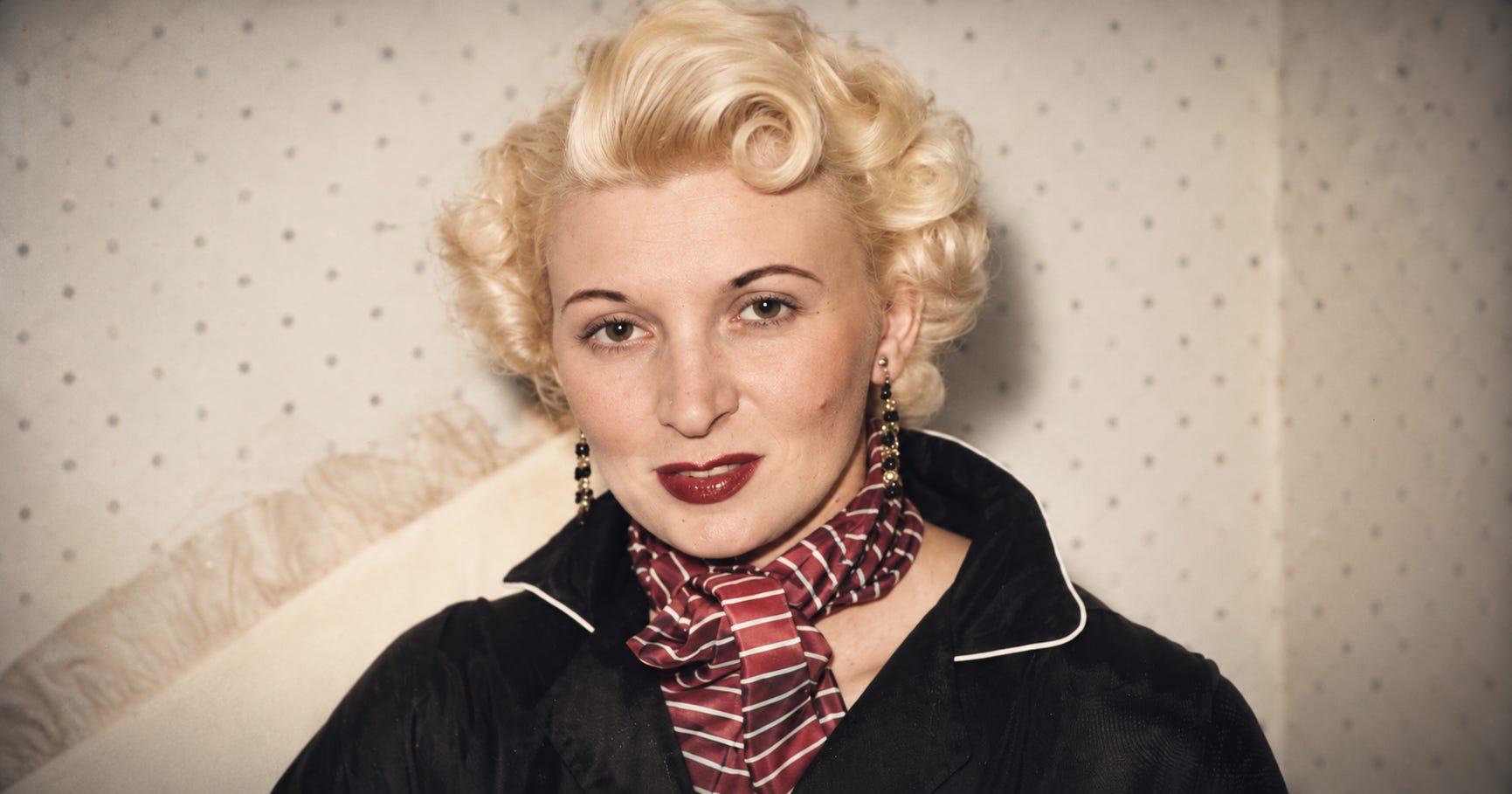
Ruth Ellis
The last woman to be hanged in the UK.
More than seventy years later, her name still provokes debate.
Most recently, the debate has been ignited by the decision to grant her a posthumous conditional pardon.
Understandably, almost every discussion centres on one question:
Should she have been executed?
However, as I read about the case, I found myself thinking about something I’d experienced many times during my own career.
On the evening of Easter Sunday, 10th April 1955, Ruth Ellis took a taxi to a flat in Hampstead where she believed her former partner, David Blakely was going to be.
When she arrived, she saw David’s car pulling away.
Ruth then walked about a quarter of a mile to the Magdala pub in Hampstead, where she found David’s car parked outside.
Ruth waited outside, until about 9.30pm when David came out of the pub and headed towards his car with a friend.
She then walked over to David with a revolver in her hand and began firing at him.
Although David tried to get away, he was struck several times and collapsed to the ground.
A woman at the scene was also injured, when a bullet or bullet fragment struck her hand.
Having discharged the firearm, Ruth made no attempt to get away. She just stood there, allowing an off-duty police officer, who’d been inside the pub, to disarm and detain her.
She was recorded as saying to this officer, “I am guilty. I’m a little confused.”
Local police officers then arrived, and she was taken into custody.
David was taken by ambulance to hospital where he was pronounced dead on arrival.
A later post-mortem examination showed several vital organs, including his heart, had been struck. It also found one of the shots was fired at extremely close range, causing powder burns on David’s back.
At the police station Ruth continued to admit having shot David.
With witness evidence, Ruth’s own admissions and the medical evidence establishing the cause of death, detectives charged Ruth Ellis with David Blakely’s murder.
On the face of it, the police had a very strong case and would have had no problem producing the evidence to prove it.
But an important element to any murder investigation isn’t just evidencing what happened, it’s seeking to understand the reasons behind it.
To understand why these events unfolded as they did, detectives needed to look at the relationship between Ruth Ellis and David Blakely.
There is a principle in murder investigation: if you want to understand how a person died, you first have to understand how they lived.
Most murders aren’t random, and they rarely happen without a motive.
The answer to why a person died can usually be found by examining their life and the people in it.
So, even in a case that appears as straightforward as this, where the killing was witnessed and Ruth admitted what she had done, detectives still had that important job to do. To build a picture of not just what happened that night, but what led to it.
In late 1953, Ruth was the manager of a nightclub called The Little Club in Knightsbridge. It was there that she met David, who was a racing driver.
They started a relationship that moved quickly. Despite being engaged to another woman, David moved into Ruth’s flat above the club.
Their relationship quickly became volatile, with regular arguments and reconciliations.
Alcohol became a major factor in fuelling these arguments, particularly because David was considered a heavy drinker.
Jealousy was another recurring theme. David disliked the attention Ruth received from men at the nightclub, while Ruth struggled with David’s relationships with other women during theirs.
In 1954, Ruth fell pregnant with David’s baby. She made the decision to have an abortion.
During her trial, Ruth said David had regularly assaulted her and that she was often covered in bruises.
In early 1955, Ruth began a relationship with another man, Desmond Cussen. Despite this, she and David remained emotionally attached. Ruth became pregnant again and maintained that David was the father.
Toward the end of March 1955, Ruth said David punched her in the stomach during an argument. She subsequently suffered a miscarriage.
By early April 1955, the relationship was effectively over, although Ruth made several attempts to contact David.
On 10 April 1955, those events culminated in Ruth following David to the Magdala pub in Hampstead, where she shot and killed him.
By then, detectives had gathered far more than an account of a shooting.
They had assembled the fullest picture they could of the events that led to David Blakely’s death.
From that point, the investigation was no longer in their hands.
And for me, that was the hardest part of a murder investigation.
I sometimes find it difficult to articulate exactly what it feels like investigating a murder. It’s unlike anything I’ve ever done in policing or beyond.
The one word I come back to is responsibility. The sense of that can, at times, feel overwhelming.
At the heart of every murder investigation is a victim whose life was taken from them too early. Alongside them is a family trying to come to terms with that fact.
The immense responsibility I felt was to those people.
That sense of responsibility was never greater than when I was the Case Officer on an investigation, where the role is both the day-to-day running of the enquiry, and ensuring the evidence is good enough to make an arrest, obtain a charge and obtain the conviction.
When I performed this role there was so much weight on my shoulders that I considered it ‘my job’.
As Case Officer I would meet the victim’s family, which only intensified the feelings of responsibility.
Sitting opposite people when they’re in those early stages of grief, when they’re trying to process the worst news of their lives, when their future looks so bleak and uncertain, I couldn’t help but get caught up in their emotions.
I wanted nothing more than to be able to take away their pain. But I knew I couldn’t do that.
The best I could do was seek answers to the questions they were desperate to know.
Why did this happen? Who did it? What happens next?
I couldn’t get their loved one back, all I could do was get them the justice they deserved.
It was the motivation I carried into every investigation, which often lasted months, sometimes even years.
It’s why I found myself living, eating and sleeping an investigation.
I was thinking about on the way to work and on the journey home. When I was eating dinner with my family, putting the kids to bed or watching TV, thoughts of the investigation wouldn’t be far from my mind.
When I lay in bed, I would be running through the investigation. What are we missing? What line of enquiry should we follow? In fact, I used to do some of my detective work at night, when the world was quiet and I wasn’t distracted. More times than I can remember I’d bound into the office the next day with an idea of how we can move forward.
There were periods when the investigation took over my life.
I would find myself working crazily long hours, finishing after midnight and back in for the early morning meeting, day after day, week after week.
I didn’t see my own family. My health suffered. The bags under my eyes were more like suitcases.
But I did it anyway, and gladly.
And it all comes down to that responsibility I felt for doing the best possible job I could for the victim and their family.
So, when I’d been doing all of that for so long, invested so much of myself, and pulled together as much evidence as I possibly could, the case was finally ready for trial.
I handed that responsibility on.
Responsibility that passed from lawyers to barristers and, ultimately, to the court. And all I could do was trust in the system. That all those subsequent people would do what was expected of them.
And the result would be the right one.
One that reflected what happened.
The problem was that experience had taught me the system didn’t always get it right.
So rather than trusting the system to get it right, I found myself hoping it would.
But why is that? What was it about the …