Mention the Yorkshire Ripper investigation to almost anyone and several things will come to mind.
Most will think first of the murders. The crimes were truly abhorrent.
Others will remember the mistakes made during the investigation.
But for me, as someone who investigated murders years after Sutcliffe was caught, I find myself thinking about something very different.
Not what happened during the investigation.
But what happened because of it.
In the early hours of 30th October 1975, detectives were called to Scott Hall Road, Leeds, after the body of a woman was discovered on waste ground beside the carriageway.
She had been struck repeatedly to the head before being stabbed numerous times.
At that stage, there was nothing to suggest the investigation would become one of the largest murder enquiries in British history.
The victim was identified as 28-year-old Wilma McCann.
As detectives began building a picture of Wilma’s life, they established she was a mother of four young children who lived just a short distance away. In fact, her home could almost be seen from where her body was found.
Their enquiries revealed that Wilma occasionally engaged in sex work to make ends meet. When she failed to return home, her eldest child took the younger children out to look for her. A neighbour later found them cold and distressed at a nearby bus stop.
Detectives had very little forensic evidence to work with, as DNA profiling was still years away.
Standing beside Wilma McCann’s body, detectives had no reason to believe they were investigating anything other than a single, brutal murder.
But as further attacks occurred, detectives began to recognise disturbing similarities. The victims were attacked at night, often after being alone with the killer. He typically struck them from behind with a hammer before using a knife, and many of the women were known to engage in sex work.
The consistency of the attacks left detectives in little doubt they were dealing with a serial killer.
Serial murder is rare in the UK. When it does happen, it attracts enormous media attention.
As the investigation grew, the media gave the unknown killer a name. Drawing comparisons with the Whitechapel murders a century earlier, they dubbed him the Yorkshire Ripper.
That name, combined with the way many of the victims were portrayed in the media as sex workers, made the attacks seem as though they were happening to ‘other people’.
But in June 1977, that belief was shattered.
The next victim was 16-year-old Jayne MacDonald, a shop assistant who had spent the evening with friends before beginning the walk home. She never made it. Like the women before her, she was attacked from behind with a hammer before being stabbed. Her body was found the following morning in a playground. She became the seventh victim of the Yorkshire Ripper.
As detectives, we often talk about public confidence and public fear. Jayne’s murder had a huge impact on both. Until then, many people believed the killer was targeting a particular group of women. That changed almost overnight. Suddenly, nobody felt quite as safe as they had before.
For detectives, the similarities to the earlier murders were obvious. But there was one crucial difference. Jayne wasn’t involved in sex work. That was a significant development in the investigation.
When police investigate a serial killer, they’re not just trying to catch them. They’re also trying to prevent the next murder. An apparent change in the killer’s choice of victim meant the measures already in place had to be reassessed.
Over the next three years, a further six women were murdered, bringing the total number of victims to thirteen. Some were involved in sex work, others not.
There were also attacks where the victim survived. These women became an invaluable source of information that might help identify the killer. How he spoke. The words he used. How he approached his victims. How he escaped. Even what he smelled like, whether he smoked, or whether he appeared familiar with the area. Individually, those details might seem insignificant. Together, they could help bring detectives closer to catching him.
Importantly, if detectives developed a credible suspect, these women might be able to pick him out in an identity parade.
Now, you may be asking yourself, “why hasn’t he been arrested by this stage?”
There were five years between the first murder and the last.
At least thirteen women were murdered, and around half as many again who survived the attacks.
That meant around twenty opportunities to secure the evidence needed to catch him.
All those crime scenes with the potential for clues. Countless witnesses, including some who might be able to pick the suspect out. Surely, they had opportunities to catch this killer?
And it is a perfectly reasonable question to ask.
The thing is, every opportunity to find that breakthrough piece of evidence also generated more information for detectives to assess, record and follow up.
In many ways it’s hard to comprehend just how much work an enquiry like this generates.
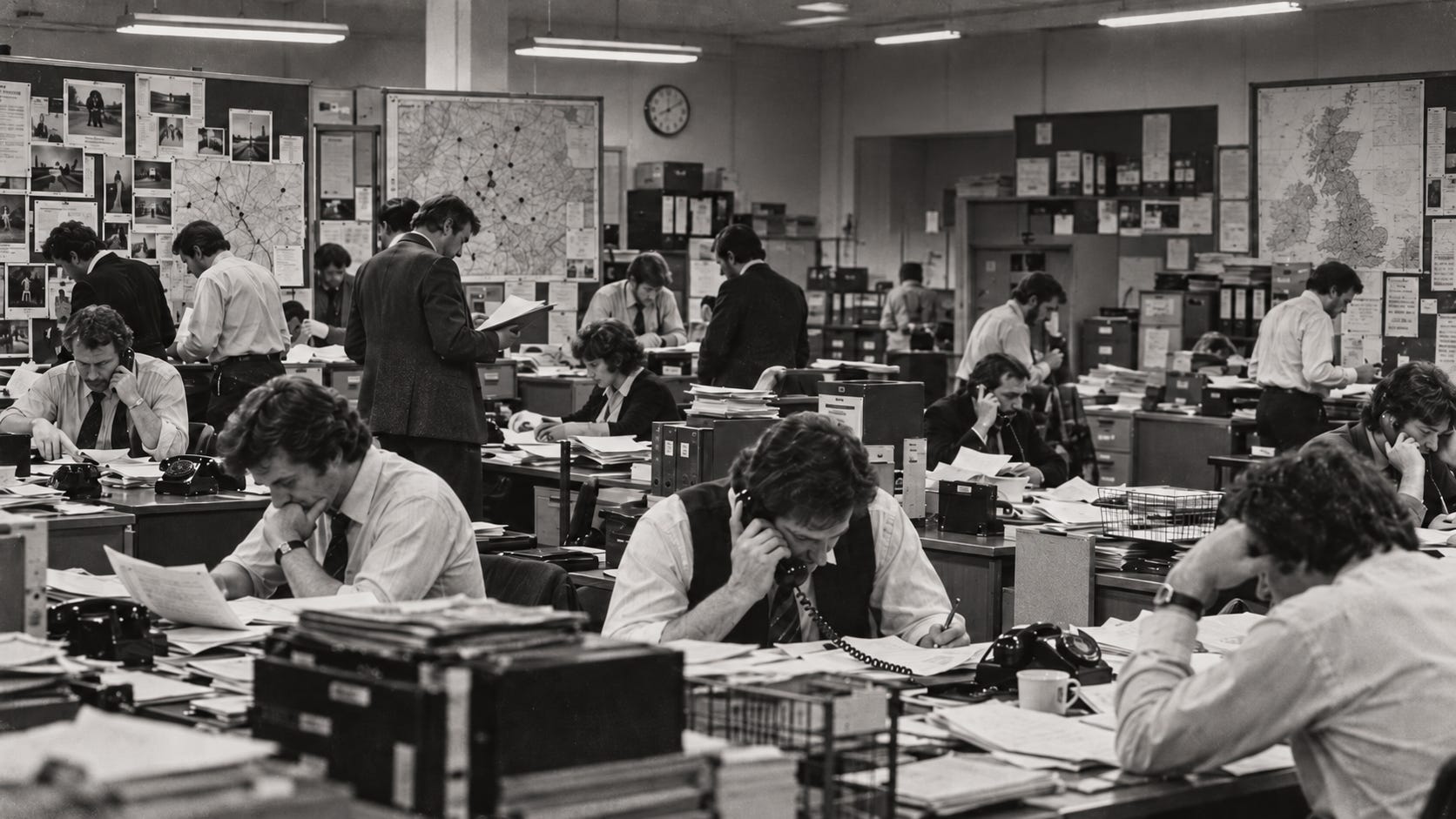
There were hundreds of detectives working on the investigation, each producing witness statements, reports and countless other documents as they carried out enquiries.
The enquiry generated around a quarter of a million names.
I can only imagine how many documents and exhibits those enquiries produced.
To put the sheer volume into context, at one police station where the enquiry was being run, the floor of the room used to store the documentation had to be reinforced to take the weight.
An absolutely colossal amount of information. All on paper.
There were no computers.
Everything had to be recorded, indexed and cross-referenced by hand.
The challenge wasn’t a lack of information. It was finding the one piece that mattered.
Added to that, the attacks were carried out across multiple police forces, each with their own investigations.
It was hard enough to keep track of the information within one force, let alone across several.
So, as much as every attack created new opportunities. It also created an enormous amount of new work.
Earlier, I mentioned Jack the Ripper. His murders took place around 90 years before those committed by the Yorkshire Ripper. Yet, in many respects, the methods available to catch a serial killer hadn’t changed as much as you might think. The biggest advance was the use of fingerprints. But if an offender took care not to leave them behind, they offered little help.
If we fast forward less than 40 years to the murder investigations I worked on, the opportunities available to detectives were a world apart. DNA. CCTV. ANPR. Mobile phone analysis. Digital forensics. Methods that would have seemed like science fiction to the detectives investigating the Yorkshire Ripper. That’s why I think it’s unfair to judge them by today’s standards.
Before I go any further, it’s worth saying that I’ve deliberately not covered every victim and every attack. Not because they’re any less important, but because this isn’t intended to be a complete account of the case. My focus is on the investigation itself and some of the key moments that shaped it.
One of those moments came in March 1978.
By then, detectives had been investigating for almost three years. Eight women had been murdered, and several others had survived attacks.
They were under enormous pressure. Not just from the public, but from themselves.
Every day the killer remained unidentified carried the possibility of another attack.
And just picture what it felt like being one of those detectives when news filtered through that there was a new victim.
I’ve been there. For me, it wasn’t a serial killer, but a series of linked sexual assaults. And over several weeks rather than several years. But each time I heard we had a new victim, it increased the pressure I felt to catch him before he could hurt anyone else. I can only imagine what that must have been like when the victims were being murdered.
So, I think it’s important to bear that pressure in mind when looking…