Businesses comparing SEO and PPC agencies are choosing between long-term organic visibility and immediate paid search traffic, though most modern strategies combine both approaches. Search engine optimization (SEO) builds sustainable rankings and authority over time, while pay-per-click (PPC) advertising generates instant visibility and measurable lead acquisition through targeted ads. The most effective digital marketing strategies integrate SEO and PPC data together to improve conversion performance, reduce acquisition costs, and create consistent search visibility across both organic and paid results.
Choosing between SEO and PPC agencies isn’t about picking a winner—it’s about understanding which strategy aligns with your business goals, budget, and timeline. An Austin restaurant needing customers next week faces a completely different decision than an established law firm planning for the next five years.
This guide breaks down how each approach works, what they cost, when each makes sense, and how combining them often delivers the best results. You’ll learn the key differences, see real cost comparisons, and get a framework for deciding what works for your specific situation.
SEO builds long-term authority while PPC delivers instant visibility and leads. This episode breaks down the fundamental differences between the two and reveals when to use each—or better yet, how to combine them for maximum results. Learn the smart framework for choosing based on budget, timeline, and local competition
Search Engine Optimization (SEO) is the practice of improving your website so it appears higher in unpaid search results when people look for products or services like yours. When someone in Austin searches for “coffee shops near me” or “emergency plumber,” SEO determines which businesses show up in the organic results below any paid ads. Unlike advertising, where you pay each time someone clicks, SEO builds visibility that continues generating visitors without ongoing costs per click.
The work happens in three main areas: creating content that matches what people search for, fixing technical issues that might prevent search engines from understanding your site, and building authority through links from other reputable websites. For a local business, this might mean writing helpful blog posts about your industry, making sure your site loads quickly on phones, and getting listed in local directories.
On-page optimization focuses on individual web pages and the content they contain. This includes researching the exact phrases your customers type into Google, then creating pages that directly answer those questions. You’ll also optimize elements like title tags (what appears as the blue link in search results), meta descriptions (the preview text below the title), and headers that organize your content.
An Austin restaurant might create a page targeting “best brunch in East Austin” with menu details, photos, and information about weekend specials. The page title, headers, and content would naturally incorporate related terms people actually search for.
Technical SEO addresses the behind-the-scenes elements that help search engines crawl and understand your website. This includes site speed (how quickly pages load), mobile responsiveness (how well your site works on phones), and site structure (how pages connect). Search engines favor websites that provide smooth experiences—pages that load in under three seconds, work perfectly on any device, and have clean code that’s easy to process.
Local SEO targets searches with geographic intent, like “dentist near me” or “Austin web design.” This involves claiming your Google Business Profile, ensuring your business name, address, and phone number match across all online directories, and collecting customer reviews. For Austin businesses, local SEO determines whether you appear in the map pack (those three businesses Google shows with maps) when someone searches for services in your area.
Pay-Per-Click (PPC) advertising is a model where you pay a fee each time someone clicks your ad. Instead of earning visits organically, you’re essentially buying traffic by bidding on ad placement in search results, social media feeds, or other websites. Google Ads is the most common platform, though Facebook, Instagram, and LinkedIn also offer PPC options.
The ads appear at the top of search results with a small “Sponsored” label. You create ads, choose keywords to target, set a maximum price you’re willing to pay per click, and your ads compete with other businesses for those top spots.
Search ads are text advertisements that appear above organic results when people search on Google or Bing. You bid on specific keywords, write ad copy that encourages clicks, and only pay when someone actually clicks through to your website. An Austin HVAC company might bid on “AC repair Austin” to capture homeowners actively looking for help, knowing these searchers are more likely to convert into customers.
The position of your ad depends on your bid amount and Quality Score (Google’s rating of how relevant your ad is to the search). Higher Quality Scores mean you pay less per click while maintaining good ad positions.
Display ads are visual banner advertisements that appear on websites across the internet, not just in search results. These might show up on news sites, blogs, or any website that participates in Google’s Display Network. Remarketing takes this further by specifically showing ads to people who previously visited your website but didn’t make a purchase or fill out a contact form.
If someone visits your Austin bakery’s website and looks at wedding cakes but doesn’t request a quote, remarketing ads can show them your wedding cake offerings as they browse other websites later.
Local Service Ads are Google’s specialized format for service businesses like plumbers, electricians, and house cleaners. These ads appear at the very top of search results with a “Google Guaranteed” badge, and you only pay per lead (when someone calls or messages you) rather than per click. Google verifies your business credentials, insurance, and licenses before approving you for these ads, which adds credibility.
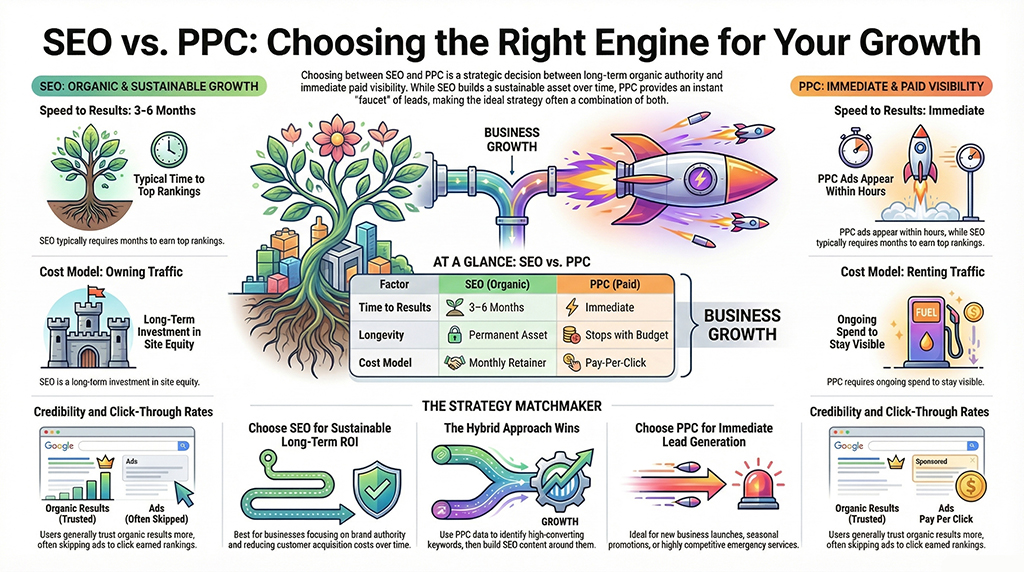
SEO and PPC take fundamentally different approaches to getting your business in front of potential customers. Understanding these differences helps you choose the right strategy for your situation.
| Factor | SEO | PPC |
|---|---|---|
| Cost Model | Monthly retainer for ongoing work | Ad spend budget plus management fees |
| Time to Results | 3-6 months for rankings | Immediate visibility |
| Longevity | Continues generating traffic | Stops when the budget runs out |
| Click Cost | Free once ranked | Paid per click |
| Targeting | Keyword and content-based | Demographics, location, interests |
| Credibility | Higher trust from users | Lower trust, marked as ads |
SEO typically involves paying a monthly retainer for ongoing work like content creation, technical fixes, and link building. You’re not paying for individual visitors—instead, you’re investing in improvements that generate free traffic over time. PPC operates on a pay-per-click model where you set a budget and pay each time someone clicks your ad.
An Austin law firm might pay $100 per click for competitive terms like “personal injury lawyer,” while a local coffee shop might pay $2 per click for “coffee shop South Congress.” The costs vary dramatically based on how many other businesses are bidding on the same keywords.
PPC delivers immediate visibility. Your ads can appear within hours of launching a campaign, generating traffic the same day. SEO takes longer—typically three to six months before you see meaningful improvements in rankings and traffic. However, those SEO results continue growing over time, while PPC traffic stops the moment you pause spending.
PPC offers precise targeting options. You can show ads only to people within a 10-mile radius of your business, only during business hours, only to people who have visited your website before, or only to specific age groups. SEO targeting happens through the content you create and keywords you optimize for, which is less precise but captures people earlier in their research phase.
Organic search results generally receive higher trust because they’ve “earned” their position through relevance rather than paying for placement. Many users skip past ads entirely to click organic results. However, PPC ads at the top of results still capture significant attention, especially for searches with clear commercial intent like “buy running shoes” or “emergency plumber.”
SEO offers compelling advantages for businesses willing to invest in long-term growth, though it comes with trade-offs.
PPC provides immediate results and precise control, balanced against ongoing costs.
Agencies structure pricing differently for SEO versus PPC, which affects both your monthly costs and when you’ll see returns.
Most SEO agencies charge monthly retainers ranging from $1,500 to $10,000+, depending on your market’s competitiveness and the scope of work. This covers activities like content creation, technical optimization, and link building. You’re paying for expertise and labor rather than ad placement, with the understanding that results build gradually over several months.
PPC agencies typically charge 15-25% of your monthly ad spend as their management fee, plus the actual advertising costs. If you spend $5,000 monthly on Google Ads, you might pay an additional $750-$1,250 for agency management. Management costs scale as your ad budget grows.
Some agencies offer pricing tied to actual results like lead generation or ranking improvements. These arrangements might include lower base fees plus bonuses for hitting specific targets. While attractive, these models require clear definitions of what constitutes a qualified lead to avoid disputes.
Choosing between SEO and PPC depends on your specific situation rather than which strategy is inherently “better.”
If you already rank on page one for some keywords, investing in SEO to expand those rankings often makes sense. However, if you’re completely invisible in search results, PPC provides immediate visibility while you build organic presence. New businesses typically benefit from running PPC initially while simultaneously investing in SEO.
Highly competitive industries like personal injury law or emergency plumbing in Austin might require 12+ months of SEO investment to rank organically. PPC becomes more practical for immediate lead generation in these situations. Less competitive niches might achieve strong rankings within 3-6 months, favoring SEO investment.
Limited budgets often point toward SEO since you’re building an asset rather than renting visibility. However, you’ll need patience for results. Larger budgets can support both strategies simultaneously. Consider that $2,000 monthly might generate 40-100 clicks via PPC in competitive markets, while the same investment in SEO could eventually generate hundreds of free clicks monthly.
Certain situations make SEO the logical primary strategy.
Businesses planning to operate for years in the same market benefit most from SEO’s compounding returns. A restaurant opening in East Austin might invest heavily in local SEO, knowing that top rankings will generate consistent customers for years without ongoing ad costs.
When monthly ad budgets are restricted, but you can afford ongoing optimization work, SEO provides better long-term value. A $1,500 monthly SEO retainer builds toward sustainable visibility, while $1,500 in PPC might only generate 15-30 clicks in competitive markets.
Specific scenarios make PPC the smarter initial investment.
Businesses requiring quick revenue—whether newly launched, seasonal, or facing cash flow challenges—benefit from PPC’s instant traffic generation. A new HVAC company might run aggressive PPC campaigns during the summer months to build a customer base and cash flow, then reinvest profits into long-term SEO.
Time-sensitive offers or seasonal promotions require immediate visibility that SEO can’t provide. A retailer running a holiday sale benefits from PPC’s ability to drive traffic within hours and pause immediately when the promotion ends.
The most effective strategies combine both approaches, leveraging their complementary strengths.
Run PPC campaigns for valuable keywords where you don’t yet rank organically, then gradually reduce ad spend as your SEO improves rankings for those terms. You might discover through PPC that “emergency plumber South Austin” converts extremely well, justifying focused SEO content creation around that search term.
PPC campaigns generate immediate data about which keywords drive conversions and what ad copy resonates. Apply these insights to inform your SEO content strategy. Conversely, use SEO data about which organic pages convert well to create targeted PPC campaigns around similar topics.
Tracking the right metrics helps you evaluate whether your investment generates acceptable returns.
Monitor monthly organic search traffic, ranking positions for target keywords, and most importantly, how many organic visitors become customers or qualified leads. A 50% traffic increase means little if those visitors don’t convert. Focus on conversion rate and cost per acquisition from organic channels.
For PPC, track your Quality Score (Google’s rating of ad relevance), average cost per click, and cost per conversion. Rising Quality Scores indicate improving campaign relevance, which lowers costs over time. If you’re paying $150 per lead and your average customer value is $2,000, that’s sustainable—but if you’re paying $150 per lead with $200 average customer value, the economics don’t work.
Recent changes in search technology are reshaping both SEO and PPC strategies.
Google’s AI-powered search features now directly answer many questions without requiring clicks to websites. This changes SEO strategy significantly—you’ll want to optimize for featured snippets, People Also Ask boxes, and AI overview appearances. Structure content with clear, concise answers to specific questions rather than just targeting keywords broadly.
Google’s automated bidding systems increasingly use machine learning to optimize PPC campaigns. This reduces manual work but also makes basic campaign management less valuable. The focus shifts toward strategy, creative testing, and conversion optimization rather than just bid management.
Understanding common agency agreements helps you avoid problematic partnerships.
Month-to-month contracts offer flexibility to leave if results disappoint, though agencies might prioritize clients with longer commitments. Long-term contracts (6-12 months) often come with lower monthly fees but lock you in even if the relationship isn’t working. For first-time agency partnerships, consider starting with a 3-month trial period before committing longer.
Quality agencies provide clear monthly reports showing exactly what work they completed, what results they achieved, and how performance trends over time. Red flags include vague reporting, refusing to share access to your own Google Analytics or Ads accounts, or inability to explain their strategies clearly.
Evaluating potential agency partners requires looking beyond sales pitches to assess actual capabilities.
Ask for case studies from Austin businesses in similar industries, including specific ranking improvements, traffic increases, and lead generation metrics. Generic testimonials mean little compared to documented results with businesses facing similar challenges. Austin Code Monkey has helped local businesses achieve measurable growth through strategies tailored to Austin’s competitive landscape.
The best agency relationships feel like partnerships rather than vendor transactions. Look for agencies that ask detailed questions about your business, explain strategies in understandable terms, and respond promptly to questions. During initial consultations, assess whether they’re genuinely interested in understanding your situation or just pitching a standardized package.
Choose agencies that stay current with search engine changes and emerging technologies like AI-powered search. Ask about their approach to voice search optimization and adapting to Google’s increasingly AI-driven results pages.
Most Austin businesses benefit from combining both SEO and PPC strategically rather than choosing one exclusively. The right mix depends on your current visibility, budget, timeline, and competitive situation, which requires personalized analysis.
Austin Code Monkey specializes in helping local businesses navigate these decisions with strategies tailored to Austin’s market. Our approach combines technical SEO expertise, local market knowledge, and data-driven PPC management. Contact us for a free consultation to discuss which strategy fits your goals and how we can help you stand out in Austin’s competitive digital landscape.
Most PPC campaigns show initial data within the first week, but meaningful optimization and consistent lead generation typically develop after running campaigns for at least one month. The first few weeks involve testing ad copy, refining targeting, and identifying which keywords actually convert rather than just generating clicks.
Yes, agencies specializing in both can provide integrated strategies that leverage data from both channels. However, verify their expertise in each area through case studies and certifications. The best combined approaches use PPC data to inform SEO content strategy and vice versa.
Professional agencies typically provide monthly comprehensive reports with weekly or bi-weekly check-ins for active campaigns, including clear metrics on traffic, leads, and return on investment. More frequent reporting might indicate micromanagement, while less frequent updates suggest the agency isn’t monitoring performance closely enough.
Modern search marketing strategies increasingly combine organic search engine optimization (SEO) and pay-per-click (PPC) advertising to balance long-term visibility with immediate customer acquisition. SEO improves a website’s authority, technical performance, and relevance so it can earn consistent organic rankings over time, while PPC campaigns provide instant placement in search results and generate performance data that helps refine targeting and messaging. When managed together, insights from paid campaigns inform organic content strategy, and SEO improvements can lower advertising costs by increasing overall search relevance and conversion quality. Austin Code Monkey offers integrated organic SEO and PPC management services for businesses seeking measurable growth through coordinated search marketing, including technical optimization, local search visibility improvements, conversion-focused content development, and data-driven paid advertising management designed to support both short-term lead generation and long-term digital visibility.

Austin Code Monkey
Phone: (737) 932-7532
Hours: Monday – Friday, 10:00 AM – 10:00 PM
Website: https://austincodemonkey.com/
Get Started Today:
Don’t let your competitors dominate your business in search queries. Partner with Austin’s leading SEO company and ensure your business appears when and where your customers are searching. Contact Austin Code Monkey today and take the first step toward complete digital dominance in the Austin market.