America after all it is you and I who are perfect, not the next world. -- Ginsberg
This project began when I was invited to play at a reception hosted by the Orange County Museum of Art in honor of Robert Rauschenberg. I took my inspiration from Rauschenberg’s art as I programmed music for the evening, and the great range of his work gave me the freedom to choose from a variety of sounds including world music, jazz, and pop, along with other forms of electronica. Contemporary world music reflected Rauschenberg’s global vision and especially his work in the 80s which focused on local cultures and indigenous traditions. Cutting-edge electronica and acid-jazz were used liberally in the spirit of innovation and for their frequent use of sampling techniques (a form of collage) and their nature as technological art. The work of John Cage was incorporated, as was that of Fluxus artist Yoko Ono. Elements of spoken word were layered over instrumental tracks, reflecting Rauschenberg’s use of text.
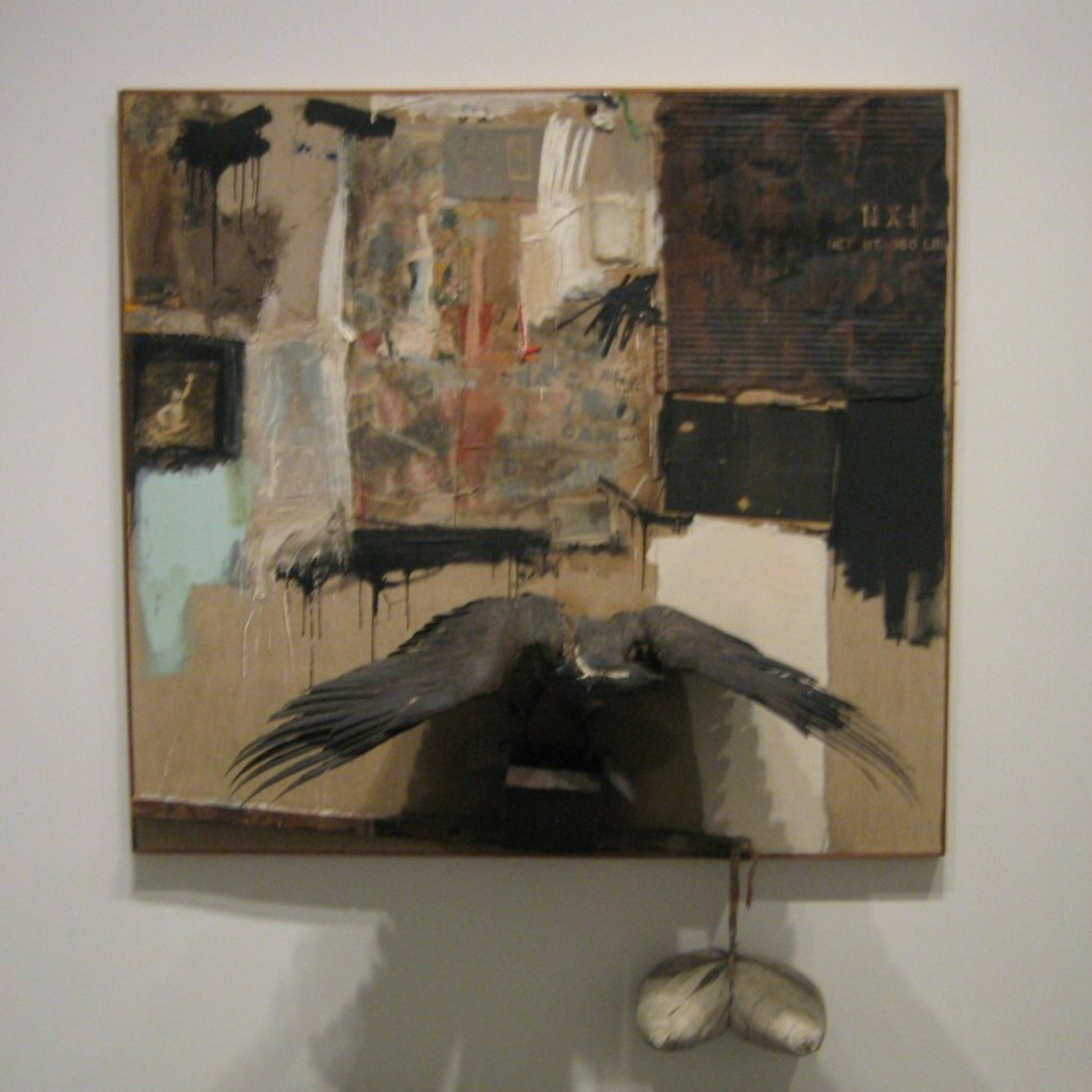
While I was pulling this material together, late at night, a bird perched near my window and began to sing (loudly). At first annoyed, I was soon struck by the strange beauty and complex patterns of the music. I put a tape recorder near the window so that I could capture the song and use it as a recurring bridge between selections. The bird song, along with background traffic and kitchen noises, was a nod to the audio component of Rauschenberg’s 1/4 Mile Piece, and was meant to evoke a multitude of associations, including the birds used in some of the artist’s works and his environmental concerns.
After the event, I was left with a number of ideas not necessarily appropriate for a party setting, but which I wanted to explore. The late artist/director John Boskovich suggested that I make a companion piece to the live recording, and the result is the Rauschenberg Alternate. Rauschenberg’s aesthetic and artistic approach (especially his work with the combines) influenced the form, content, and tone of the piece. Essentially, the work is a meditation on America, community, and individualism. Its elements are lifted directly from my life: my reading, my work with electronica, and the sounds from my window. So the aural “collage” is composed using the sounds of my life, as Rauschenberg’s combines incorporate newspaper clippings, and as some of his installations include recorded sounds.
At the time I had been reading Allen Ginsberg’s “Deliberate Prose” in addition to researching Rauschenberg, and was thinking a great deal about American politics and the place of the outsider in America. Some of the notes of introspection, spiritual resilience, and sadness reflect those musings (though certainly I view the piece as ultimately hopeful). The use of electronica then gains another dimension as it is, in other forms, the backdrop to life in many urban subcultures, and perhaps the score to modern-day disassociation. The range of rhythm tracks gives a varied texture to the collage, underscores the sentiments expressed, and helps to create the arc of the piece. The spoken passages and the bird song add counterpoint with their own distinct rhythms.
Ginsberg’s poetry (from a June, 1959 reading in San Francisco) is placed prominently, along with readings from Amiri Baraka and Carl Hancock Rux. The bird sounds, beautiful and complex, are also almost sinister in their grating, insistent tone, especially when mingled with the muffled sounds of passing cars, and to me add a certain pathos. Used as a motif and an architecture, they are ultimately ambiguous and color the piece differently depending on one’s sensibilities.
Because of my background as a club DJ, I approached the piece much as I would a condensed evening of dance. The arc that arises naturally in such an evening is reflected here, along with a sort of narrative progression. The piece opens with Ginsberg’s benediction and Leary’s initiation, and unfolds from there. It peaks with the twin statements of Ginsberg and Rux, separated by the hypnotic and melancholy "Sunbeams." "Argha Noah" is perhaps the most hopeful note, envisioning a new age emerging from the receding waters of chaos. "Because" is a directly personal statement, and the coda by the Red House Painters is meant as a tonic to all of the the electronica, and a representation of pure and simple acoustic American music.
Programmed and mixed in May of 2001