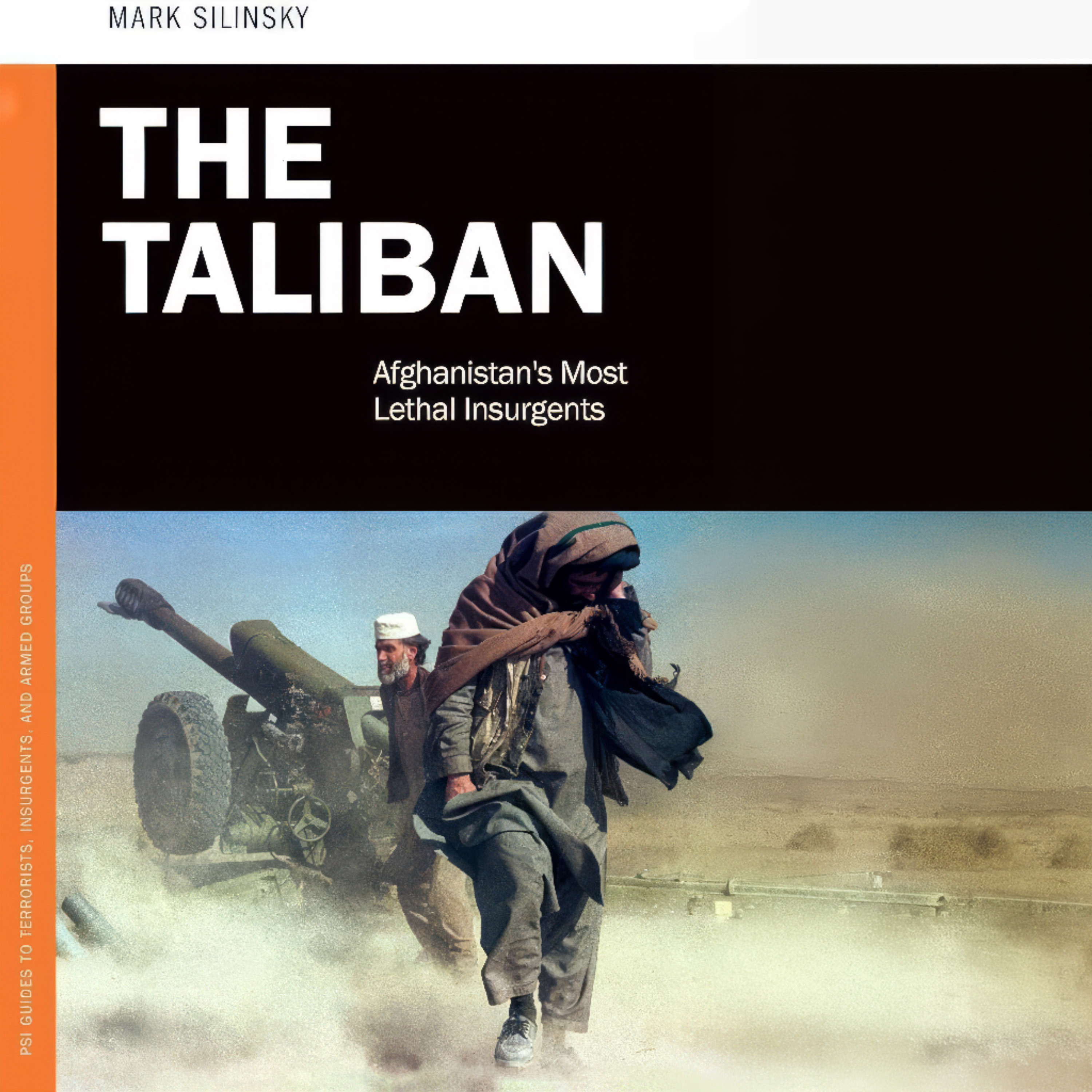
Hello and welcome to a reading from The Taliban – Afghanistan’s Most Lethal Insurgent Group, written by Mark Silinsky and published by Praeger, an imprint of Bloomsbury Publishing in New York, New York. This reading is brought to you by Kensington Security Consulting, where we bring education to national security. This reading turns to chapter four and the early American victories
In the United States, some Americans, still smarting from the September attacks on the homeland, could now lampoon those who hosted their Afghanistan-based enemy. Not all the jokes were clever, and many smacked of a conqueror’s hubris. Jokes such as, “That’s as fast as a Taliban switching sides,” showed a sardonic delight in the crumbling status of the Taliban. Despite the Christmas holiday warmth, the American public was not spared gelid humor. “What is the difference between Osama Bin Laden and the cave dwellers of Mesa Verde in Colorado? The cave dwellers survived.” But many al-Qaeda members survived, and US forces were determined to hunt them down and kill them.
Some snags, disappointments, and reverses were expected, given the sturdiness of the Taliban enemy. Many U.S. special operators found exactly what they anticipated in Taliban and al Qaeda fighters -men and boys fanatically dedicated to their cause and comrades. In early December, an American major said, “I thought Kandahar would fall in about a week, and it hasn't. I lost a lot of beers on that." But the momentum was irreversibly with the United States and its allies. One U.S. gunship pilot and part-time graphic artist, Captain Alex "Sketch" Fulford, conceded that the Taliban “still had teeth” but retorted that Americans “have pliers."
U.S. troops were particularly eager to capture or kill bin Laden, who slipped from their grip into Pakistan. But they did find his computers, hard drives, and diaries, as well as myriad documents confirming the Omar bin Laden relationship. Central Command (CENTCOM) Commander General Tommy Franks vowed prophetically, "The world is not a large enough place for him to hide."
There were other reasons for American confidence. When it became clear that the Taliban were being thrashed, many Afghans switched allegiance to the victorious Americans and Northern Alliance leaders. General Franks took delight in the village elders’ keenness to lead their tribal councils, or shuras, towards peaceful terms with U.S. forces. More than a few Taliban leaders flipped sides by late 2001. Often, there is no shame among Afghans in switching sides, as long as it doesn’t happen too frequently. In other countries, what would be considered treasonous is, in Afghanistan, seen as political chess. One Taliban commander stated in January 2002, “This is a normal thing in Afghanistan, because everyone loves their lives and wants to stay alive. We switch sides all the time.” This is hamsaya.
Profile 6 Sayed Rahmatullah Hashemi: God and Taliban at Yale
The late 2001 sudden diaspora of the Taliban forced its leadership into distant places. Most sought refuge in Pakistan; some straggled to Iran; others were cuffed and crated to Guantanamo. One enrolled at Yale. Sayed Rahmatullah Hashemi, the former Taliban spokesman and ambassador at large, though with only 4 years of standardized education, was given special student status at Yale. At 27, he was much older than the average Yale freshman. This special student was special indeed.
Hashemi grew up in the border areas of Afghanistan and Pakistan. He attended school until he was 13, and most of his English instruction came from an American charity group. In the wake of the Soviet defeat, he hitched his star to the Taliban in 1995. And, his fortunes soared. He became a spokesman and general diplomat for the Taliban government at an age when Ivy League men are usually chasing coeds. But like his meteoric ascent, his failing fortunes mirrored those of other Taliban leaders. In 2002 he was broke and unemployed with few prospects.
But he knew something of the United States, which he had visited a year earlier. As a roving ambassador, in March 2001, he spoke to students at the University of Southern California. In the shadow of Tommy Trojan, Hashemi cast Afghanistan as a victim and denied the destruction of the Buddhas. They had been worn by rain. Also, Afghanistan was tolerant of other religions. The Taliban didn’t hate or harm women. The only thing the Taliban hated was the old king of Afghanistan, whom he deprecated as “a rotten old, knucklehead.” Afghans were hungry and poor, and it was largely the fault of Western policy and the current sanctions.
But not all in the audience were charmed. A woman approached him slowly, tore off her burka, and shouted solidarity with Afghan women and scorn for the Taliban. Bridling himself, the diplomat responded, "I'm really sorry for your husband. He might have a very difficult time with you."
Hashemi made important connections as an ambassador. One proved to be his booster and got him into Yale after the Taliban were crushed. A famous political science professor, John Gaddis, wrote, "I think it's great. It seems to me that's exactly what we ought to be doing. I'm happy he is here." Even some ardent Yale feminists offered support, though cautiously and convolutedly. A co-ed explained, "As a white American feminist, I do not feel comfortable making statements or judgments about other cultures, especially statements that suggest one culture is more sexist and repressive than another. American feminism is often linked to and manipulated by the state in order to further its own imperialist ends."
But many Yale alumni were not so supportive. A gay Yalie was not keen on bunking with a dorm mate who “not only discriminated against gays, but actually stoned them to death.” U.S. Army Captain Flagg Youngblood protested, “That my alma mater would embrace an ambassador from one of America’s declared and defeated enemies and in the same breath keep ROTC and military recruiters off campus shows where Yale’s allegiance falls. Yale’s actions show that they consider the U.S. military more evil than the Taliban.
David Bookstabber added to the brouhaha by instigating a campaign to mail plastic fingernails to Yale’s administration. The fingernails were symbolic of the Taliban’s practice of yanking out the fingernails of women who wore nail polish in the time of the Taliban. An administrator in the law school's development office barked incredulously at Mr. Bookstabber, "What is wrong with you? Are you retarded?" In response to the “Nail Yale” hullabaloo, the dean of admissions at explained that if Yale didn’t admit the Taliban, he would have “enrolled at Harvard.”
Hashemi did not make the final cut for regular admissions. Whether or not the plastic-nail, mail-in protests were effective, or if Hashemi didn’t pass the Ivy League academic muster, the candidate was not accepted to George Bush’s alma mater. Some chuckled that he was “Talibanned.”
Thank you for listening to this reading from “The Taliban – Afghanistan’s Most Lethal Insurgent Group.” If you enjoyed it, please consider subscribing and liking it. Nothing in this book represents the official position of any person or agency of the United States government. On behalf of Kensington Security Consulting, thank you for listening.