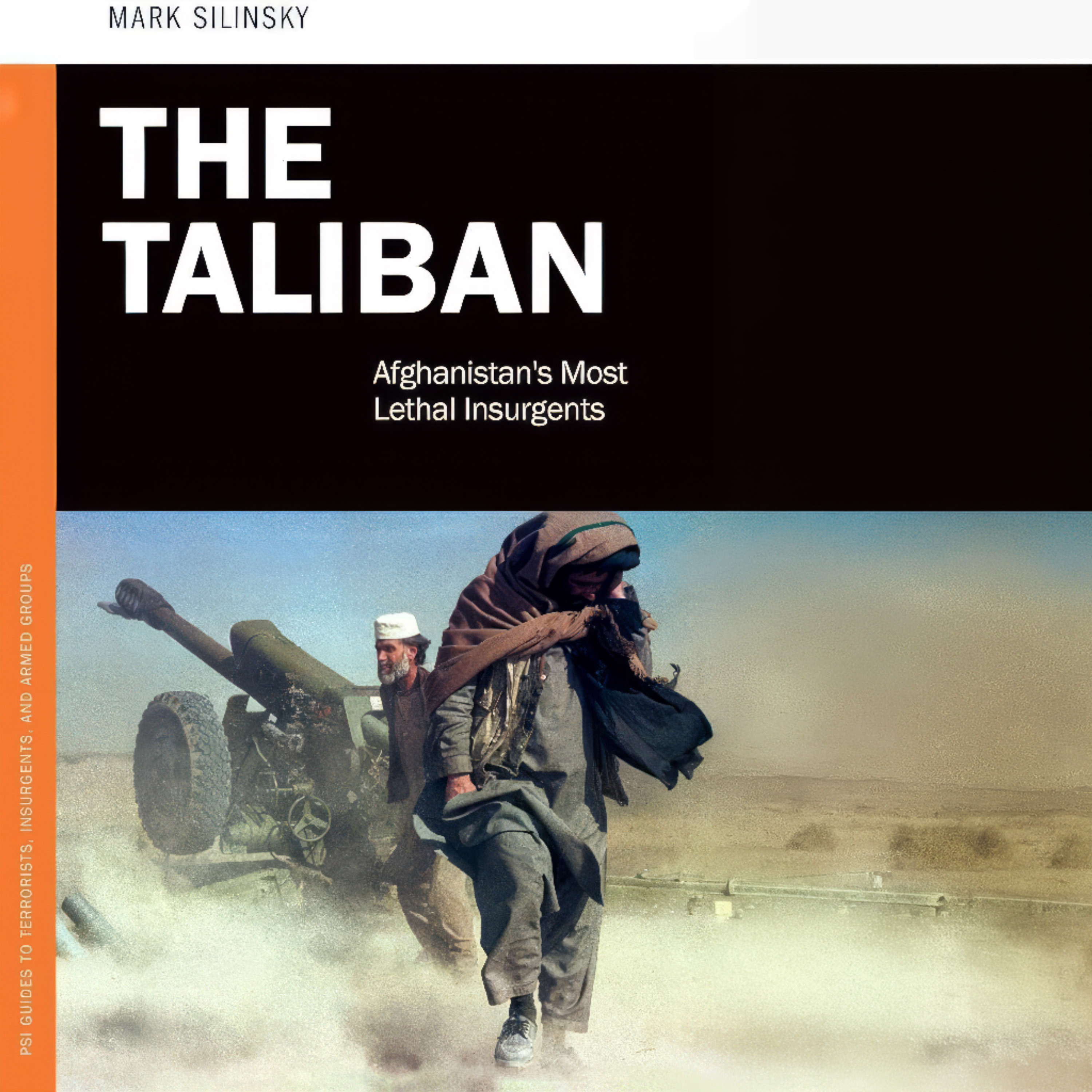
Hello and welcome to a reading from The Taliban – Afghanistan’s Most Lethal Insurgent Group, written by Mark Silinsky and published by Praeger, an imprint of Bloomsbury Publishing in New York, New York. This reading is brought to you by Kensington Security Consulting, where we bring education to national security. We begin with Chapter One: The Landscape, The People, and Islamism.
CHAPTER FOUR: THE TALIBAN IN DEFEAT
Chapter three was a brief portrait of Afghanistan during the Taliban’s rule from 1996 to 2001. Chapter four will cover the Taliban after their expulsion from Afghanistan, when the group was revived, armed, and once again lethal.
The US Prepares to Attack
The Taliban expected the United States to retaliate for hosting bin Laden, but they were optimistic about their prospects. As mujahedin, many of the Taliban’s senior leaders had engaged Soviet armor and artillery in the 1980s, and some would storm through Afghan cities as Taliban leaders in the 1990s. In autumn 2001, the Taliban were emboldened by religious zeal and nationalist hubris and challenged the United States to deploy to Afghanistan. US Special Forces would soon oblige. Al Zawahiri, al Qaeda’s second-in-command, disparaged the fighting qualities of American men. He airily asserted, “The American soldier is not fit for combat. The Hollywood promotion will not succeed on the real battlefield.” Other Muslims shared this disdain because the United States had left Somalia and Lebanon in defeat. Islamist élan had defeated Washington and could do so again.
Jingoism, religious fervor, and the prestige associated with battle drew young Afghan and Pakistani men to swell the ranks of the Taliban, literally by the busload. Trickle, then pour, through the open borders, Pakistani volunteers came to Afghanistan to fight America in a holy war. Caravans of buses, cars, motorcycles, and harlequin-colored jingle trucks ferried aspiring fighters from the Pakistani town of Quetta and the Chaman crossing to points north into Afghanistan. Much of “Pashtunistan” held solidarity with the insurgents as America prepared to invade Afghanistan in 2001.
In Pakistan, public opinion, particularly among the clergy and intelligentsia, was loudly opposed to US military action against Afghanistan. The streets of Pakistan’s cities teemed with placard-wielding protesters railing against American intervention. Many screamed for battle. An al Qaeda leader clarified, “The mujahedeen gathered from all countries…to fight this new global Crusader alliance and their hypocritical lackeys, mercenaries, and highway bandits…The proud Afghan people fights for its (sic) faith.”
Some were clamoring for battle, but not all Afghans had an appetite for war. Many were drained and war-weary, and they remembered well the devastating effects of the Soviet and civil wars. Middle-aged men and women recalled the privations they endured as youngsters and, a generation later, now feared for the safety of their own children. Some were mystified as they should brace for an American invasion in response to attacks perpetrated by unwanted Arab guests who had long overstayed their welcome.
Furthermore, some Afghans detested the Arabs they knew. The Arab-speaking cadre who came to Afghanistan to fight the Soviets often did not learn the local customs or language, made little effort to socialize, and seemed overweening and patronizing toward indigenous Afghans.
As in Afghanistan, there was divided opinion in America about hastening to war. Muslim and left-oriented university student groups deprecated what they considered President Bush’s chauvinism. At a venue long associated with utopian pacifism and multiculturalism, more than 2,500 demonstrators on the University of California-Berkeley campus cautioned against a military response. As an example, one student pleaded, "You don't want the hand of the United States killing innocent civilians. Send them food rather than bombs.” Afghans would get both.
There were echoes of the 1960s in the media, intellectual circles, and academia, as many opinion-makers counseled against war. But there was little smash-mouthed, anti-Americanism of the earlier, radical era. The rhetoric was more dispassionate. Gary Sick, who advised President Carter on the National Security Council, recommended stringent sanctions to force the Taliban’s hand, and Steven Zunes warned that military attacks would enrage and embolden Muslims around the world. Richard Falk of Princeton put the onus on the Bush administration to comply with the Taliban’s demands to provide evidence that bin Laden was culpable for the attack. People for the Ethical Treatment of Animals (PETA) took out magazine ads decrying US military action in Afghanistan.
Critics in Congress voiced early concerns. Representative Cynthia A. McKinney accused the U.S. media of disseminating only “white noise.” She said in late October 2001, “I don't think anybody is supporting the Taliban, except maybe some elements of the State Department and the CIA” while, in her view, the military was contaminating the nation’s moral hygiene with its push to war. She also accused the Bush administration of having received advance warning of the September attack and intentionally failing to act.
But most Americans were resigned to, and many were eagerly anticipating, meting out punishment against those culpable for attacking America. And they were convinced that this would be a just war. When the fighting started, the United States did send food, as well as clothing, medicine, and basic provisions, to the Afghan non-combatants. But the US Air Force also dropped bombs to kill the Taliban who would not surrender.
At this time, President Bush pledged to eradicate the terrorist networks in Afghanistan and elsewhere. He famously declared, "Either you are with us, or you are with the terrorists." He underscored that these demands were not negotiable and that individuals and groups that collaborated with al Qaeda were subject to attack.
As this was happening, the Pentagon organized for war. Veteran B-52 bombers, a workhorse in the Southeast Asian war, were prepped for action in Afghanistan. Soldiers, sailors, and airmen were readied, as war planners looked to history for lessons on how to fight in Afghanistan. Defense Secretary Donald H. Rumsfeld was determined not to repeat the mistakes of other invaders of Afghanistan. He pledged to use the full spectrum of military power, but it was unclear whom the United States would be fighting. Not all of bin Laden's forces and training camps were co-located with Afghanistan’s military rulers. The United States needed more intelligence.
Thank you for listening to this reading from “The Taliban – Afghanistan’s Most Lethal Insurgent Group.” If you enjoyed it, please consider subscribing and liking it. Nothing in this book represents the official position of any person or agency of the United States government. On behalf of Kensington Security Consulting, thank you for listening