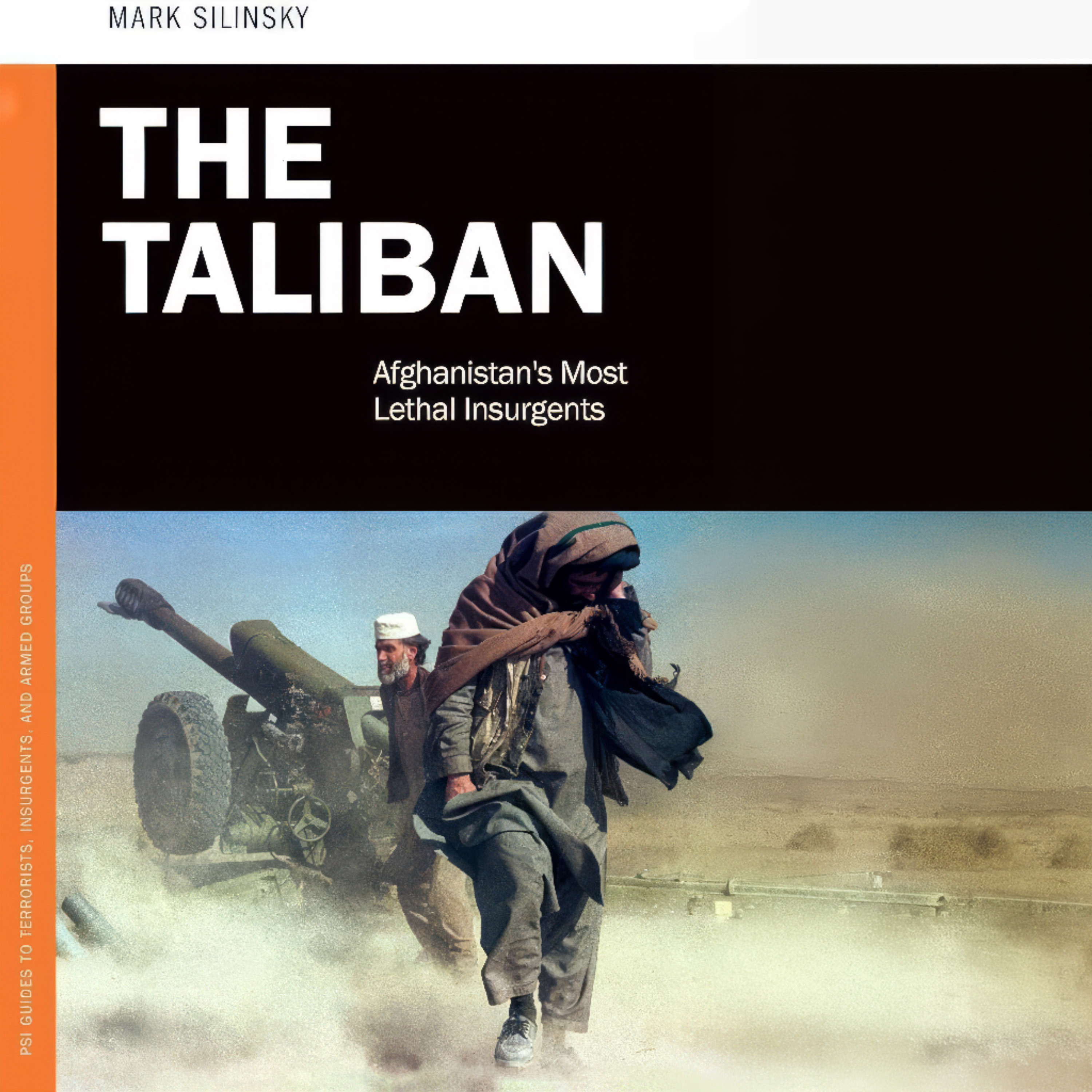
Hello and welcome to a reading from The Taliban – Afghanistan’s Most Lethal Insurgent Group, written by Mark Silinsky and published by Praeger, an imprint of Bloomsbury Publishing in New York, New York. This reading is brought to you by Kensington Security Consulting, where we bring education to national security. We begin with Chapter One: The Landscape, The People, and Islamism.
Two weeks after the attack on the US heartland, the United States deployed a small team, called Jawbreaker, under the direction of Gary Schroen, to rebuild the capabilities of the Northern Alliance. They succeeded. Schroen, a seasoned operative with vast experience in South Asia and who knew many of the leading Alliance personalities, bypassed the Pakistanis and established bases for American special operations forces. From these bases, he and his men guided the Alliance with advanced technology. In 2012, Schroen would claim, "CIA station chief Cofer Black told me, 'find Bin Laden, kill him and cut off his head, put it on dry ice and ship it back to me, and I'm going to take it down to show the President'.
The celebrated U.S. Green Berets, lauded in military folklore and popular culture, were deployed to Afghanistan. Some had trained in Pakistan and knew the languages, culture, and terrain. They studied the mujahedeen’s tactics on the Soviets in detail. They were ready.
Opposing U.S. forces were the Taliban, whose precise numbers and military capabilities were not clearly known. Many estimates were about 50,000 troops and foreign volunteers. Many Taliban were armed with AK assault rifles, some of which were locally fabricated, and some heavier individual weapons, such as rocket-propelled grenades (RPGs).
The basic Taliban fighting unit consisted of 8-10 men who were transported in the back of pickup trucks. Of the estimated 50,000 Taliban force, about 8,000-12,000 were foreign. In September and October 2001, most units were ad hoc and poorly organized. However, they were augmented by elements from the Islamic Movement of Uzbekistan (IMU) and Pakistan’s Islamist organizations. The Taliban had about 650 armored vehicles, mostly Soviet-era scout cars and armored personnel carriers. Their air force consisted of a few old Soviet fighters, used almost exclusively as bombers. There were about 10 transport planes of dubious reliability and quality.
The Fighting Starts
When Mullah Omar would not surrender bin Laden, the United States initiated hostilities. Initially, elite teams of U.S. and British soldiers were deployed to target key Taliban command and control centers. Small teams of 4-to-12 men were infiltrated to pinpoint command posts, supply depots, training headquarters for air- and sea-launched munitions that began to devastate Taliban positions in early October 2001. Targets included air defenses, military communications sites, and training camps inside Afghanistan.
American and British military and political leaders debated which set of tactics would be more suitable to ferret-out and destroy Al Qaeda and the Taliban. They determined that American and British forces should have a light ground presence and should support indigenous anti-Taliban forces, particularly from the Northern Alliance. These Afghan soldiers were rugged, eager, and well positioned to kill Taliban. Uzbekistan became a main forward based for allied forces. Tajikistan and Kazakhstan were supportive. In addition to ground fighting, U.S. bombers pulverized Taliban targets from the air.
The devastating effects became cinematic, as thermo-baric plasma bombs ignited the air in tunnels and cave complexes. The Taliban had shown ingenuity building quarters in caves with brick or cement floors and steel doors. Some of these quarters were powered by generators and had a perimeter of anti-aircraft guns and rocket launchers. Many were equipped with computers and modern communications. But this offered little protection against the blast power of U.S. advanced munitions, such as the 5,000-pound ``bunker-buster” or “big blue” the 15,000 pound relic of the Vietnam era. Also called the “daisy cutter,” the BLU-82 killed anything within a radius of 600 yards.
. In what was described as a “blowtorch effect,” many Taliban who, like their Afghan forbearers, took refuge in tunnels and caves, were cremated alive. When channeled to underground tunnels, blast pressure and heat crushed and incinerated almost anything inside. From a distance, video coverage captured small mountains collapsing under the blast of these and other U.S. munitions. The vice-chairman of the Joint Chiefs of Staff, General Peter Pace, said, “As you would expect, they make a heck of a bang when they go off, and their intent is to kill people.”
It was hard for Taliban and al Qaeda to escape the allied juggernaut, though bin Laden and some of his compatriots famously and sometimes inexplicably did so. U.S. aerial surveillance craft prevented large deployments of Taliban from taking effective shelter, which was often a death sentence. Some of the munitions were guided, and others were unguided. This war initiated the widespread use of Global Hawk unmanned spy planes and Predator-launched drone warfare. Another advantage for the United States was the ability to deploy and resupply hundreds of assault troops by helicopter onto a mountain target.
Not all the warfare was gory, and there were moments for the human touch in battle. After U.S. Army Rangers stormed the compounds of the in-flight Taliban, they left American mementos. In mid-October, soldiers left the famous photograph of American firefighters hoisting the U.S. flag in the rubble of the World Trade Center on September 11, 2001. The Rangers also left some American graffiti on the walls of a Kandahar building, which read, “Freedom Endures.”
Across Asia, Europeans were largely sympathetic to Washington’s efforts. Britain and the Netherlands ranked as the European countries with the highest levels of support. Queen Elizabeth II expressed "disbelief and total shock" at the September attacks at St Paul's Cathedral. Polls revealed that half of all Europeans championed what President Bush called the “War on Terrorism.” Parisians, often very reluctant to praise American foreign policy, were very responsive to President Bush’s decision to fight. About two-thirds of the French backed the American war on the Taliban in October 2001. Many European intellectuals recognized the attacks as a threat to the core tenets of international order and law. For there to be peace in the world, there needs to be war on the Taliban.
As the Taliban became a global news story, European journalists sought new angles to cover the war. Over the course of the insurgency, several would be abducted, and some would be killed. British journalist, Yvonne Ridley, infiltrated herself in the Taliban’s lair in late September 2001 and was caught immediately. In Taliban captivity, she became a sensation on Fleet Street and, after she was released 10 days later, took a new job for Al Jazeera. She then became a Muslim.
But others saw her, as well as some other headline-grabbing journalists, as narcissistic and irresponsible. During the ordeal, her 9-year-old daughter, Daisy, begged for her mother’s life on television. After the mother was released, a pouting Daisy confided on an open microphone, “I wish you were a normal mummy…No one else's mummy has been caught by the Taliban.”
Thank you for listening to this reading from “The Taliban – Afghanistan’s Most Lethal Insurgent Group.” If you enjoyed it, please consider subscribing and liking it. Nothing in this book represents the official position of any person or agency of the United States government. On behalf of Kensington Security Consulting, thank you for listening.