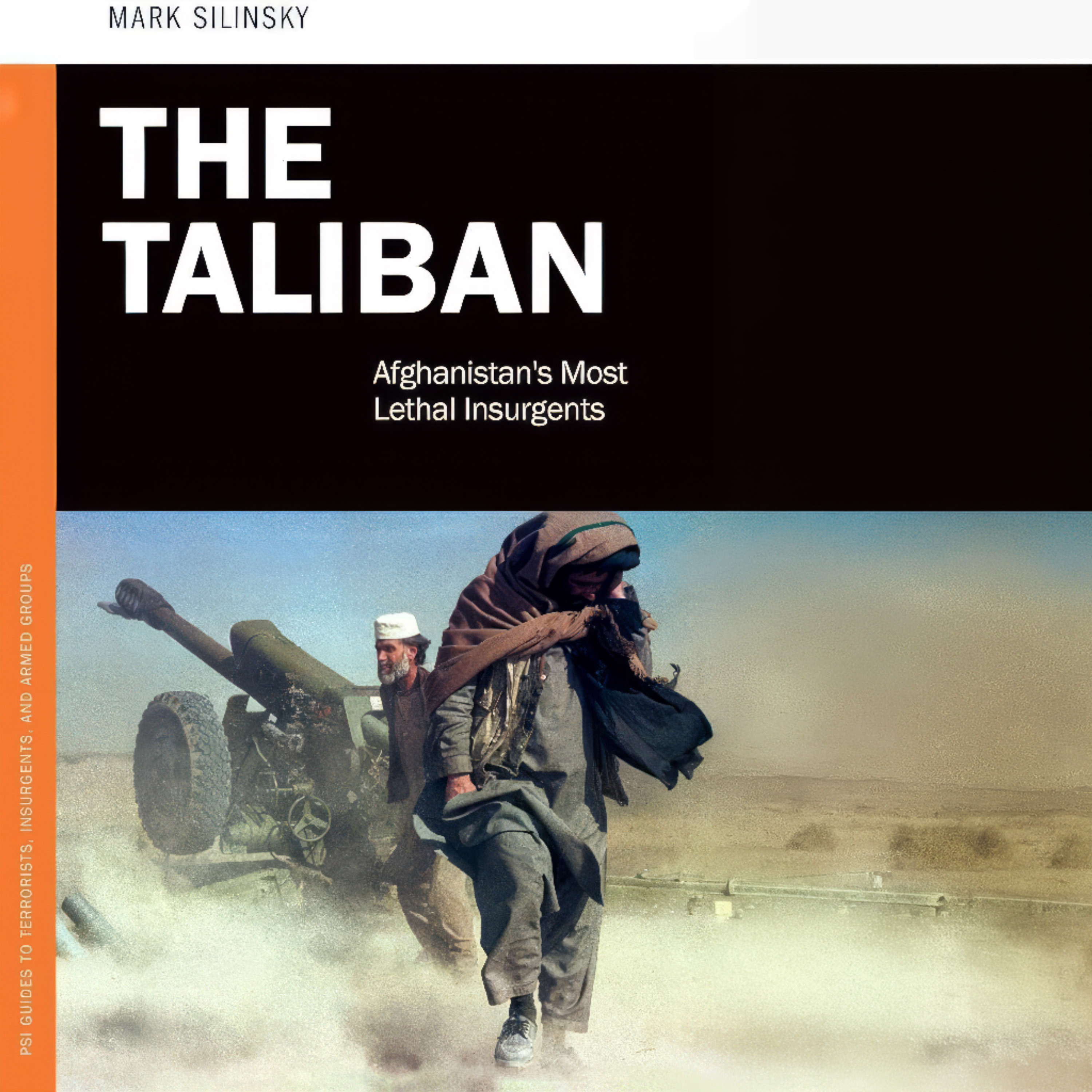
Hello and welcome to a reading from The Taliban – Afghanistan’s Most Lethal Insurgent Group, written by Mark Silinsky and published by Praeger, an imprint of Bloomsbury Publishing in New York, New York. This reading is brought to you by Kensington Security Consulting, which brings education to national security. We begin with Chapter One: The Landscape, The People, and Islamism.
Tactics
From Timid Tactics to Blitzkrieg Warfare
Some of the early tactics, especially during their first rise to power in the mid-1990s, were unconventional and often daring, known as “Mad Max style.” They were effective, though primitive. Also called “blitzkrieg” combat, some early Taliban tactics involved heavily armed men supported by armored pickup trucks plunging into enemy positions. These tactics were developed by the mujahideen in the 1980s. They stripped weapons from Soviet MI-8 and MI-24 gunships and mounted them on pickup trucks. These were initially used against the Northern Alliance and later against the Coalition. They called these armed trucks, which formed a makeshift cavalry, ''ahu,'' or deer.
In this tactic, pickup trucks armed with crew-served weapons charged at full speed, firing as they advanced to disorient the targets. In some charges, as many as 50 trucks participated, shooting, terrorizing, and scattering the enemy. Some of these attacks proved effective.
Many of the Taliban’s vehicles suited the environment well. The al Qaeda leader and strategist Al-Adel, in his observations of early battles, praised the durability and adaptability of the “Corolla vehicles.” Not all of the Taliban’s trucks were Toyotas, but Adel joked that “if the Japanese had seen the vehicles in action, they would have used them in advertisements.” Motorcycles, called “iron horses,” along with living, four-legged horses, were quick and agile, well suited to mountainous terrain. Horses often replaced trucks in transporting leaders to hidden caves and encampments. Like other insurgents, the Taliban preferred traveling light, relying less on roads or logistical resupply. But the Taliban dominate their environment and have mastered desert-like terrain.
By 2003, the Taliban began to conserve some of their larger-caliber munitions. According to al-Adel, the Taliban and al Qaeda stopped firing on Coalition aircraft because their anti-aircraft guns were not accurate enough to bring them down. Also, firing these weapons revealed their location and invited counterfire from Coalition forces.
Profile 15: Aafia Sadiqui - Brandeis’ Lady Al Qaeda
In some ways, Dr. Aafia Sadiqui (sometimes spelled Saddiqui or Siddiqui) fits the standard profile of many American-educated Islamists. Like several other al Qaeda compatriots who studied in the West, the Pakistan-born, Texas-raised, MIT-educated neuroscientist was heavily involved in Islamic activities during her university days in Boston. She was active in the MSA.
She earned advanced degrees in the sciences. What certainly sets her apart from other al Qaeda cadre is her receipt of a Ph.D. in brain science from Brandeis University, an unlikely venue for promoting Islamic supremacy. In Boston, where she lived in the late 1990s, she became deeply involved in the Muslim community, particularly the more devout subculture. She became involved in the workings of the Islamic Society of Boston, where the Tsarnaev brothers would later attend services. She became enamored of the works of Abdullah Azzam. She married a Pakistani, had three children, got divorced, and then left the United States for Pakistan on Christmas Day 2002. She married the nephew of Khalid Sheik Mohammad (KSM), the planner of the September 2001 attacks, who is also a cousin of Ramzi Yousef, a man convicted of the 1993 World Trade Center bombing. People joked that she married into al Qaeda royalty. What happened during the next 5 years remains mysterious.
She was arrested at a border crossing into Afghanistan and remanded to U.S. authorities. She possessed information on chemical and biological weapons and other documents found on a disk that were connected to terrorist operations. She also possessed sodium cyanide and couldn’t explain why she was carrying it into Afghanistan. Earlier, KSM had mentioned her name. He accused her of being involved in al Qaeda fund-raising operations. While in U.S. custody, Sadiqui obtained an assault rifle and, screaming profanities, fired at a U.S. soldier. She missed, but the soldier returned fire, striking her in the abdomen. She survived and was brought back to the United States to stand trial.
At trial, her lawyer claimed that Sadiqui's identity had been stolen by a woman who might have worked with KSM. In court, Lady al Qaeda, who had become a sensation in her native Pakistan, began to act brusquely. Despite her ties to Brandeis, Aafia demanded that no Jews sit on her jury. She shouted at Judge Berman, “The next question will be on anti-Semitism. Israel was behind 9/11. That's not anti-Semitic!” She yelled at an Army officer, "I was never planning a bombing! You're lying!” Her facial contortions, simpering, and outbursts did not help her case. In September 2010, the tirade-prone 37-year-old was sentenced to 86 years in federal prison for attempted murder, armed assault, and other charges.
Her case was taken up by Yvonne Ridley in Britain. Former congresswoman Cynthia McKinney dubbed the sentence “political” and proclaimed in Lahore, “I am here for Sidiqui (sic).” I decided to support her when I heard of her. The sentence was upheld on appeal in November 2012. But the whole affair confused some of Sadiqui’s old Boston acquaintances. They remembered a shy, studious, and exotic young woman who spent much time at the local mosque. "She was just nice and soft-spoken… and not terribly assertive."