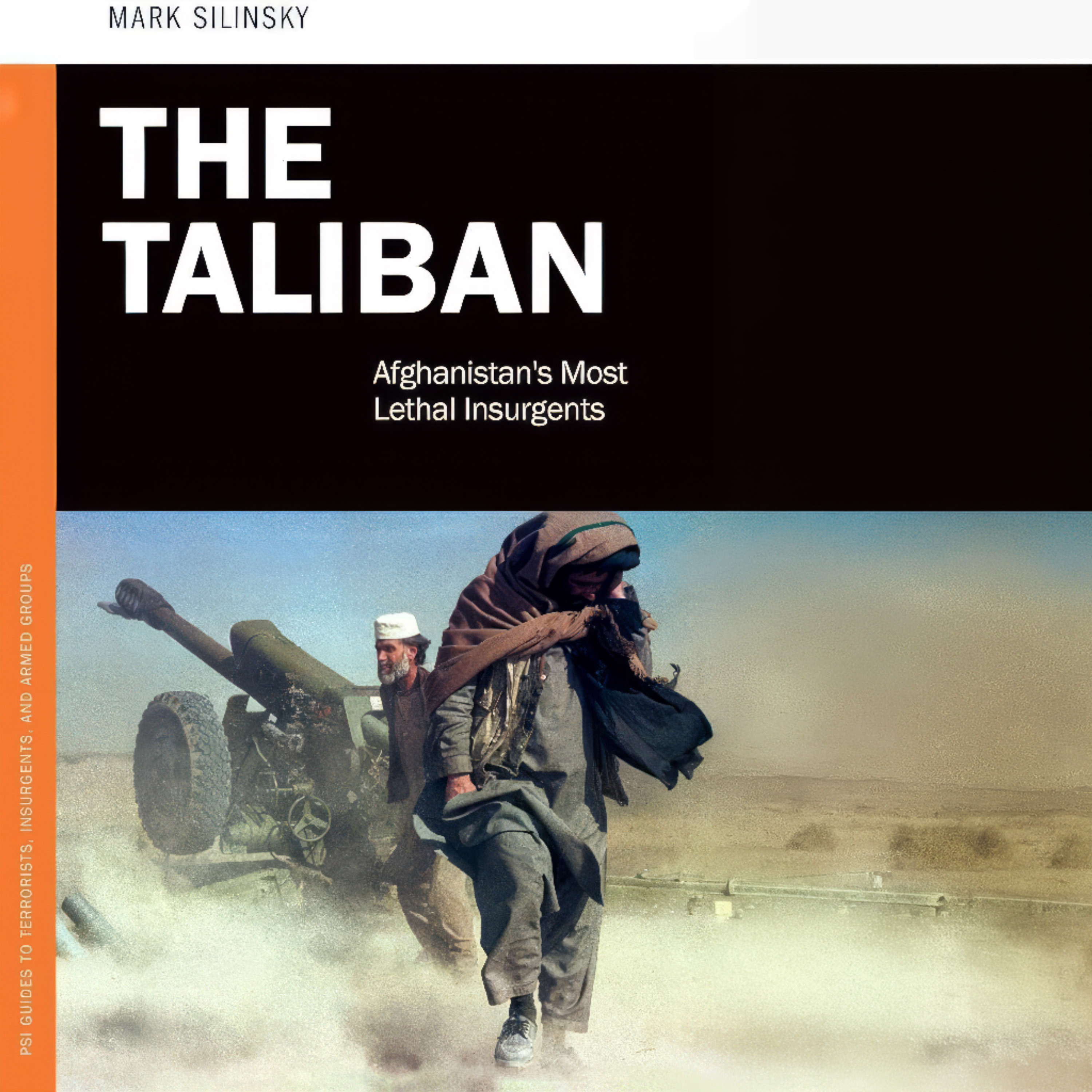
Hello and welcome to a reading from The Taliban – Afghanistan’s Most Lethal Insurgent Group, written by Mark Silinsky and published by Praeger, an imprint of Bloomsbury Publishing in New York, New York. This reading is brought to you by Kensington Security Consulting, where we bring education to national security.
Towards War
The Taliban, Foreign Relations, and the United States 1996-2001
The Taliban’s domestic plans floundered and most failed, and their foreign relations were no more successful. They had warm relations with elements of Pakistan and the Pakistani intelligence. But they did not enjoy close relations with other neighbors. The governments of Iran and Afghanistan were often at odds and sometimes came near blows during the Taliban’s reign. Part of this is explained by sectarian differences – the Taliban are Sunni and the Iranians are Shia. But the frosty diplomatic relations cannot be understood by religious division alone.
The 1998 killing of Iranian diplomats was followed by the Taliban’s accusation that Iran was funding its enemies. Early in the Taliban’s rule, the mullahs made enemies with principals in Teheran. Iranian leaders criticized the destruction of the Buddhist statues as barbaric. Several times, Iran and the Taliban came close to war. The Taliban army threatened to deploy medium-range missiles, which may not have been serviceable, to any Iranian attack. The Taliban also accused Iran of harboring Shia enemies.
After the September 2001 attacks, Afghanistan’s foreign relations suffered a significant blow when its two Arab links severed diplomatic relations. Saudi Arabia and the United Arab Emirates cut their relations shortly after the attack. Pakistan, the only other nation recognizing the Taliban government, withdrew all staff from its Kabul embassy. After Pakistan cut its relations in November 2001, Afghanistan became completely diplomatically isolated.
Well before September 2001, the Taliban had a significant image problem that could not be easily prettied-up. It would be challenging to create a government whose political philosophy, state craft, and social mores were more antithetical to US values than those of the Taliban. US Secretary of State Madeleine Albright spoke for many elites with her full-throated attack of the Taliban's treatment of women and children as ``despicable.'' This was important in Democratic Party-led Washington, where women’s issues were loudly trumpeted.
Hollywood stars, led by Meryl Streep, Geena Davis, and Sidney Poitier joined the Feminist Majority to lobby the White House and the State Department to torque-up sanctions on the Taliban cut off aid to countries that recognized and traded with them. They also entreated Washington to increase humanitarian assistance to Afghan women refugees. In a “Dear Abby” column, Mavis Leno claimed partial victory by quoting a woman in Kabul who whispered, “Let me call you the angels of mercy. Your love is our hope.”
Ms. Leno scored successes. The Department of State admitted more Afghan refugee women to the United States. American conservatives and liberals saluted the pro-woman, anti-Taliban agenda of Ms. Leno. She was applauded by the popular television host Bill O’Reilly as being a “patriot.” Nonetheless, there is no evidence that the Taliban were concerned with, or even took note, of Hollywood’s efforts.
Washington’s smart set saw Taliban leaders as primitive, patriarchal, heartless, and vulgar. To the extent to which he was known, Mullah Omar was loathed by political leaders and opinion makers in the nation’s capital. First Lady Hillary Clinton denounced the servitude in which all Afghan females subsisted. Any positive image of the Afghan fighting spirit against the Soviets was largely forgotten. Washington’s embrace of the zealous and self-sacrificial anti-Soviet Afghan mujahedeen of the 1980s had long waned by the mid-1990s.
Western media became incredulous as the Taliban revived the darkest imagery of the Nazi era. Statesmen and journalists registered disgust and alarm at the Taliban’s plans to force all Hindus in the country to wear identity tags. In turn, the Taliban were openly contemptuous of the United States. A reclusive Omar did not show interest in warming relations with the United States, and his only verified direct contact with US officials took place in August 1998, 2 days after President Clinton ordered a missile strike to blast bin Laden’s training camps. In response to the attack and fear of more strikes, Omar tried to assure State Department officials that bin Laden was leashed. But Omar refused to extradite him.
The Taliban explained that mandates of Afghan culture, particularly the requirement to give guests protection, or melmastia, precluded yielding bin Laden, who was their honored guest. The Taliban leadership claimed that they could not relinquish him to the United States without weakening the Taliban’s global prestige.
However, the US State Department was not swayed by this argument. Senior leaders proffered evidence that bin Laden was directly tied to many terrorist activities and plots. Diplomatic cables revealed bin Laden’s imprimatur in other high-profile plots, including a plan to blow up US airliners in the Pacific. In response, the Taliban underscored they “have always and always will condemn terrorism, including hijacking."
Though the August 20, 1998, missile strikes quieted, if only temporarily, Mullah Omar, it had no such effect on his most infamous guest. Ever loquacious, Bin Laden continued to inveigh against Americans, Jews, Christians, and other non-Muslims. He became particularly vocal after the missile strike, and reiterated his fatwa (religious ruling), urging Muslims to kill American, British, and Israeli citizens, and he also reserved the right to use weapons of mass destruction.
According to declassified State Department cables, Mullah Omar hoped to open a dialog with State Department officials in August 1998. In October 1999, the Taliban suggested a trial by a panel of Islamic scholars by the Organization of Islamic Conference or the United Nations. The White House was not persuaded.
Thank you for listening to this reading from “The Taliban – Afghanistan’s Most Lethal Insurgent Group.” If you enjoyed it, please consider subscribing and liking it. Nothing in this book reflects the official position of any person or agency of the United States government. On behalf of Kensington Security Consulting, thank you for listening.