Listen

Description

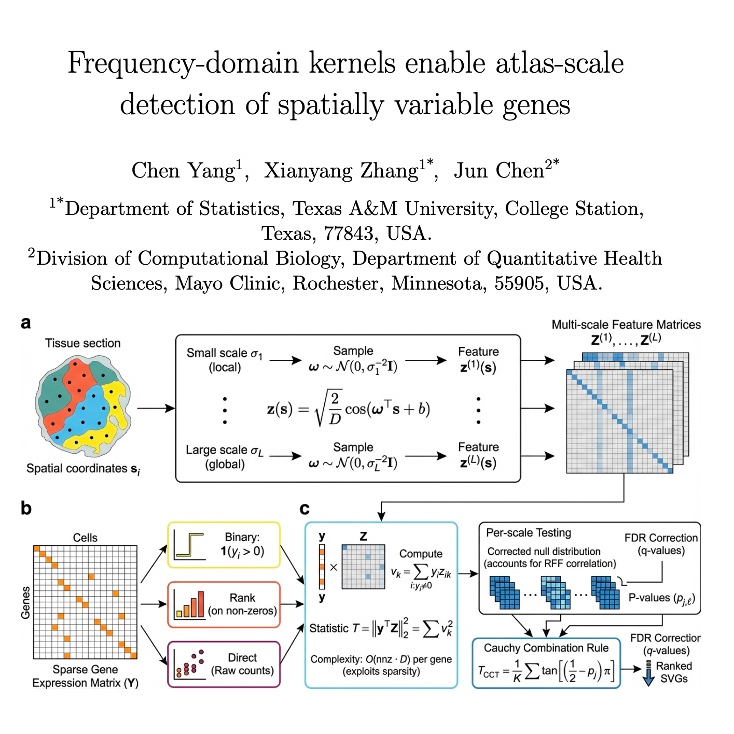
The paper introduces FlashS, a novel computational framework designed to identify spatially variable genes (SVGs) within massive spatial transcriptomics datasets. Current methods often struggle to balance statistical accuracy with the computational scalability required for million-cell atlases, frequently failing due to high memory demands or simplified models. FlashS overcomes these limitations by transforming spatial testing into the frequency domain using Random Fourier Features, which allows for the detection of complex, multi-scale patterns without the need for expensive distance matrices. The method incorporates a three-part test to handle extreme zero-inflation and a kurtosis-corrected null distribution to ensure precise statistical calibration. Across diverse benchmarks and biological tissues like the human heart and mouse brain, FlashS consistently outperforms existing tools in both speed and the recovery of biologically meaningful gene programs. Consequently, it offers a robust, memory-efficient solution for researchers mapping the functional organization of complex tissues at an unprecedented scale.

References: