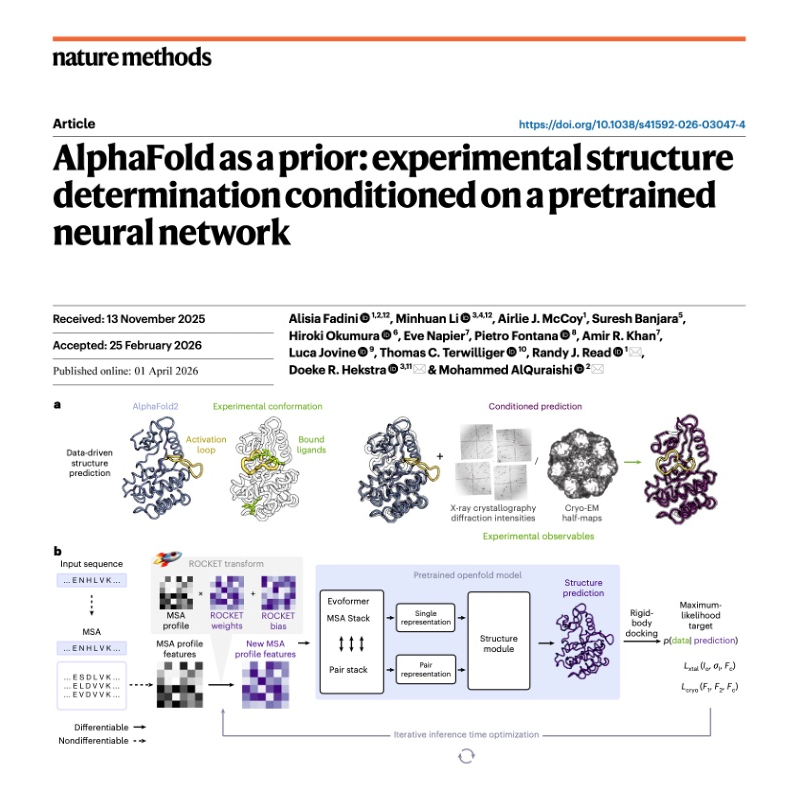
The paper introduces ROCKET, a novel computational framework that enhances AlphaFold2 by incorporating real-world data from X-ray crystallography and cryo-electron microscopy. While standard machine learning models excel at predicting protein shapes from sequences, they often struggle with dynamic conformational changes and low-resolution experimental signals. ROCKET addresses these gaps by optimizing structures within a specialized coevolutionary embedding space rather than using traditional coordinate adjustments. This method allows for the automated creation of accurate atomic models even when dealing with noisy data or significant structural rearrangements. Evidence demonstrates that the tool outperforms existing software at low resolutions, successfully capturing complex biological states that were previously difficult to model. Ultimately, the research establishes a flexible, retraining-free approach for blending experimental observations with advanced biomolecular machine learning.
References:
- Fadini A, Li M, McCoy A J, et al. AlphaFold as a prior: experimental structure determination conditioned on a pretrained neural network[J]. Nature Methods, 2026: 1-11.