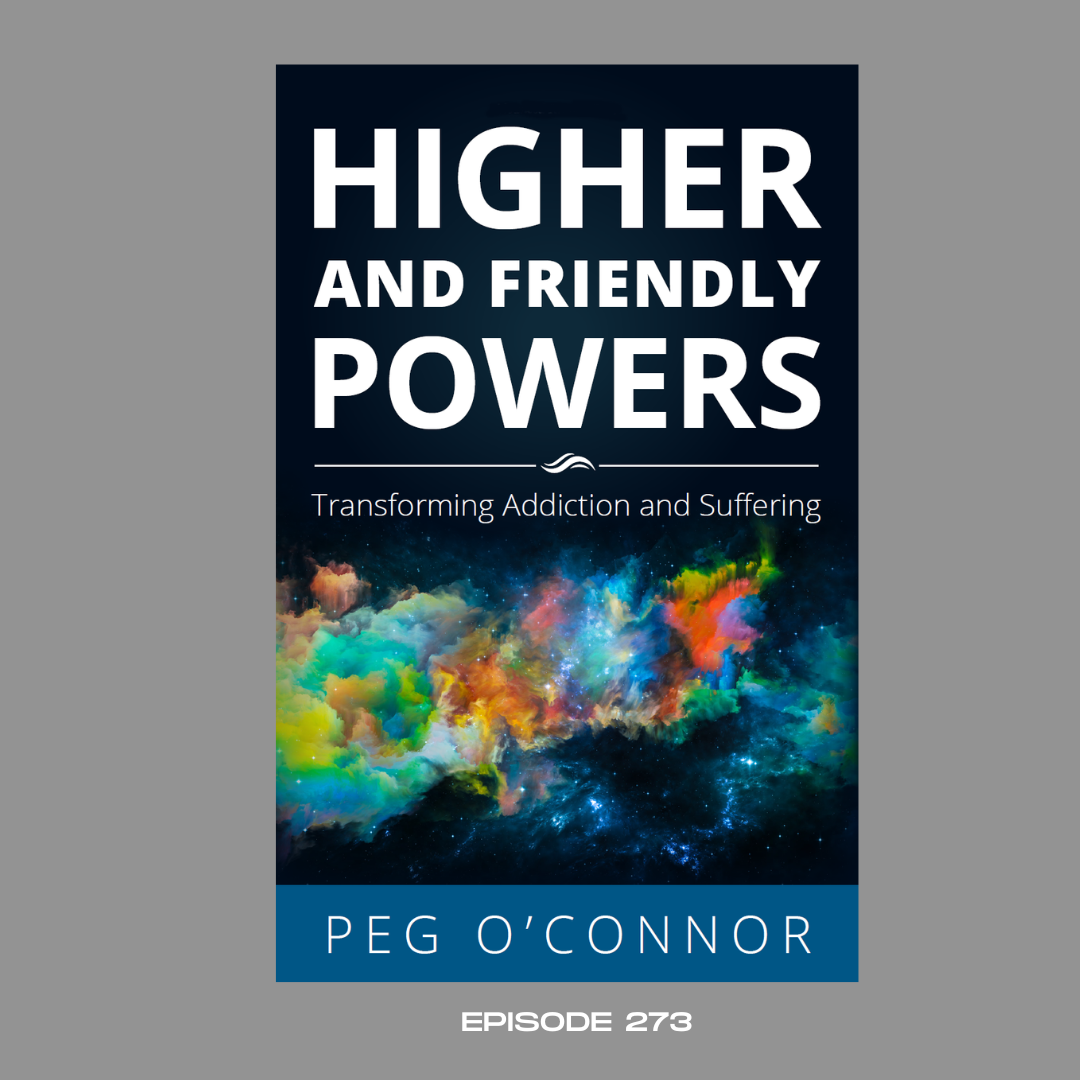
Is it possible that the “higher power” concept that animates Bill W.’s framework for Alcoholics Anonymous is based on an overly narrow reading of William James, a preeminent psychologist and intellectual giant of the early 20th century? On this episode of The Beyond Belief Sobriety Podcast, author Peg O’Connor unpacks a compelling theory as well as insights from her new book, “Higher and Friendly Powers: Transforming Addiction and Suffering.”
Many people don’t naturally resonate with the Christian-centric God at the heart of AA and enshrined in the 12 steps. Although William James used “higher power” language, his writings actually reflect a broader, more inclusive and nuanced view of spirituality. He may have deployed the term “reborn” in the context of addiction, but Peg believes it was meant to describe joyful, transformational recovery – not a specific or confining religious experience.
A professor of philosophy at Gustavus Adolphus College, Peg offers an alternative view for those who have struggled with the concept of powerlessness as a first step towards recovery. If you yearn for healing and community but feel uncomfortable with – or even alienated by – mandates to surrender, this is a thought-provoking invitation to reframe every step towards sobriety as an expansive process of engagement and self-discovery.
“I believe I make my own character, so it isn’t for some providential God to change my character. I’m responsible.” (Peg)
“When people feel they have reasons not to belong (in the AA program), that’s a problem.” (Peg)
“Physics traffics in faith as much as any discipline. So physicists makes hypotheses about things that can’t yet be proved. They become foundational and only later do they prove it.” (Peg)
“Faith (for William James) is a kind of working hypothesis. That’s all it is. There’s no special kind of religious faith. Faith is just that willingness to live on a maybe or possibility.” (Peg)
“(The idea that) my powerlessness over alcohol extends to everything else in my life, that’s the leap I couldn’t make. The language of surrender … always has negative connotations. When you surrender you’re forced to give up something.” (Peg)
“Renouncing is a very active thing to do and it’s proactive. It looks forward and says, ‘I don’t want to be that kind of person anymore.’ It opens up possibility.” (Peg)
“It’s a kind of violence to try to make someone else’s spiritual beliefs fit into your own framework or deny spiritual experiences because they don’t fit your framework.” (Peg)
“Self-knowledge is one of the most important things we need to have in life. You better know yourself because if you don’t, people will tell you who you are and how you should be.” (Peg)
Peg O’Connor is a Professor of Philosophy at Gustavus Adolphus College in St. Peter, MN, recovering alcoholic of 34 years, and author of “Higher and Friendly Powers: Transforming Addiction and Suffering” (Wildhouse Publications, 2022) and Life on the Rocks: Finding Meaning in Addiction and Recovery (Central Recovery Press, 2016). She writes the column “Philosophy Stirred, Not Shaken” for psychologytoday.com.