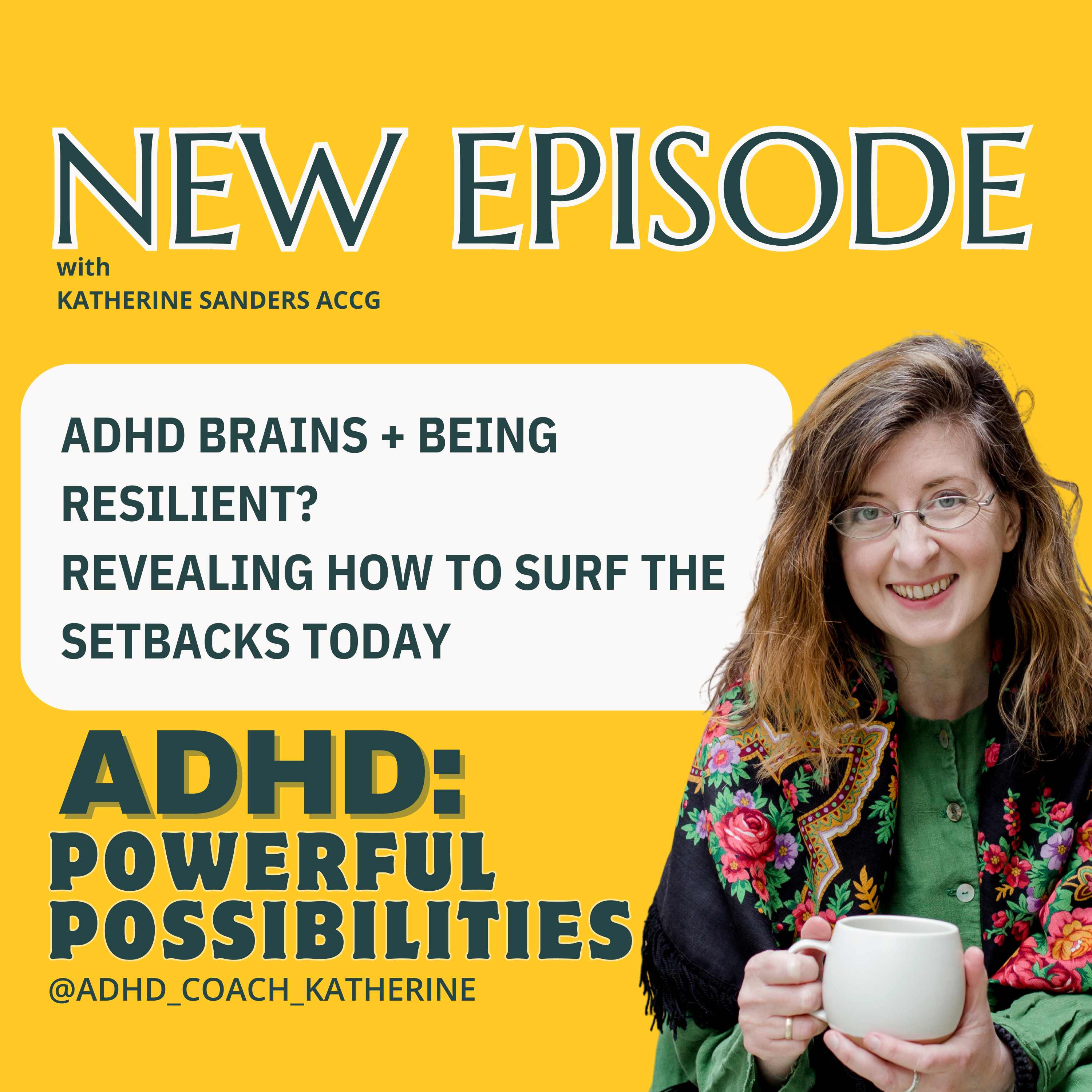
ADHD, resilience, breaking down misconceptions and exploring how those with ADHD can harness their unique strengths to build true resilience.
In This Episode:
- Understanding Resilience: What does resilience really mean for those with ADHD? clue: It’s not about ignoring your emotions or pushing through no matter what; it’s about adaptability and flexibility in the face of challenges.
- The Misconceptions of Resilience: Why has resilience gained a negative reputation and how these perceptions can be harmful, especially when they ignore systemic issues and individual mental health needs.
- Strategies for Building Resilience:
- SODAS Method: Situation, Options, Disadvantages, Advantages, Solution. A structured approach to problem-solving that can help when you're feeling overwhelmed.
- STOP Method: Stop, Take a breath, Observe, Proceed. A simple technique to manage emotional dysregulation and ensure thoughtful responses to stress.
- Mindfulness and Neuroplasticity: How practices like mindfulness can alter brain function, supported by insights from neuroscience, to enhance resilience in the ADHD brain.
Key Quotes from the Episode:
- "Instead of thinking about resilience as never feeling down, ignoring our emotions, pushing on no matter what's happening around us—that isn't resilience."
- "Resilience is actually more about adaptability. Becoming flexible and changing with the circumstances and requirements that we find ourselves facing."
Listener Interaction:
- Question of the Week: How do you define resilience? Has your perception changed after listening to today’s episode?
- Call to Action: Share your thoughts on resilience and any strategies you’ve found effective. Connect with me on @adhd_coach_katherine
If you enjoyed this episode, please consider subscribing and leaving us a review on your favourite Platform.
Your feedback helps us grow and continue providing great content. Tune in next week for more insightful discussions!
Connect with Katherine here:
Website
Instagram
Tiktok
Facebook
Youtube
LinkedIN
Threads
Dr Neff - self compassion
Stop Scan Shift - download here
Neurodivergent Practitioners Directory - https://neurodivergentpractitioners.org/
Cameron Gott - ADHD Pyramid of Needs. https://www.camerongott.com/hierarchy-of-adhd-needs
Biederman, J., & Faraone, S. V. (2006). The effects of attention-deficit/hyperactivity disorder on employment and household income. Medscape General Medicine, 8(3), 12.
- This study explores the impact of ADHD on employment and income, providing valuable insights into the challenges faced by individuals with ADHD in professional settings.
Bölte, S., & Holtmann, M. (2014). Relevance of Resilience in Childhood and Adolescence in the Context of ADHD. ADHD Attention Deficit and Hyperactivity Disorders, 6(4), 211–219.
- This article discusses the significance of resilience in the context of ADHD during childhood and adolescence, highlighting the importance of understanding and fostering resilience in individuals with ADHD from a young age.
Dweck, C. S. (2008). Mindset: The New Psychology of Success. Random House.
- Carol Dweck's book delves into the concept of mindset, particularly the growth mindset, which is relevant for individuals with ADHD in cultivating resilience and embracing challenges as opportunities for growth.
Erickson KI, Voss MW, Prakash RS, Basak C, Szabo A, Chaddock L, Kim JS, Heo S, Alves H, White SM, Wojcicki TR, Mailey E, Vieira VJ, Martin SA, Pence BD, Woods JA, McAuley E, Kramer AF. Exercise training increases size of hippocampus and improves memory. Proc Natl Acad Sci U S A. 2011 Feb 15;108(7):3017-22. doi: 10.1073/pnas.1015950108. Epub 2011 Jan 31. PMID: 21282661; PMCID: PMC3041121.
Graziano, P. A., Reavis, R. D., Keane, S. P., & Calkins, S. D. (2007). The role of emotion regulation in children's early academic success. Journal of School Psychology, 45(1), 3–19.
- This study examines the role of emotion regulation in academic success, providing insights into how emotional regulation strategies can contribute to resilience, particularly in academic settings relevant to individuals with ADHD.
Halmøy, A., Fasmer, O. B., Gillberg, C., & Haavik, J. (2009). Occupational outcome in adult ADHD: impact of symptom profile, comorbid psychiatric problems, and treatment: a cross-sectional study of 414 clinically diagnosed adult ADHD patients. Journal of Attention Disorders, 13(2), 175–187.
- This study investigates the occupational outcomes of adults with ADHD, shedding light on the challenges they face in professional settings and the role of resilience in navigating these challenges.
Loe, I. M., & Feldman, H. M. (2007). Academic and educational outcomes of children with ADHD. Journal of Pediatric Psychology, 32(6), 643–654.
- This article discusses the academic and educational outcomes of children with ADHD, highlighting the importance of resilience in overcoming academic challenges and achieving success in educational settings.
Ramsay, J. R., Rostain, A. L., & Bishop, J. (2016). The Adult ADHD Tool Kit: Using CBT to Facilitate Coping Inside and Out. Routledge.
- This book offers practical tools and strategies, including cognitive-behavioral therapy (CBT), for coping with ADHD challenges in adulthood, emphasizing the role of resilience in managing symptoms and improving overall functioning.
Stixrud, W., & Johnson, N. (2018). The Self-Driven Child: The Science and Sense of Giving Your Kids More Control Over Their Lives. Penguin Books.
- William Stixrud and Ned Johnson's book explores the importance of autonomy and resilience in children and adolescents, providing insights into fostering resilience from a young age, which is relevant for individuals with ADHD.
Littman, A. J., White, E., Satia, J. A., Bowen, D. J., & Kristal, A. R. (2006). Reliability and validity of 2 single-item measures of psychosocial stress. Epidemiology, 17(4), 398-403.
- This study assesses the reliability and validity of single-item measures of psychosocial stress, which are relevant for understanding the relationship between stress, resilience, and ADHD symptoms.
Marshall, S. A., Zentall, S. S., & Muchinsky, M. M. (2011). Achievement, emotional intelligence, and personality: A study of ADHD and non-ADHD college students. Journal of Attention Disorders, 15(2), 130-139.
- Investigating the relationship between achievement, emotional intelligence, and personality traits in college students with and without ADHD, this study sheds light on factors contributing to resilience and success in academic settings.
Mikami, A. Y., & Hinshaw, S. P. (2006). Resilient adolescent adjustment among girls: Buffers of childhood peer rejection and attention-deficit/hyperactivity disorder. Journal of Abnormal Child Psychology, 34(6), 823-837.
- This research explores factors contributing to resilient adjustment in adolescent girls, including the buffering effects of childhood peer rejection and ADHD symptoms, offering insights into protective factors that promote resilience.
Molina, B. S., Hinshaw, S. P., Swanson, J. M., Arnold, L. E., Vitiello, B., Jensen, P. S., ... & Houck, P. R. (2009). The MTA at 8 years: Prospective follow-up of children treated for combined-type ADHD in a multisite study. Journal of the American Academy of Child & Adolescent Psychiatry, 48(5), 484-500.
- This longitudinal study provides insights into the long-term outcomes of children with ADHD, including factors associated with resilience and positive adjustment over time.
Owens, J. S., Goldfine, M. E., Evangelista, N. M., Hoza, B., & Kaiser, N. M. (2007). A critical review of self-perceptions and the positive illusory bias in children with ADHD. Clinical Child and Family Psychology Review, 10(4), 335-351.
- Examining self-perceptions and the positive illusory bias in children with ADHD, this review offers insights into factors that may enhance resilience and self-esteem in individuals with ADHD.
Skirrow, C., McLoughlin, G., Kuntsi, J., & Asherson, P....