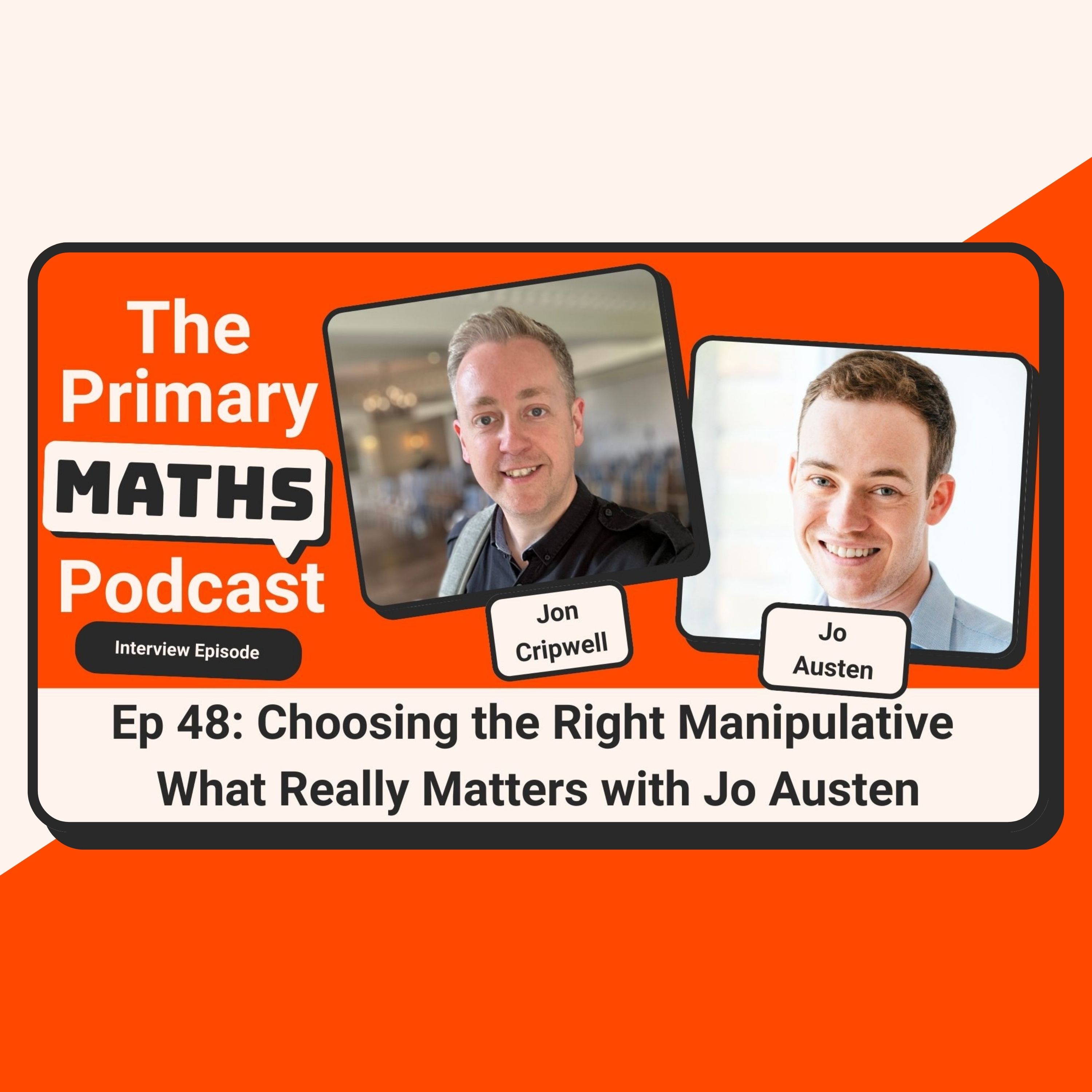
How do we decide which manipulative to use in a maths lesson, and why does that choice matter so much?
In this episode, I am joined by Jo Austen for a practical conversation about manipulatives, models, and professional judgement. Rather than treating resources as interchangeable or decorative, Jo helps us think carefully about what different manipulatives do mathematically, and what they quietly emphasise or obscure.
We explore how manipulatives fit within the CPA approach, why different models foreground different mathematical structures, and how physical properties such as loose parts, fixed parts, colour, and layout shape what pupils notice. We also discuss when virtual manipulatives can add real value, and where physical resources still play an essential role.
Along the way, Jo makes a compelling case for forward-facing maths: choosing representations not just to get through today’s lesson, but to build understanding that will support pupils later on. This is a conversation about preparation rather than performance, and about making deliberate choices that support thinking rather than replace it.
In this episode, we discuss:
If you have ever wondered why a particular resource works, or does not work, in your classroom, this episode will help sharpen your thinking.