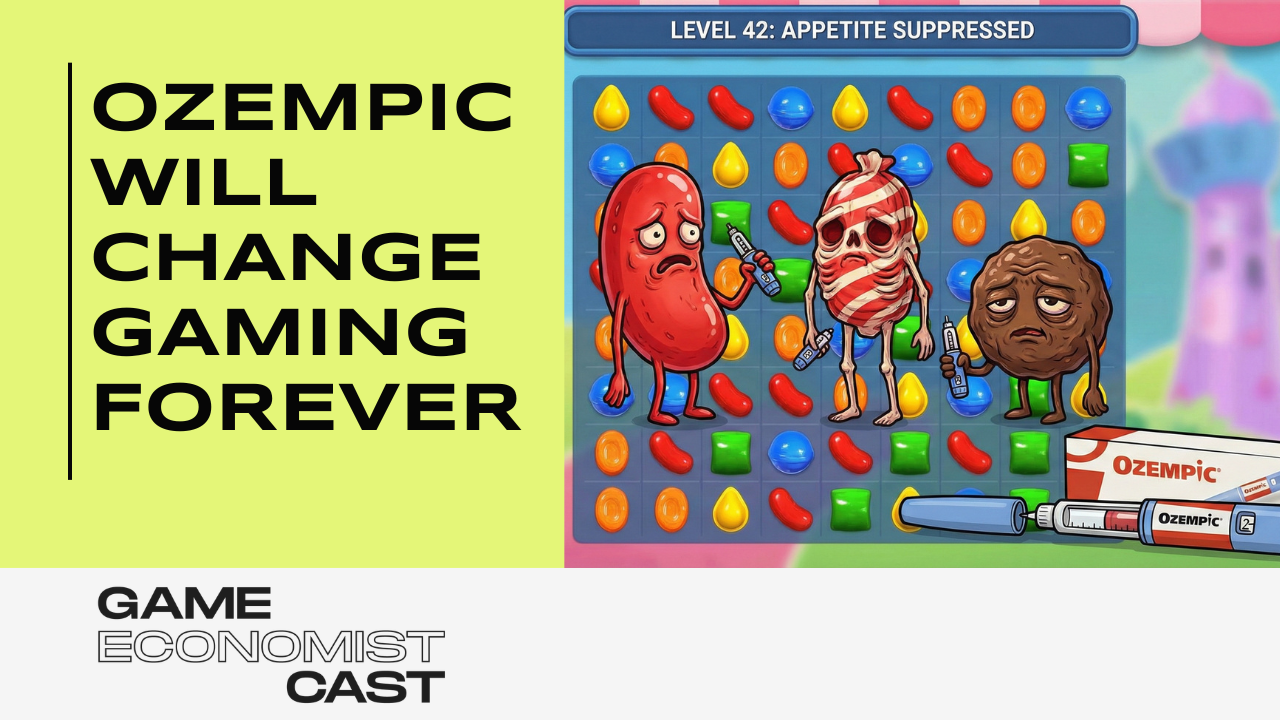
If the majority of mobile casuals' target audience takes Ozempic, what effect does that have on games? No one's asking these questions, so welcome to the Game Economist Cast.
Weight loss drugs, AI copilots, and gambling apps dominated the most expensive media real estate on earth, and games were barely in the frame. In this episode, we unpack what that signal means for interactive entertainment, Eric uncovers Riot’s 2XKO downsizing to Google’s Genie 3, and the future of engines. Phil previews his GDC talk on the economics of a billion-dollar cosmetic economy, Chris breaks down his attempt to design and publish a trading board game, and we ask a harder question: in a world of Ozempic and infinite AI supply, what actually happens to gaming demand?
We discuss:
• The 2XKO reset and the economics of niche within niche genres
• Team size, burn rate, and why a 160-person fighting game team changes the break-even math
• Free to play cosmetics versus box price DLC in a capped DAU genre
• Why betting apps can out-monetize most games on ARPDAU
• How appetite suppression might reallocate time, spending, and loop sensitivity
• Genie 3 and the cost curve of game production
• Engines as rule governance layers in a probabilistic content world
• Cosmetic economies as foundational theory
• Scarcity, signaling, and equilibrium pricing in digital status markets
• Price discovery, private information, and turning trade into tabletop play
Listen now!