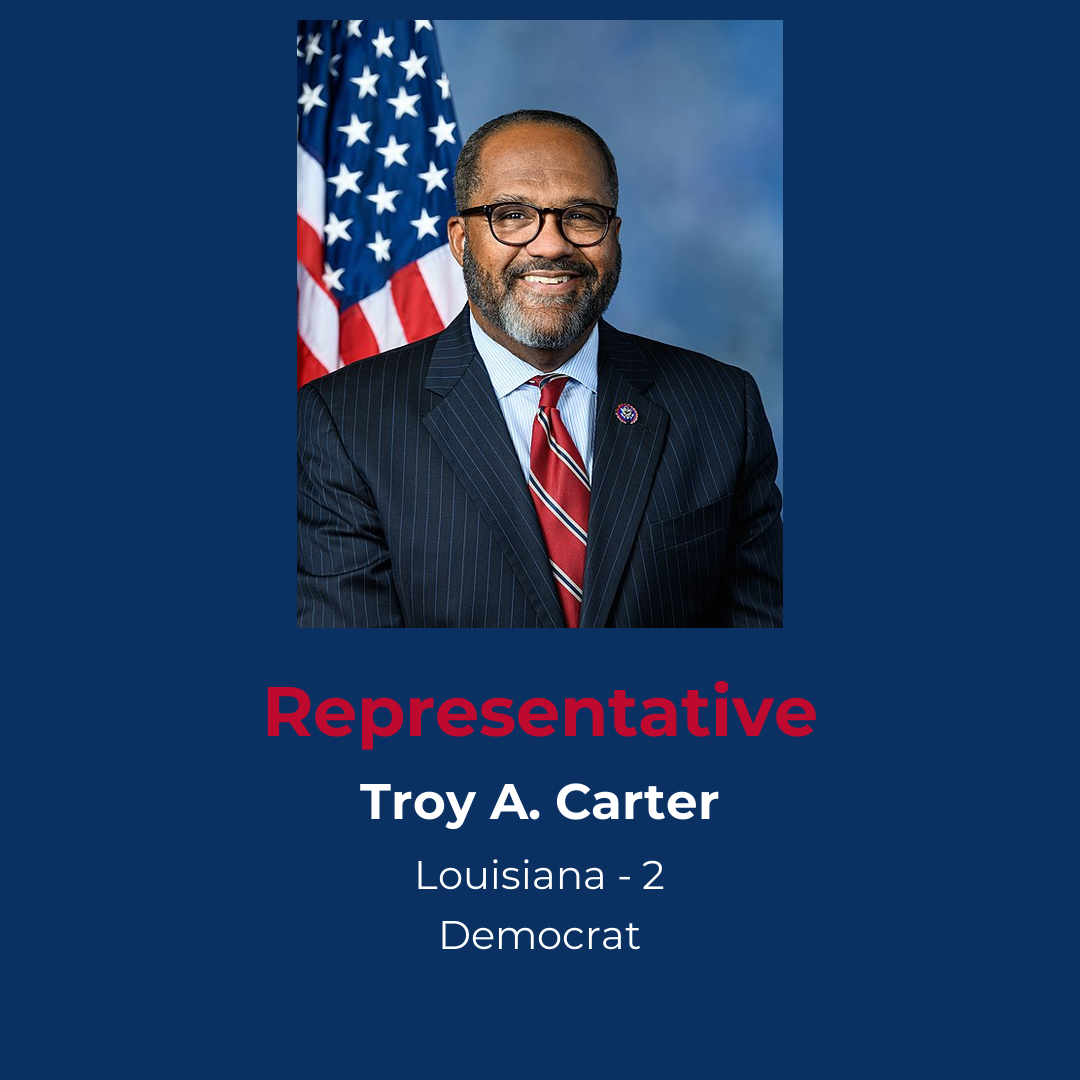
Troy Carter is the only Democrat in Louisiana’s congressional delegation, carrying the immense weight of representing the state's liberal, urban, and Black voters almost entirely on his own. He is a fixture of New Orleans politics, having served on the City Council and in the State Senate for decades before his election to Congress in 2021.
He represents Louisiana’s 2nd District, a meandering "snake" of a district that follows the Mississippi River to connect the two largest Black population centers in the state: New Orleans and Baton Rouge. This geography makes him the representative for the heart of Louisiana's tourism, port, and industrial economies.
The district is infamously known as "Cancer Alley," an 85-mile stretch of the Mississippi River lined with over 150 petrochemical plants and refineries. Carter walks a delicate tightrope here: he is a vocal advocate for Environmental Justice and stricter EPA regulations to protect residents' health, while simultaneously sitting on the Energy and Commerce Committee to protect the jobs those industries provide.
In the 119th Congress, Carter secured a seat on the powerful Energy and Commerce Committee, a massive upgrade that gives him direct jurisdiction over the very industries that dominate his district. He has used this perch to fight against the Trump administration's attempts to roll back pollution controls on chemical plants.
Carter’s personal life is a blend of public service and military discipline. He is the creator of the Algiers Jazz Walk of Fame and is married to Brigadier General Ana Carter of the U.S. Army, making them a true power couple in both D.C. and NOLA circles.
"He represents the Jazz clubs of New Orleans and the chemical plants of Cancer Alley. Troy Carter is the man walking the tightrope between culture and industry along the Mississippi River."
Troy Carter: The River Guardian
To understand Troy Carter, you have to understand the Mississippi River. His district doesn't just sit near it; it hugs it. From the wards of New Orleans, up through the River Parishes (St. Charles, St. John the Baptist, St. James), and ending in North Baton Rouge, Carter represents the artery of the American South.
Born and raised in the Algiers neighborhood of New Orleans, Carter is local royalty. He was elected to the Louisiana House of Representatives in 1991 as the first African American to represent District 102. He then served on the New Orleans City Council, where he became known for focusing on neighborhood revitalization—literally paving the streets and lighting the parks of the West Bank. After a stint in the State Senate, he won the special election to replace Cedric Richmond in 2021.
In Washington, Carter has become the Democrats' point man on disaster resilience. Representing a district that is frequently ground zero for hurricanes (including Katrina and Ida), Carter has focused his legislative energy on the National Flood Insurance Program (NFIP). In the 119th Congress, he introduced the National Flood Insurance Program Automatic Extension Act, seeking to end the constant political brinksmanship that leaves homeowners wondering if their coverage will lapse during hurricane season.
But his most defining battle is over public health. His district contains "Cancer Alley," where residents suffer from disproportionately high rates of cancer and respiratory illness due to industrial emissions. Carter has been aggressive in demanding federal oversight. He praised the EPA's 2024 rule cracking down on chloroprene and ethylene oxide emissions and has fiercely opposed recent attempts by the Trump administration to grant exemptions to these facilities. He frames this not as "anti-industry," but as "pro-human," arguing that companies making billions on the river owe it to their neighbors to stop poisoning the air.
District Context: Louisiana 2nd (U.S. Census Data)
The Ri...