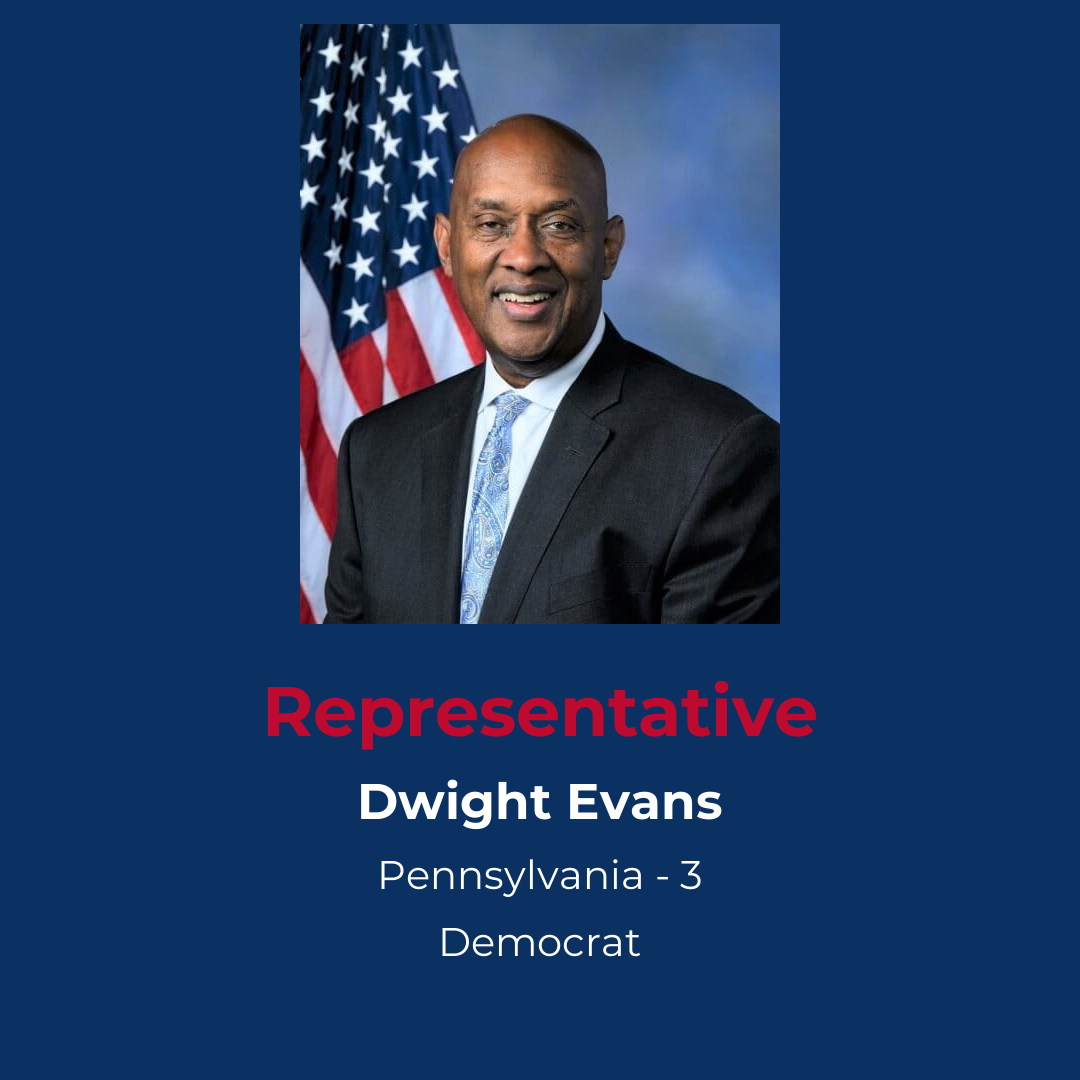
Dwight Evans is a legislative architect known for turning local experiments into national policy. His signature achievement, the Pennsylvania Fresh Food Financing Initiative, successfully brought 88 grocery stores to underserved areas and became the model for the federal Healthy Food Financing Initiative (HFFI).
He represents Pennsylvania’s 3rd District, which covers the heart of Philadelphia, including West Philadelphia, Center City, and Northwest Philadelphia. It is a district of stark contrasts, housing both the Ivy League wealth of the University of Pennsylvania and some of the poorest zip codes in the state.
Before Congress, Evans served 36 years in the Pennsylvania House of Representatives, where he made history as the first African American Chairman of the Appropriations Committee. He held the gavel for two decades, earning a reputation as a master dealmaker who directed billions in state funding to Philadelphia’s economic development.
A member of the powerful House Ways and Means Committee, Evans focuses on "poverty-busting" tools like the Earned Income Tax Credit (EITC) and the Child Tax Credit. He argues that the tax code is the most efficient way to inject capital directly into struggling households.
His unique policy niche is "Middle Neighborhoods"—working-class communities (like his own West Oak Lane) that are neither booming nor collapsing, but need specific, targeted investment to prevent decline and stabilize homeownership.
"He spent 36 years holding the purse strings in Harrisburg before coming to Washington. Dwight Evans is the quiet architect who proved that a grocery store can be a more powerful tool for change than a speech."
Dwight Evans: The Block-by-Block Builder
Representative Dwight Evans calls himself a "policy entrepreneur," and his resume supports the title. Born and raised in the Germantown and West Oak Lane sections of Philadelphia, Evans entered the State House in 1980 at the age of 26. He didn't just stay there; he built a machine. In 1990, he became the first African American to chair the House Appropriations Committee in Harrisburg. For the next 20 years, he was arguably the most powerful Philadelphian in state government, using his control over the budget to fund stadiums, convention centers, and neighborhood revitalization projects.
His most enduring legacy, however, is the Fresh Food Financing Initiative (FFFI). In the early 2000s, Evans recognized that "food deserts" were killing his constituents—not just from hunger, but from diabetes and heart disease caused by a lack of fresh produce. Instead of just asking for grants, he created a public-private partnership that incentivized supermarkets to open in distressed neighborhoods. The program was a massive success, creating 5,000 jobs and opening nearly 90 stores. When he arrived in Congress in 2016, he worked to scale this model nationally, successfully embedding it into the federal Farm Bill.
In Washington, Evans serves on the House Ways and Means Committee, the oldest and most powerful committee in Congress. He views his seat there as a tool for equity, fighting to expand the Low-Income Housing Tax Credit (LIHTC) and reform the tax code to help minority-owned small businesses. Locally, he has championed the "Reconnecting Communities" initiative, recently securing a massive $158 million grant for the "Chinatown Stitch"—a project to cap the Vine Street Expressway, which had severed Philadelphia’s Chinatown neighborhood for decades.
District Context: Pennsylvania 3rd (U.S. Census Data)
The Philly Core: This district is entirely within the city limits of Philadelphia. It includes University City (UPenn, Drexel), the skyscrapers of Center City, and the residential rowhouse neighborhoods of West Oak Lane, Germantown, and Roxborough.
Population: ~759,000.
Demographics: A "Majority-Minority" district (roughly 52% Black). It...