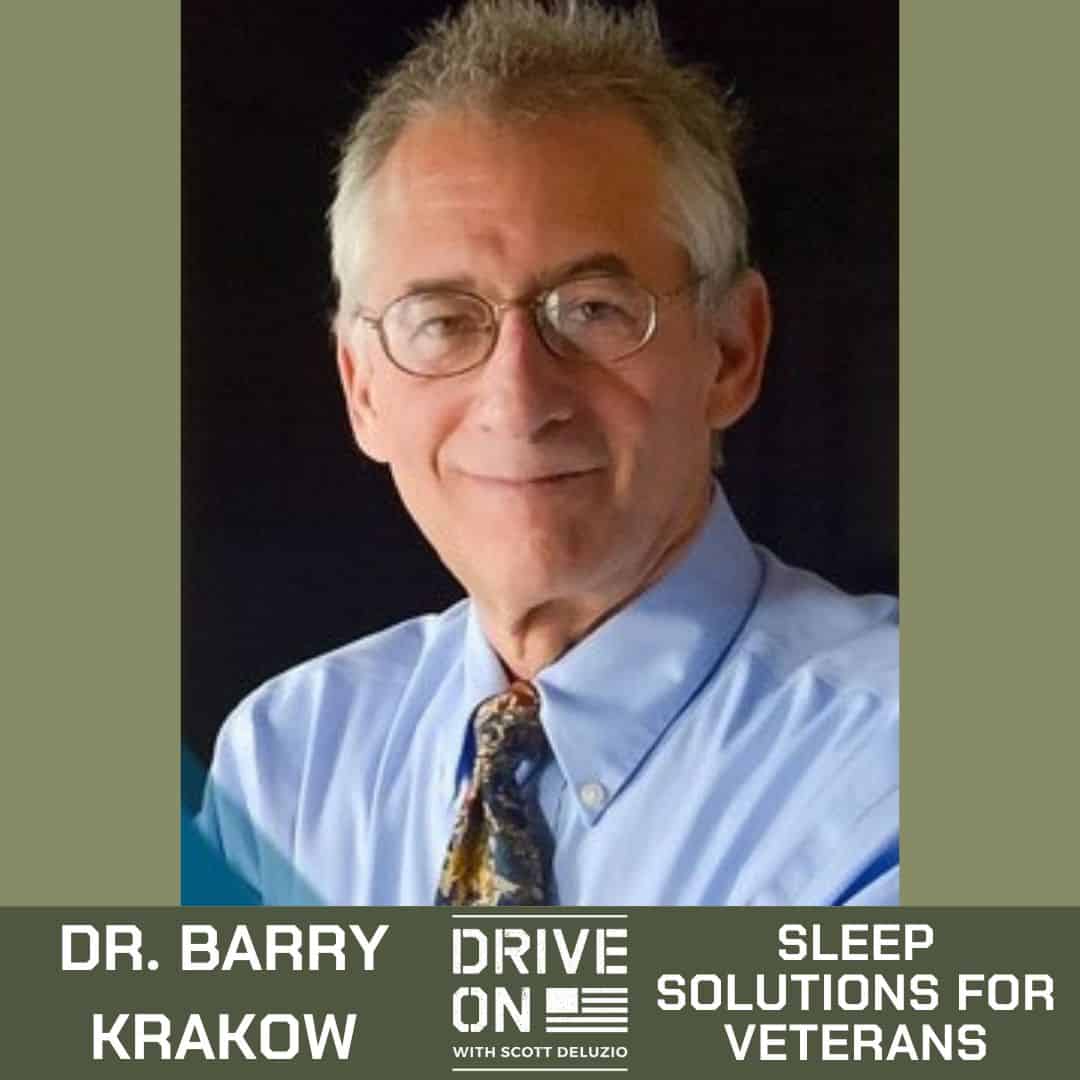
Scott DeLuzio: [00:00:00] Hey, everybody. Welcome back to Drive On. I’m your host, Scott DeLuzio. And today my guest is Dr. Barry Krakow. Barry is a sleep medicine specialist who has worked in the field of sleep research and clinical sleep medicine for more than 30 years. And he’s here today to discuss techniques. techniques to treat nightmares, insomnia, and other sleep related issues, which seem to plague the military and the veteran community.
So, uh, before we get started, welcome to the show, Dr. Krakow. I’m glad to have you here.
Dr. Barry Krakow: Thank you very much. Very, very glad to be here.
Scott DeLuzio: Yeah, absolutely. So, uh, talk a little bit about your background already in the, the intro here, but, um, for the, the folks that aren’t familiar with you, can you tell us a little bit about yourself and, and who you are?
Dr. Barry Krakow: Sure thing. Um, I trained in internal medicine, yet, uh, by 1988, uh, my career basically [00:01:00] involved working with mental health patients who have sleep disorders. Uh, we started out with some very innovative research, uh, treating chronic nightmare patients, and that broadened and led to discoveries of the great complexity that we find in the sleep disorders that are in psychiatric or mental health patients, whatever terms you like.
Um, in my, in my career, one of the things that’s been very interesting and relevant to our discussion is that, um, many military institutions. have brought me in for trainings, um, actually all over the world. Landstuhl in Germany, uh, Center, Tripler in Hawaii, Fort Bliss, Fort Campbell, Walter Reed, South Dakota VA.
I mean, I’ve been to probably 20 or 25 places. specifically trying to broaden their understanding of this complexity. We call it, um, sleep dynamic [00:02:00] therapy is the model that we use. And, and by the way, I recently, uh, published this book, Life Saving Sleep, uh, this year, which is designed to show that, uh, sleep disorders are a lot more a component.
of the mental health disorders that people are suffering from. And so a much more active, aggressive, comprehensive plan needs to be formulated to actually get people not only to have the sleep get better, but by getting the sleep better, improving mental health.
Scott DeLuzio: And that’s such a strong, uh, tie between the two, between the sleep and the mental health.
Um, and. I know through various people that I’ve spoken to, a lot of times they, they talk to people who suffer from all sorts of different mental health conditions. And there is that, that tie where they also aren’t sleeping. And now maybe it’s as a result of, [00:03:00] um, you know, maybe the nightmares of a traumatic event that they’re having, that they have experienced, I should say.
Um, and, and that’s causing the sleep problems, but then those sleep problems aren’t. Making the mental health condition any better. And it’s just like this vicious cycle where it’s like one thing happens and then another and then another, and it snowballs out of control.
Dr. Barry Krakow: Right. And it’s most important to take that point you just said, because that’s where.
The problem originated in this distinction about mental health and sleep as if somehow, well, you’re traumatized. So naturally you have nightmares. Naturally you have insomnia and that sounds all very logical, but that’s not really the way to...