In our last episode we talked about the differences between PCOS and Adrenal Dysfunction, which is often called Adrenal Fatigue. Adrenal Fatigue or Adrenal Dysfunction is not a ICD10 diagnosis. There is an actual ICD10 billable code called: unspecified adrenocortical insufficiency (E27.40). But there is controversy in using this code for patients. It is technically meant for conditions where the adrenal glands do not produce enough steroid hormones such as cortisol and aldosterone. You might be saying, but this sounds exactly like Adrenal Fatigue/Dysfunction! Most people with Adrenal Dysfunction have normal labs, so their doctor cannot code for Adrenocortical Insufficiency (E27.4). And because their labs and testing look normal people are told they are fine and dismissed.
In this episode, we are going to talk about the testing for Adrenal Dysfunction. There are some testing that can show Adrenal Dysfunction such as saliva and urine testing. But most conventional docs are mainly familiar with blood testing. Typical blood testing for adrenals usually will show that a person doesn’t have adrenal dysfunction, when in reality, they do.
We are going to talk about the different methods for testing Adrenal Dysfunction.
Let’s start by talking about the most common testing method that most docs use, blood testing.
Adrenal Blood Testing:
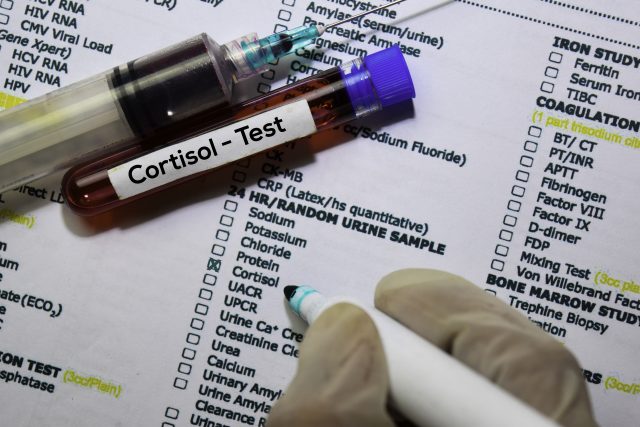
Cortisol: Blood testing for cortisol is not accurate. Most, if not all people with Adrenal Dysfunction will test normal for cortisol blood testing. The reference ranges are vast and a blood test is only done once or twice in one day. And when you have a needle coming to stab you, automatically the body raises the stress hormones. So cortisol can be falsely elevated in a blood test.
DHEA: DHEA is secreted mainly from the adrenal glands. In adrenal dysfunction, you will see lower levels of DHEA. DHEA reference ranges are vast and everyone falls in normal when doing a DHEA total blood test. But a DHEA-sulfate blood test is fairly accurate for evaluating levels of DHEA in the body. But again, those lab reference ranges are still pretty broad. But in general, terms, if the DHEA is low or low normal range then you can start to consider that a person has Adrenal Dysfunction.
Testosterone: DHEA is secreted mainly from the adrenal glands and will convert to testosterone for females. In adrenal dysfunction, you will see lower levels of testosterone in women because of the reduced DHEA levels. In men with adrenal dysfunction, you will also see lower levels of total testosterone. Testosterone reference ranges are very vast. Quest has a reference of 2-45 for females and for males the reference range is 250-1100 ng/dL. These are pretty big reference ranges. But if someone has a low normal testosterone level you can consider that person has Adrenal Dysfunction.
Pregnenolone: Pregnenolone is secreted from the adrenal glands and there is a small amount made in the spinal cord and brain making it very neuroprotective. Pregnenolone is accurate as a blood test. But like DHEA and Testosterone, the reference ranges for pregnenolone is huge. For Labcorp the reference range is anything less than 150 is normal and Quest has a range is 22-237 ng/dL. Usually, any level under 80 will be considered for Adrenal Dysfunction.
Saliva tests are much more accurate for cortisol than a simple blood test. Doing a series of 3-4 specimen samples of saliva throughout the day can really reflect the cortisol diurnal curve.
There are four samples of saliva taken. Morning, noon, afternoon late evening. Often in Adrenal Dysfunction, you will see low cortisol in the morning and elevated cortisol at night. It is much more accurate to see this in a salivary test.
There are several companies that do saliva testing. We have used ZRT and Diagnos-techs mostly with patients on testing adrenals using saliva.
This leads us to the next testing, A DUTCH test. A DUTCH test is a urine test. It is one of the most comprehensive hormone tests and adrenal testing available. It can check all the hormones with urine testing. And there is an add on or extended test that can also check the cortisol diurnal curve accurately.
If you are interested in getting tests done for Adrenal Dysfunction, we have all the testing available for purchase from our store. Because you are a Progress Your Health podcast listener, use the codePYH67 for 20% off.
PYHP 067 Full Transcript:
Dr. Maki: Hello, everyone. Thanks for joining us for another episode of the Progress Your Health Podcast. I’m Dr. Maki.
Dr. Davidson: And I’m Dr. Davidson.
Dr. Maki: So, in this episode, we’re going to continue our series on adrenals. The last one, we talked about the kind of transitioning from concealed type of PCOS to adrenal fatigue, or if you would like to use the term adrenal dysfunction. This one we’re going to talk about testing.
Dr. Davidson: Sorry, I’m a little distracted. If any of you hear like a little like chomping noise throughout the entire episode, I apologize. We have our dog with us because we always bring him to our office, and he’s going to town on this bone.
Dr. Maki: Yeah, he’s sitting at our feet enjoying a bone of some sort.
Dr. Davidson: It won’t be a bone much longer, I think it’s gonna be eaten.
Dr. Maki: Yeah.
Dr. Davidson: But yes, we’re going to talk about–we’re going to continue talking about adrenal fatigue or as we like to call it more adrenal dysfunction. One of the main things that, you know, we’ve been dealing with adrenal fatigue, adrenal dysfunction for years, I mean, since we started practice in 2003, 2004. But what we’ve always run up against and even now in 2019, is you know, patients aren’t really technically being diagnosed with adrenal fatigue, because technically, it’s not a diagnosis.
Dr. Maki: Yeah, right. We touched on this in the last episode too; how cortisol is such a major hormone, you know, like you said, we can’t live without it. Our body– we wouldn’t survive without that major hormone. But yet, when it comes to a diagnosis, there’s these two rare things. What was the one– What was the diagnosis, the ICD 10 code that you actually found? What was the name of that?
Dr. Davidson: Well, throughout the years, I’ve always been looking for some kind of ICD–you know, ICD-10 code to be able to diagnose, you know, there’s Dr. Maki will talk a little bit about Addison’s and Cushing’s disease, but there is one that has been around not that long called an Unspecified Adrenal Cortical Insufficiency. Now, that is also a little bit vague, and a lot of doctors don’t use it because the whole kind of controversy behind it is the diagnosis is meant for people, you know, patients that don’t produce enough cortisol and aldosterone or cortisol or aldosterone. And you might say, “Hey, that sounds just like adrenal fatigue, adrenal dysfunction.” But everybody that does the typical normal lab testing that their conventional doctors do always come out in the normal range. So, they can’t diagnose them with that E27.4 ICD-10 diagnosis code because their labs look normal when in reality, we know you know, that they’re not normal; that they have adrenal dysfunction. But they’re told that they’re normal, they’re dismissed and sent on their way.
Dr. Maki: Yeah, right. S, that’s really a kind of a drawback from doing a Blood Cortisol test. And most functional medicine doctors are aware that. Most functional doctors do not test cortisol through blood precisely for that reason because everybody, as you said, is going to fall within that reference range. And it’s a fairly wide reference range. You might be low normal, but technically, if the numbers low normal, using that objective information for that for– to be able to build that diagnosis code, you wouldn’t be able to do it if the number– if the cortisol level comes back within that reference range, you wouldn’t be able to use that, that diagnosis code. So, it really leaves doctors and patients with really no other options. That’s why a lot of people that we work with, they don’t really have a diagnosis. They have this kind of pseudo functional medicine ideas or concepts or theories that are not an actual real diagnosis.
Dr. Davidson: And that’s a good, you know, kind of segue into, you know, blood testing. So typically, when you’re looking at testing for any diagnosis for any condition is, “Hey, let’s do some lab testing. Let’s do some blood testing.” That’s what pretty much most conventional doctors will do. And Dr. Maki’s right, if you do a cortisol blood test, everybody– I would say probably most, if not all, of the people with adrenal dysfunction, come back with a normal Blood Cortisol level on that test. And of course, you know, we had talked about the diurnal curve of cortisol, the adrenals secrete cortisol; high in the morning, it comes down slowly with time, and then it’s very low at night so that we can go back to sleep. So, when you’re doing a blood test, it’s just one second, one minute of your day. Let’s say you go in at 10:00 in the morning, it’s not– and the reference ranges are huge, everybody just falls in those normal reference ranges. And some doctors trying to be a little bit more progressive might have somebody go in at 8:00 o’clock in the morning and then go back at 4:00 in the afternoon. But they’re still gonna– nine times out of 10, you know, if not 10 times out of 10, fall in that normal range.
Dr. Maki: Yeah, because the range is so wide. So, everybody falls within that range. When you do a morning cortisol, you have to be at the lab by 9:00 o’clock. But when you’re trying to assess someone’s adrenal function– so, think about it, you got to get up, you got to shower, you got to put in your clothes, you got to drive to the lab, and have to be there before 9:00 o’clock, depending on what time you woke up. Of course, your cortisol is going to be a little bit higher by the time you get there. So, because you’re awake and you’re moving and you’re driving your car, you know, on your way to the lab, it may still below normal, but it’s more than likely can still be a normal test.
Dr. Davidson: And you think, you’re sitting in the lab, you have a needle coming at your arm to be stabbed. No matter how calm and cool and collected you are, your cortisol levels are still going to spike up a little bit as a stress response to a needle coming to stab you in the arm. That’s why I’m– on a side note, a lot of times when you run someone’s fasting glucose, it might be high normal or a little over the edge normal. And that’s usually because I’ll ask them, “Hey, how was that draw?” And they’ll say, “Oh, it was awful. They had to poke me twice. And they were moving the needle around. And I had this huge bruise.” And I’ll say, “Yeah, no wonder, you know, your cortisol went up, and that automatically mobilizes glucose. So, that’s why your glucose is a little bit over the edge normal.” So, definitely blood testing and with cortisol to determine cortisol levels for adrenal dysfunction is a no go.
Dr. Maki: Yeah. And that’s even why like coffee is not, you’re not really supposed to drink coffee in the morning because coffee raises cortisol. Cortisol will have an effect on your blood sugar, and it can throw off pretty much everything: throw off your blood sugar and throw up your cholesterol control of all those numbers. So, you know, that’s why they usually only recommend water in the morning because you’re already going to get a skewed result. But based on we just talked about, the needle driving to the, you know– If you’re driving they’re before 9:00 o’clock, you’re probably going to be stuck in at least a little bit of traffic or some kind of rush hour. Those are all kind of stressful things that’s going to give you an artificially inflated number anyways, so back to your point, then everyone’s going to have a normal number. Now, I’ve seen over the course of the years, I’ve never seen a low cortisol on a blood. Have you ever seen a low one?
Dr. Davidson: I’ve seen. Definitely seen low normal, but not actually out of their huge humongous vast reference ranges. But I have seen high.
Dr. Maki: Yeah. I’ve seen a few high. They were kind of borderline like Cushing’s, like the patients didn’t end up having to have Cushing’s because again, Cushing’s is a fairly rare problem. But they were definitely, you know, high– an elevated number that was, you know, certainly got our attention for sure.
Dr. Davidson: And also to