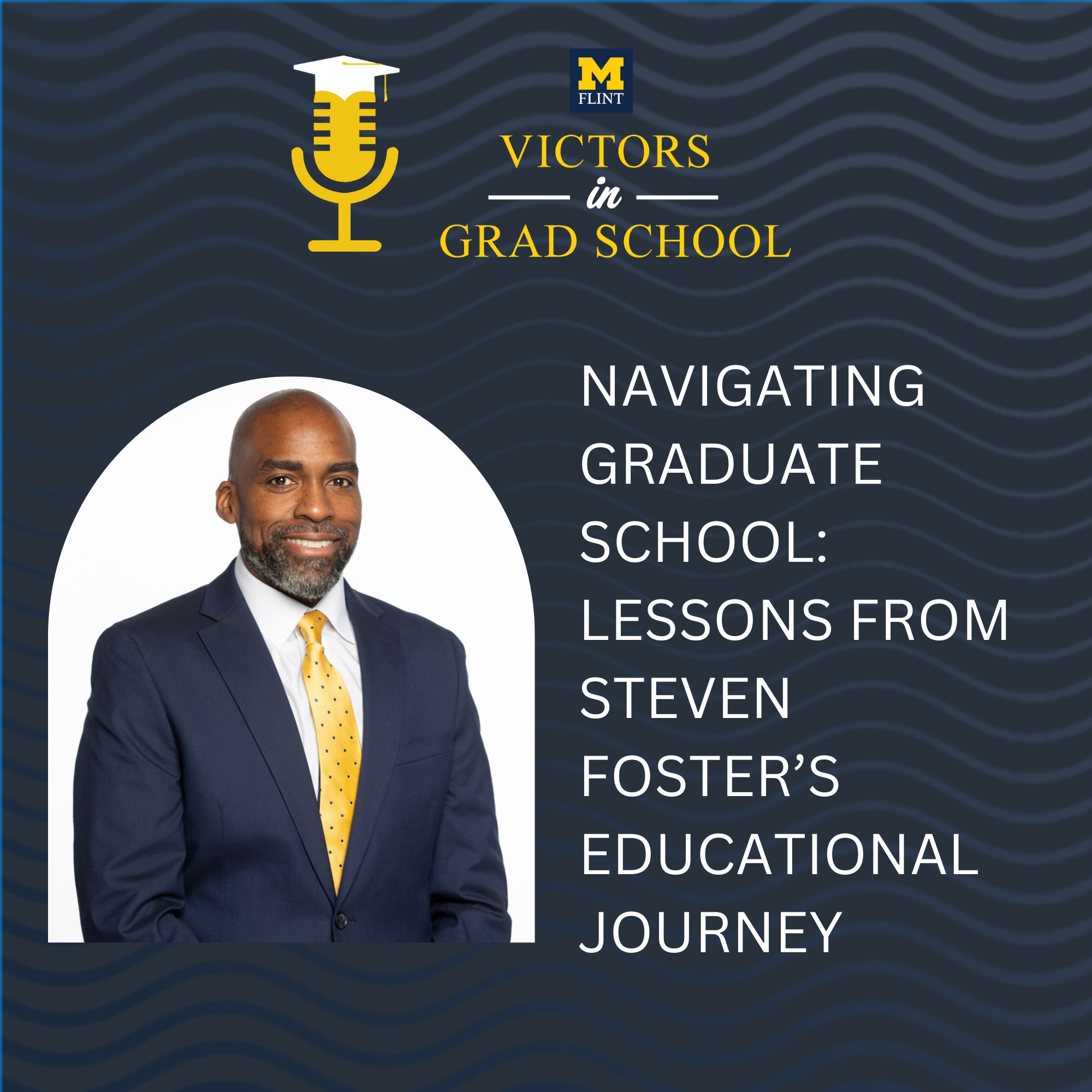
Are you considering taking the next big step in your educational journey? Whether you're just starting to think about graduate school or already knee-deep in your studies, the latest episode of "Victors in Grad School" is packed with insights you won't want to miss.
In this episode, Dr. Christopher Lewis sits down with Steven Foster, Director of Financial Aid at the University of Michigan Flint, to discuss what it truly takes to thrive in graduate school. Their lively conversation weaves through Steven's personal journey—from earning his bachelor's in English Language and Literature, jumping straight into the workforce, and then making the pivotal decision to return for his master's in Educational Leadership at Wayne State University.
One major theme is the importance of having a clear motivation for pursuing graduate studies. As Steven Foster shares, his return to school was sparked by an early realization that additional credentials would be crucial for career advancement and personal growth. This combination of upward and social mobility, practical experience, and a passion for educational outreach shaped his path and success ().
Discipline, curiosity, and organization are highlighted as the bedrock skills for anyone navigating graduate school. Steven Foster emphasizes that being disciplined and staying organized are essential, especially when juggling work and academic responsibilities (). He notes, "Being disciplined, being curious, being open… those skill sets are extremely important in your journey."
Another key takeaway is the role of community and support systems. Graduate school can be overwhelming, and imposter syndrome is a common stumbling block. Steven Foster candidly discusses how self-awareness, open communication, and fostering connections with peers and mentors can provide the reassurance and encouragement needed to push through challenging moments ().
Listeners will find practical advice throughout, from evaluating graduate programs and career prospects to leveraging faculty relationships and embracing opportunities for professional and personal development. Steven Foster encourages prospective students to research institutions thoroughly and think beyond just degree requirements—consider how the experience can open doors to consulting, teaching, volunteering, and more ().
If you're seeking inspiration, reassurance, or actionable tips for your graduate school journey, this episode is for you. Tune in and let Steven Foster and Dr. Christopher Lewis guide you through the path to graduate school success—because your journey is uniquely yours, and with the right tools and mindset, you can be victorious too!
Click here to listen and start your journey to grad school success today!
TRANSCRIPT
Dr. Christopher Lewis [00:00:01]:
Welcome to Victors in Grad School, where we have conversations with students, alumni, and experts about what it takes to find success in graduate school.
Dr. Christopher Lewis [00:00:11]:
Welcome back to Victors in Grad School. I'm your host, Dr. Christopher Lewis, Director of Graduate Programs at the University of Michigan Flint. Really excited to have you back again this week. As always, we are on a journey together, and I call it a journey because it truly is a journey. You are on a unique journey, something that you are going to be going through, whether you're at the very beginning and just starting to think about graduate school, or maybe you've applied, maybe, maybe you've been accepted. You could be in any of these places, you could even be in graduate school. But throughout all of this, you are on a journey.
Dr. Christopher Lewis [00:00:44]:
And through this journey, there are things that you can do to be able to help you to be successful along the way. And that's why this show exists. Every week I love being able to bring you different pieces of advice, different thoughts, different perspectives, and also different people that have gone before you to be able to give you some perspectives on their own experience going through graduate school. This week we got another great guest. Stephen Foster is with us, and Stephen is the Director of Financial Aid at the University of Michigan Flint. And I'm really excited to be able to have him here to tell you about his own experiences going through graduate school. And to welcome him to the show. Stephen, thanks so much for being here.
Steven Foster [00:01:24]:
Thank you, Kris, for having me.
Dr. Christopher Lewis [00:01:25]:
I am really excited to be able to have you. And one of the first things that I love doing is turning the clock back in time, and I want to go back a little ways because I know you did your undergraduate work, and after you went through that experience and got that Bachelor of Arts in English Language and Literature, you went off and got a job. You went off and worked, and you jumped into the world of financial aid.
Steven Foster [00:01:49]:
I did.
Dr. Christopher Lewis [00:01:50]:
And you never looked back. But one of One of the things that I want to do is ask you about this point in time, because there was a point in time that you were working, you're out there, but at some point you had this inkling that you needed to go back. You wanted to continue. You had to scratch that itch for going back and getting more education. And I guess bring me back to that point and what made you decide that that was the right time, the right place?
Steven Foster [00:02:16]:
You know, thank you, Kris, and I'm excited to be here just to share some of my experiences. And I did receive my undergrad from University of Michigan, graduated with my master's in educational leadership from Wayne State University. And what really inspired the additional need for education is I knew that at one point in my career I was going to need it for that upward mobility, that social mobility, and having the credential, right, makes it a little bit easier, right, to give you the practical hands-on experience, to give you the theoretical aspect side, educational leadership research, to give you the technical pieces that you need to be a, a successful administrator and leader. So I knew that early on in my career because I actually started my graduate program and my graduate work about 2 to 3 semesters out from my undergrad after graduating. So I knew, I just knew early on that, hey, I need this credential, I'm going to need this credential along the way to help me to advance. And so I went to work during the day, and as soon as I was done at work during the day, I would go right into classes in the evening. And I guess early on it helped me because I still had some level of discipline as a student from my undergraduate experience. So I think that helped me a little bit along.
Steven Foster [00:03:49]:
The way in order to help me to, to push through to my master's to completion.
Dr. Christopher Lewis [00:03:54]:
Now, I know you did your master's degree at Wayne State University and you got a Master of Education in Educational Leadership and Administration, and there are a lot of programs that are in the Master of Ed space and you chose Wayne State. So bring me back to that point. And when you were thinking about looking at, you know, pers— all the different prospective universities, what made you decide on Wayne State University? What made it stand out? And talk to me about that process for yourself.
Steven Foster [00:04:23]:
Yes. So I was looking at several programs and I really wanted to go into education. I wanted to go back in— I wanted to go in a K-12 setting. So I actually was looking at master's for teacher certification programs and I was looking at the University of Michigan. I also was looking at the University of North Carolina Chapel Hill. I looked at Michigan State University and ultimately landed at Wayne State University for actually selfish reasons. It was a tremendous benefit called, uh, educational benefit, and it kind of altered my plans from, uh, going into the classroom and really finding my passion in the higher education side of, of education where I could affect change, where I could help students— be that bridge and bridge that gap to students to promote higher education and to promote education from a different lens, um, besides going into the classroom. So that's what kind of detoured me.
Steven Foster [00:05:29]:
It was actually the benefit of getting my degree paid for, but also I really got a passion for educating students how to think about college affordability, how to think about college finance, and how to plan for college, how to be successful in college and looking at higher ed. From the outreach side of things and being a bridge and being a spokesperson about the many benefits of receiving a higher education degree can bring to students and their families.
Dr. Christopher Lewis [00:06:02]:
Now, going from undergrad to grad, you said that it had been a few terms out from when you graduated to when you started. And when you go into a graduate program, there definitely is a transition because it's a different way of being taught, a different— level of expectations by faculty members and a different level of expectation on yourself for what you're trying to achieve. So talk to me about those transitions. And as you transitioned into graduate school and through graduate school, what did you have to do to be able to set yourself up for success? And what did you add to— have to do to be able to maintain that success throughout the graduate school journey?
Steven Foster [00:06:45]:
The biggest thing, or the number one thing that comes to my mind, is being disciplined. Being disciplined, being curious, being, being open. Because when you go undergrad or grad, I think grad is, uh, of course, higher thought processes. It's a lot of reading, it's a lot of theory, it's a lot of hands-on practice. So a combination of all of that, but being disciplined and organized. Those skill sets are extremely important in in your journey, definitely if you're transitioning back into the grad space after you've been out of school a number of years, staying on top of your assignments, staying on top of your reading, asking questions. You know the saying, there's no such thing as a dumb question, right? But having that intellectual curiosity that there are many different paths to ultimately get to where you want to be, but how you actually perceive the world of, of grad school, whatever your discipline is of study. It could be health sciences or education, social work or business, that there is some level of curiosity and exploration in coming to find out where are you the master at? What is your subject matter expertise? What are those things that interest you to where you say, I'm going to be the subject matter expert in this? It just opens your doors for possibilities to so many things.
Dr. Christopher Lewis [00:08:12]:
You know, as you talk about that, you know, you're working on a master's degree and there's some internal thought that when you are being admitted into a master's program, you are becoming a master of something, which is sometimes a little dodging when you think about it to be called, eh, I'm the master of nothing. I'm a master of none. I guess when you went into that master's degree and as you're going through this coursework and you're seeing yourself in a different way, talk to me about that transition for yourself as an individual and as a professional and how that graduate degree helped you to either refine or redefine who you were at the time and who you were becoming?
Steven Foster [00:08:53]:
I think for me, and that— I think that's an excellent question. I think that it actually allowed me to refine, but not only refine, it's so many aspects to a master's degree and to graduate education that depending on what class you are taking or depending on what season you are in, in your life and how it benefits you in that moment. So for me, because I was so early on in my career, it allowed me to kind of shape how I wanted to be perceived as a professional. It kind of shaped my modus operandi in order to be an asset and be beneficial to all of the families that I serve and, you know, faculty working with different constituencies in higher education, working— how do you have conversations with Congress versus your faculty? And, you know, dealing with some of the nuances of how do you handle a sensitive student case to a parent that just wants basic information. So it gives you a breadth and a depth in order for you how to be successful, right? And how to apply the knowledge that you acquire.
Dr. Christopher Lewis [00:10:00]:
Now, every individual, as they're thinking about graduate school, as they're going through graduate school, ends up hitting a point in time where whether it's you're seeing yourself as a master of something or you are just going through that first course where you feel that imposter syndrome and you go through this process of questioning, "Should I be here? Am I good enough?" All of those different thoughts that go through your head. Talk to me about how imposter syndrome impacted you and what you had to do to get through it.
Steven Foster [00:10:30]:
At points in all of our careers in education, as, as we're matriculating into degree programs, you know, on our jobs and our careers, maybe even in our households, there is always a bit of self-doubt in us. I could have handled that situation better, or how could I have accomplished that in a different manner? So I think that we have imposter syndrome across everything that we do, whether it's a volunteer experience, professional experience, personal experience. But for me, how I really overcame it was through self-awareness. But not also self-awareness, it's really also grasping on to like individuals. So a lot of times you're in classes with the same people. A lot of programs are cohort-based. My program was not necessarily cohort-based, but really having those conversations and building support systems to help you through. Sometimes you have to talk stuff through with a gamut of people.
Steven Foster [00:11:33]:
That could be your classmate, it could be your spouse, it could be your therapist, it could be your faculty your lead, or, you know, your advisor, or those things. So it's those people that help you along the way to be successful, but to also ground you and reel you back in when you need that reassurance. So my word of advice to people is don't be afraid to talk about the challenges that you are having. If you're in a grad program, or if you're in that space that you feel that imposter syndrome, you probably need to get it out, to express yourself, to make you feel a little bit and tackle it head on so that you don't continue to— some people, you know, beat, beat themselves up, not literally, but from that perspective. But talk to someone because someone else is also in your same shoes. And that's what I did. Latched on to some of my classmates, made sure, you know, we had regular conversations, you know, healthy debate about the work, about the assignments, about, you know, some of the challenges that we were experiencing in order to be successful. And, uh, one of the things is I was also— I was somewhat younger than some of my classmates at the time.
Steven Foster [00:12:45]:
I'm a little bit older now, but that wasn't the case when I started my master's program. I was in a class with professionals who had been working 20, 30 years at that point, and they were just starting to come back for their credential, right, for their upward mobility. And here I am, this young, spry kid coming in on the scene, and I'm in these rooms with people people who have double and triple the experience that I have, what am— how can I ever bring the value and knowledge of the experiences that, that they have? So it is a— it can be an overwhelming process, but you just have to get in where you fit in is the perfect way for me to put it. You don't have to try to over, um, outdo or outshine. Based on the little experience that I had, I still was able to contribute to the conversation in a meaningful and way.
Dr. Christopher Lewis [00:13:40]:
Now, as you think back to the beginning, before you even started graduate school, I'm sure you had some conversations with friends, with colleagues, with others that could give you their own perspectives. And if you think back to that very beginning, what's something that you wish that someone had told you, or that you had known prior to starting graduate school that would have helped you to make that transition even better?
Steven Foster [00:14:02]:
I really do believe that it was just a little bit different for me because I was passionate about education. I was getting— I had hands-on work experience. I was, I was still working and going to school. So it wasn't like I wasn't working and only going to school or went straight through. I was able to apply what I was learning in my actual day-to-day. That made my experience even more successful or more better for me as I was talking to professors and things of that nature. Definitely at the University of Michigan Ann Arbor at the time, you know, and advisors and things of that nature, their thought process was learning experience is, it's an ongoing process, right? That curiosity for exploration and for learning is important. So they, they stress the importance of, if this is the path you want to take, you have to do this, or you have to do that.
Steven Foster [00:14:55]:
So they were actually my biggest cheerleaders in making sure that I was successful in my on-ramp to my grad program.
Dr. Christopher Lewis [00:15:02]:
Well, it's always good to have those mentors and those people that help you to maneuver into figure things out along the way. And you also build relationships with faculty along the way as well. Talk to me about those relationships that you were able to build with faculty or with peers inside of your program. And how was that impactful in the experience that you went through?
Steven Foster [00:15:26]:
My relationship with my faculty advisor was, was tremendous because I was able to meet with them on a regular basis and have thoughtful conversation about what is it that I can do with this credential, what What paths make sense for me from a career perspective? What are the different things that I can do outside of my career? You know, what, what does it mean to go in consulting? I always think that ultimately I wanted to go and be a professor. I have started a PhD a while ago and opportunity came along and I put that on pause, but it's always the, the opportunity for them to share their experiences and based on the skills assets that you have, them to kind of guide you through some of those things. And that's what I'll always appreciate about definitely some of the faculty that I have connected with on a basis as a student, that they are always trying to get the best out of you, whatever that is for you as an individual. It's not, you know, they're not selling anything, they're not selling you any fairy dust and unicorns or anything like that, but they're trying to get the best out of their students. And that was the experience that I had.
Dr. Christopher Lewis [00:16:42]:
And I guess finally, as you look back on your own experience, you were successful in the journey that you went through. And as you think back, I guess, to the entire experience and you look at where you are today and you think about people that are thinking about going to graduate school for themselves, what are some tips that you might offer others considering graduate education that would help them find success sooner?
Steven Foster [00:17:03]:
Some tips is research your institutions. Research your programs, look at the viable career paths that you want to go into, and look at the plan B or look at the— what's the side hustle that I can do from this degree that will produce additional streams of revenue, additional income based on the degree that you do have? Opportunities for consulting, opportunities for part-time or work from home opportunities from whatever the deal degree program is because for me, graduate education, it opens the door even more to more possibilities than your bachelor's degree a lot of times. And that upward mobility and that social mobility is very important for our students that we serve. So you want to make sure that this is something that you're truly passionate about, but that it opens other doors and opportunities for you to get the best well-rounded experiences that you need in order to be successful, maybe in your main career. But there are also branches that shoot off from that main career— speaking engagement, teaching opportunities, professorships, consulting opportunities, volunteer opportunities on boards and different things of that nature in order to help nonprofits and stuff grow depending on whatever your discipline is. So you're volunteer, you're professional. Experience, your community experience, all of that makes you a well-rounded person. And it gives us a personal ethos for us to be change agents in that you are in the world to shed your light and shed your experience in whatever direction that is and works best for you.
Dr. Christopher Lewis [00:18:45]:
Well, Stephen, I just want to say thank you. Thank you for sharing your journey today. And, you know, I'm going to continue to encourage you now that I know that you started a PhD to keep going. I'm looking— not to stop out, but always keep going, always keep pursuing, and don't, and don't give up.
Steven Foster [00:19:01]:
Absolutely.
Dr. Christopher Lewis [00:19:02]:
So that being said, I thank you for your time today, and I wish you all the best.
Steven Foster [00:19:06]:
Thank you, Dr. Lewis. I appreciate you.
Dr. Christopher Lewis [00:19:08]:
The University of Michigan Flint has a full array of master's and doctorate programs if you are interested in continuing your education. Whether you're looking for in-person or online learning options, the University of Michigan Flint has programs that will meet your needs. For more information on any of our graduate programs, visit umflint.edu/graduateprograms to find out more. Thanks again for spending time with me as you prepare to be a victor in grad school. I look forward to speaking with you again soon as we embark together on your graduate school journey. If you have any questions or want to reach out, email me at flintgradoffice@umflint.edu.