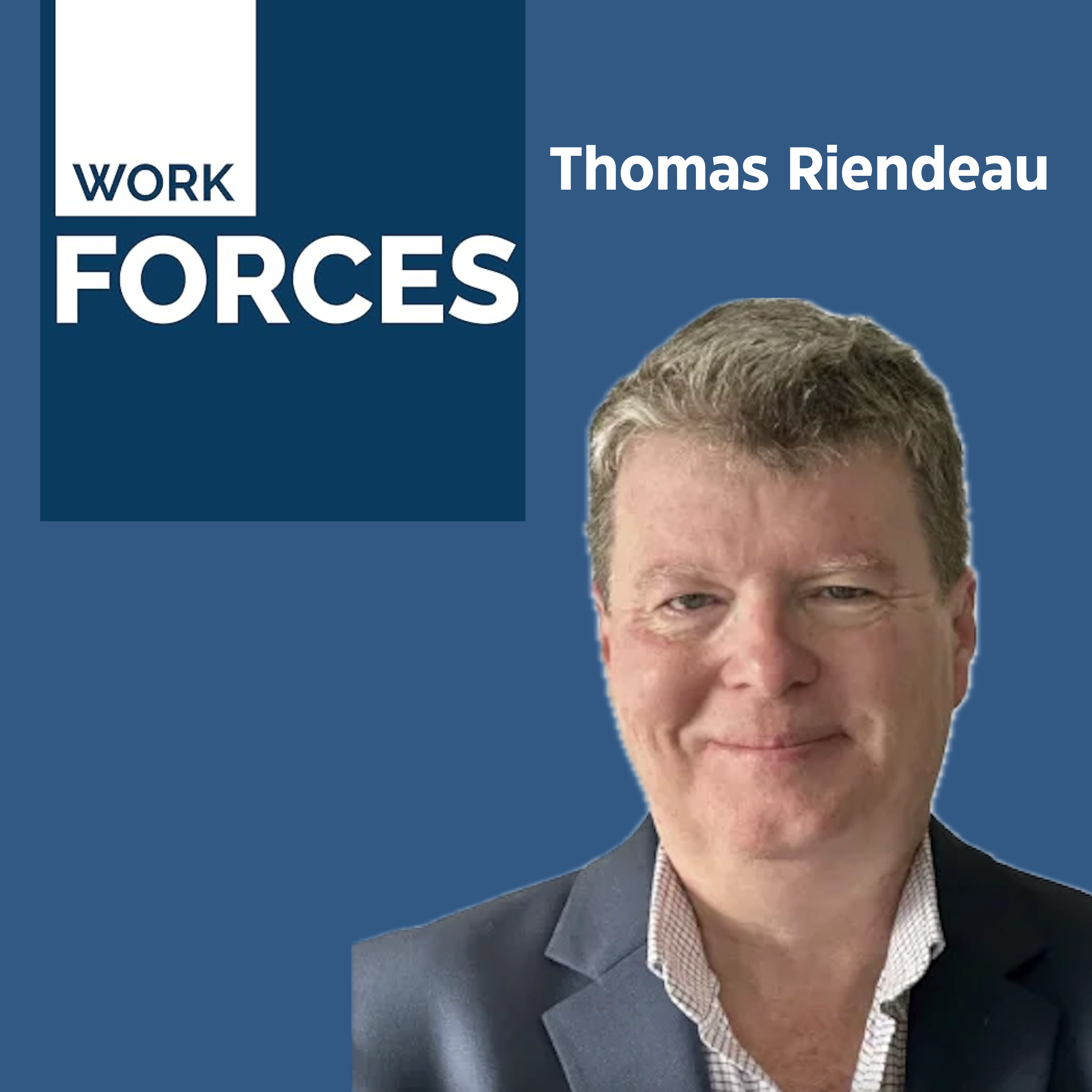
Tom Riendeau, Vice President of Workforce Learning and Skills at Magic EdTech, joins Work Forces to discuss the critical infrastructure powering the future of online education. While AI dominates the headlines, Riendeau argues that many organizations are still held back by "static" legacy content that fails to engage the modern learner. The conversation explores the operational reality of digital transformation, from improving student retention by streamlining the user experiences to using AI as a "smart assistant" for curriculum design. Riendeau emphasizes the importance of moving beyond transactional vendor relationships to find partners who can "see around corners," anticipating challenges like cybersecurity risks and accessibility compliance before they become crises. He offers practical advice for leaders on how to thread "durable skills" into technical training and build scalable learning ecosystems that truly support career advancement.
Transcript
Julian Alssid: Welcome to the Work Forces podcast. I'm Julian Alssid.
Kaitlin LeMoine: And I'm Kaitlin LeMoine, and we speak with innovators who are shaping the future of work and learning.
Julian Alssid: Together, we unpack the complex elements of workforce and career preparation and offer practical solutions that can be scaled and sustained.
Kaitlin LeMoine: This podcast is an outgrowth of our workforce consulting practice. Through weekly discussions, we seek to share the trends and themes we see in our work and amplify impactful efforts happening in higher education, industry, and workforce development all across the country. We are grateful to Lumina Foundation for its past support during the initial development and launch of this podcast, and invite future sponsors of this effort. Please check out our Work Forces podcast website to learn more. And so with that, let's dive in.
Julian Alssid: Kaitlin, in so many of our recent podcast conversations, we have discussed AI and its impact on the future of work and learning. We are all grappling with where this new technology will take us and its long-term impacts on education and the workforce. However, we have spent less time exploring the very platforms and tools that support effective online learning at its core.
Kaitlin LeMoine: Indeed. While online learning feels ubiquitous and like it has just "always been there," many organizations still hold on to static content—PDFs, textbooks, traditional curricula—that simply wasn't built for today's digital-first, immersive learning environments. And other institutions have adopted advanced technology solutions, but find themselves challenged by how to most effectively integrate tools into one seamless platform or experience.
Julian Alssid: To really modernize, you need partners who can engineer that transformation. It requires deep expertise in both learning design and software engineering, and you need teams that can build everything from custom platforms to AR simulations to fully accessible digital content at scale.
Kaitlin LeMoine: Which brings us to our guest today. We're joined by Tom Riendeau, Vice President of Workforce Learning and Skills at Magic EdTech, a provider of AI-powered digital learning solutions. Tom has spent over 35 years driving enterprise growth at the intersection of learning, technology, and workforce transformation. He has served as a trusted partner to higher education institutions, career training providers, and EdTech companies, enabling them to reimagine their content. And we're looking forward to speaking with him today! Tom, welcome to Work Forces.
Tom Riendeau: Thank you so much. This is a terrific opportunity and I'm thrilled to be here.
Kaitlin LeMoine: So Tom, to kick us off, please tell us a bit more about your background and what led you to your role at Magic EdTech.
Tom Riendeau: Sure. You know, I have always been focused on education; that was the goal coming out of my undergraduate years. But I student taught and then said, I want to do something different. And I was very fortunate to get a job as an academic advisor at one of the first what we would call online universities in the early 1990s. And I had a really special moment there. I was an academic advisor to nursing students—and at that time that institution was set up to direct students to learning that already existed in their local communities and aggregate it into a college degree. I spent almost my entire day on the phone with students. And I was on the phone with a student who was pursuing her nursing degree, and she burst into tears on me. And she started to tell me about what was going on in her life and how if she didn't finish her nursing degree by the summer, all of the disaster that would mean not only for her, but for her children, and how she was newly a single parent and all of the stress. So it wasn't even an education conversation at that point; it was really about what's going on in your life.
And that thread has continued through my career. Now, it has a happy ending, which is why I like telling the story. I got her calmed down, we had a lot of conversations over the spring, she worked incredibly hard, and then at a graduation ceremony that summer, I saw her kids holding up their "Yay Mom" signs. And that stuck with me.
So it was not planned, but I had an opportunity to join the academic publishing world through a partnership that school had—it was one of the largest academic publishers. And that sort of led into new opportunities to start to look at the early days of digital learning. And so the common theme, because of where I had started my career, each of my employers let me dive into career-focused education. They let me work with their customers who were delivering that education—whether they were career colleges, whether they were the extended campuses of traditional universities as they were getting into online, whether they were certification companies—but with that common theme of: how do you change a person's life? How do you help them advance their career? And what does that mean not only for them but for their families?
And as you start to think about it, I started to realize the impact that I was having on entire communities as I was helping more and more students—far outside of my limited capabilities to teach English to some 12th graders who didn't want to be there. And I say that cynically—I mean, with lots of love for what my parents accomplished as teachers and the lives that they changed. But really, I'm proud of all of that focus on working adults and their needs and seeing them not just as learners, but as human beings with families and communities.
Julian Alssid: That's a compelling story, Tom, and glad you've stuck with us. Very mission driven. So, you've worked now with different types of organizations, plied your trade. So what are the types of challenges that your clients face, and how have those changed or evolved over the years in this space?
Tom Riendeau: Sure. So there's some constants even over those entire decades. And those constant challenges are helping clients understand their local business needs—making sure that the solutions that my employers were developing for them are developing for them match what's actually needed. And it may be directly for that company, of what they're trying to accomplish. But getting that match right rather than just building things in a vacuum has been a constant throughout the decades.
The other piece of that is the constant is acknowledging that human face of the learner. So focusing in on what are the support systems? So are the businesses that are going to employ the learners, are they supporting and creating an environment where the learner can advance? Is there a family structure that supporting it? And that doesn't have to be a traditional family—it could be neighbors, friends, extended family—what's out there and helping find those folks who are going to be part of that support ecosystem.
What's started to change though is the student experience with technology. And that's a relatively new evolution. I talked to one very large national career college provider, and I remember going to a conference of theirs, and they had done research where they found that they were losing slightly more than half of their students within the first three minutes of their online programs. That the student experience at the login point was so complex that students were just throwing their hands up and saying, "I can't do this." And what a disaster that was for them from a business perspective, but also the human loss of, hey, here are all these learners who were excited enough to log in, to choose a program, to get ready, and that they were gone on Day One. I mean, that's an absolute crisis. And that's where a company like mine can really help in looking at that and thinking about, what's the experience of that student? If they've got 20 minutes on their lunch hour, are we making this as easy as possible for them to get into your programs? Is everything opened up for them and seamless so that they can see the value right from the beginning? Because with a few minutes, things get in the way and it becomes easy to create excuses not to continue.
And then of course, just within the last few years, some very welcome things. A renewed focus on durable skills—and you know, there are lots of terms that we're using for that, whether we mean soft skills (which is kind of an unfortunate term), but durable skills, life skills, socio-emotional skills—that sort of social intelligence that workers need to advance in their careers to move on to more leadership roles, to even to move into middle skill jobs, you need that basic skill set. And that's been welcome because I don't think there's enough focus on that. It's also... what's changed is we're now thinking about how can we actually integrate that into all aspects of the learning as opposed to having it be the thing you do for one session at the beginning and then we forget it. Like, how do we actually make that part threaded through all of the learning? I think is essential.
And then I know, I'm sure I'm going to get lots of questions about this, but what's just happened in the last year or two around AI and how that's moving. But that's, I'm sure, a whole separate conversation.
Kaitlin LeMoine: It is a conversation unto itself! But I think that the changes you've raised are really fascinating, right? I mean, this focus on the student experience with tech—that it's not just the curriculum that they're engaged with, but also the whole... their whole experience with everything from enrolling, to logging into their first course, to, I would assume, interactions with their instructor or interactions with how they're assessed or graded. I mean those... it's kind of like that whole learner journey, so to speak.
Tom Riendeau: I think it's important to treat AI, to think of AI, as your assistant in it. It's got to be a human-centered approach. But having a really smart assistant that can say things like, "Hey, did certification requirements require this particular learning objective? I don't see it here. Did you mean to leave that out? And should that be part of this healthcare course you're building? Because that's in every other course that we're seeing out in the world." That helps you build stronger content for your learner so that you're not missing things. And those are the kind of mistakes that if you're doing it manually, everybody's going to make along the way. So you've essentially got a really powerful assistant that can make the learning tighter. But to your point, Kaitlin, yeah, exactly right. It allows for more creativity on your side because you're not worried about having missed something.
Julian Alssid: So, Tom, we're interested in hearing what practical steps you can offer our listeners to help them become forces in effectively adopting digital learning solutions in this complex and ever-changing environment.
Tom Riendeau: So I'll tell you what I tell my clients. I think it's really essential to have a partner that you can rely on that can do the things either faster or better that aren't your core skill sets. So that's one piece of it. But what's really critical is: Do you have a partner that is... that understands the true strategic initiative you're trying to solve for? So, one way that you could approach things is to say, "Here's a list of all the great things we do," and that's probably duplicated across lots of different companies. Where it becomes really powerful, though, is when that partner can help you see around corners, that can help you understand what you may not be seeing yourself.
Okay, so it's a line item, you know you have to do the accessibility work, but does your partner understand why you need to do that? You need to do that because there are hidden costs to doing it wrong. First of all, there's a regulatory cost to doing it wrong, but more importantly, there's a human cost that you may not even see from the learners who don't succeed, who should have been using your products, should have been singing your praises, and if you want the kind of growth that you're looking for, this becomes essential. If you haven't considered, for example, cybersecurity, and you don't have a partner that's really looking at that, what are the hidden costs of that? Of not modernizing your system. Do you have an insurance company, for example? I mean, this is the kind of things that I mean by seeing around corners. What happens when your insurance company comes back to you and says, "Well, we're going to triple your cybersecurity insurance cost because you're using an old system that's not up to the task, and we're not willing to take on that risk for you without a dramatically higher premium." Seeing that before it becomes a crisis. Having a partner who's going to who really understands what you're trying to do, that's where you can see growth, as opposed to a service provider who comes in and says, "Tell me what to do and I'll do it for you quickly and disappear."
You know, helping find those organizations that can add value from that first conversation and come in and say, "Okay, you want to talk about this particular problem that you're facing? Let me tell you where the industry is going. Let me tell you what value I can add to this conversation and create that partnership that's really going to give you the growth that you need."
Kaitlin LeMoine: The value that comes from looking around the corner—I feel like, you know, there's so much to be said for that. And I feel like that's what we're all trying to do, right? Is to say, "Where are we now and where are we headed?" and "Who can we predict, so to speak?" Because we are certainly in a fast-moving, fast-paced landscape that is the future of work and learning.
Tom Riendeau: You want... the ideal sales conversation, if you're on the buying side of that, should be this kind of a conversation. Where is the back and forth? What is your service provider bringing to the table? How are they responding to your questions? And I love those kind of conversations. I want a sales meeting where there's lots of vigorous back and forth and pushback. I love it when a customer is like, "Wait a minute, I don't want to do it that way. Why should I do it that way?" And you know, a lot of times they have a really good reason for doing things, but that's where you get the kind of true value as opposed to, you know, otherwise you'd just order it on Amazon and be done with it. And I think for workforce education, it's got to be much more vigorous than that. It really needs to be a true partner.
Julian Alssid: These... It's such complex work. And as you've pointed out, touches on so many aspects of an organization and learning. And I feel like this is becoming like a love fest for contractors and consultants here. But, you know, like, this is why we get hired to do what we do too! It's like, sometimes it helps to have an outside look and partner that's just gonna kind of raise questions and see things in a different way. It's really, really—having been on both sides of the fence, as we all have—it's really difficult when you're in an institution to try to innovate.
Tom Riendeau: Well, it's also, it's also a matter of understanding what you do well and what you don't do well, and where you need capacity. There's a lot of good reasons to say, "Hey, for us to hire up a team to do this, to learn this skill set that's kind of outside of what we do... by the time we start seeing a return on investment, that could be months and years." Whereas, hey, for a really effective solution, we can just outsource that and have somebody who's already done all of that work and done all of that investment who can come in and work with us and understand us and help us grow that much more quickly. So, it should be seen not as a cost line that disappears, but really as an investment in growth. And I think, you know, the right partner is part of your investment and growth strategy, not... not a line item that, that you know, you have to deal with.
Kaitlin LeMoine: So, Tom, thank you for taking the time to join us today. As we wind down this conversation, how can our listeners learn more and continue to follow your work?
Tom Riendeau: Absolutely. First of all, find me on LinkedIn. But please come to our website, and I'm sure we'll put that in the show notes, but www.magicedtech.com. I am trying to be at every workforce conference, so if you see me and recognize me, please walk up to me and say hello. I love having those conversations at events. But look for our website and for LinkedIn. We also have a fun Instagram account that my colleague Chiara is running that can give you some of the insight into our day-to-day and how we're... we're not just head down, but we're also having some fun on the side as well.
Julian Alssid: Well, thanks so much for joining us today, Tom. Really appreciated the conversation.
Tom Riendeau: An absolute pleasure and I thank you for your time as well.
Kaitlin LeMoine: We hope you enjoyed today's conversation and appreciate you tuning in to Work Forces. Thank you to our listeners and guests for their ongoing support and a special thanks to our producer, Dustin Ramsdell. If you're interested in sponsoring the podcast or want to check out more episodes, please visit workforces.info/podcast. You can also find Work Forces wherever you regularly listen to your favorite podcasts. If you enjoyed this episode, please subscribe, like, and share it with your colleagues and friends. And if you're interested in learning more about Workforce Consulting, please visit workforces.info/consulting for more details about our multi-service practice.